
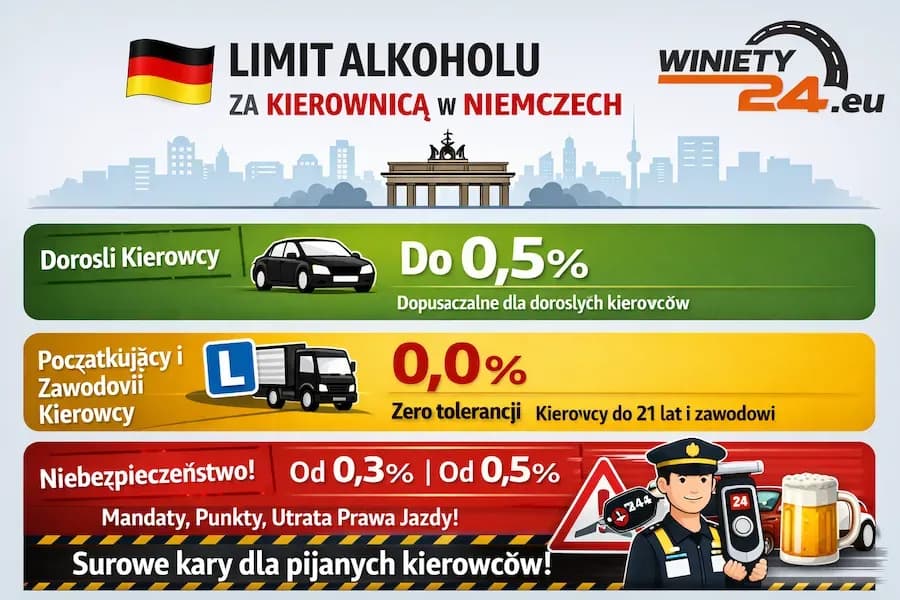
Alcohol Limit for Drivers in Germany 2026 – A Complete Guide for Drivers
Traveling to Germany by car is a daily routine for many Poles – whether for work or tourism. Although German road infrastructure is among the best in the world, local sobriety regulations are enforced with great strictness. In 2026, the alcohol limit in Germany remains a topic that raises many questions, especially in the context of high fines and a rigorous points system.
It is worth knowing that there is no room for negotiation with the police (Polizei) in Germany. The system is clear: either you comply with the norm, or you face consequences that can exclude you from road traffic for many months. Below you will find a detailed overview of limits, penalties, and rules you need to know before crossing the border in Słubice or Zgorzelec.
Permissible alcohol limit: 0.5 per mille – but with an asterisk
For a standard passenger car driver, who is over 21 years old and has held a driver's license for at least two years, the alcohol limit in Germany is 0.5 per mille. This is a safety threshold, exceeding which leads to serious problems.
However, German law provides for a situation of so-called "inability to drive" already at 0.3 per mille. If you are stopped for erratic driving, cause a minor accident, or even brake abruptly without clear reason, and the breathalyzer shows 0.3‰, you will be treated as if you were driving under the influence. In such a scenario, it doesn't end with a fine – the case almost always goes to court.
Groups subject to a 0.0 per mille limit
- Drivers during their probationary period (usually the first 2 years after obtaining a license).
- Persons under 21 years of age.
- Professional drivers (during work).
Violation of this rule results in an automatic fine of 250 EUR, 1 penalty point in the German register, and a compulsory training course (Aufbauseminar), which costs several hundred euros and extends the probationary period by another two years.
Schedule of Fines and Penalties for Alcohol in Germany (2026)
Financial penalties are just the tip of the iceberg. The German system is based on driving bans (Fahrverbot), which are extremely burdensome for commuters.
| Alcohol Concentration | Financial Penalty | Driving Ban | Points (DE) |
|---|---|---|---|
| 0.5‰ - 1.09‰ (first time) | 500 EUR | 1 month | 2 points |
| 0.5‰ - 1.09‰ (second time) | 1000 EUR | 3 months | 2 points |
| 0.5‰ - 1.09‰ (third time) | 1500 EUR | 3 months | 2 points |
| Above 1.1‰ (Offense) | Judicial fine | Min. 6 months / loss of license | 3 points |
Cyclists – limits and consequences
In Germany, a bicycle is treated as a full-fledged means of transport. The alcohol limit for cyclists is higher and amounts to 1.6 per mille. Exceeding this value not only results in a high fine but – which often surprises Poles – can lead to the revocation of a car driver's license. The German authority (Fahrerlaubnisbehörde) assumes that a person riding a bicycle while deeply intoxicated also poses a threat behind the wheel of a car.
Planning a trip through Germany? Get your vignettes!
German autobahns for passenger cars are free, but Germany is a gateway to the rest of Europe. Traveling from Poland through Germany, we usually head to countries where vignette systems are in force.
- Austria: If your destination is the Alps, be sure to check vignettes for Austria.
- Czech Republic: Avoiding traffic jams? Choose the route through Prague and buy vignettes for the Czech Republic online.
- Slovakia: Heading southeast, vignettes for Slovakia will be essential.
- Switzerland: A trip to the country of watches requires a vignette for Switzerland, which you can get instantly from us.
Frequently Asked Questions (FAQ)
1. Do Polish penalty points combine with German ones?
No, penalty points in Germany are recorded in the Flensburg register and are independent of Polish points. However, a driving ban imposed in Germany prevents legal driving on German roads.
2. Can I lose my driver's license after 0.3 per mille?
Yes, if your driving shows errors or you cause a collision. In that case, the 0.5‰ limit no longer protects you, and the situation is treated as a crime.
3. What are the consequences of refusing an alcohol test in Germany?
Refusal usually results in compulsory transportation to the police station or hospital for a blood test. The police have the right to use direct coercive measures for this.
The article was created in cooperation with experts from the portal Winiety24.eu. Legal status as of March 2026.