
Alcohol Limit in Switzerland 2026 - Regulations, Penalties, and Vignettes
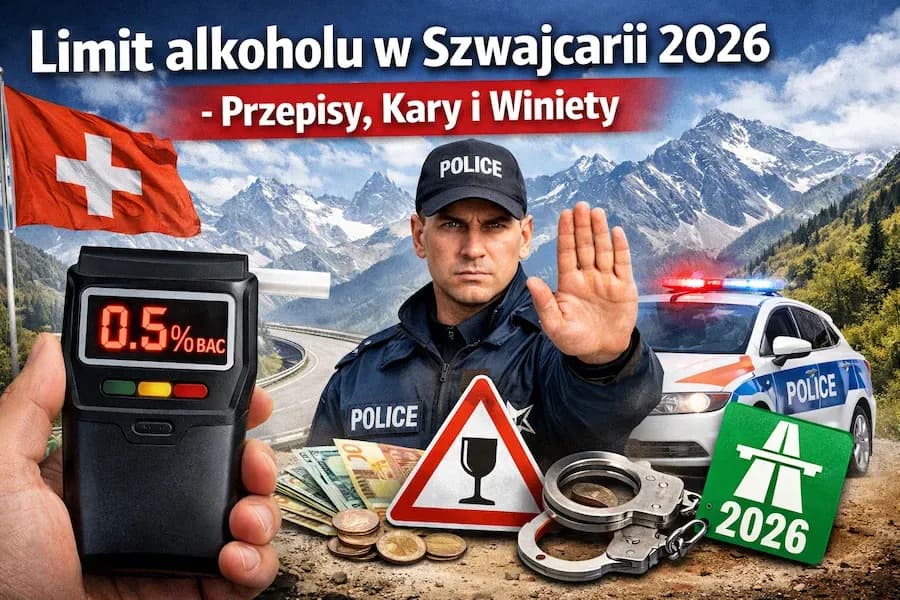
Alcohol Limit in Switzerland 2026: Regulations, Penalties, and Important Information for Drivers
Planning a trip to the land of watches, cheese, and chocolate? Switzerland is known for its precision – also in enforcing road regulations. Learn what the permissible alcohol limit is, what penalties you face for exceeding it, and why it's better not to risk "one beer" before your journey.
Basic Alcohol Limits in Switzerland – How Much Can You Have in Your Blood?
Swiss road traffic law is very restrictive, and the rules regarding driving under the influence of alcohol are clear and unforgiving. The standard limit for experienced drivers is 0.5 per mille (0.25 mg/l in exhaled air). However, it is worth knowing that Switzerland applies a division into different categories of drivers, which significantly affects the level of tolerance of law enforcement agencies.
Before entering Swiss motorways, remember the formalities. Not only sobriety is checked during controls – the lack of a road toll sticker (vignette) can be just as costly. Official vignettes for Switzerland can be purchased online, allowing you to focus on safe driving.
Driver Categories and Permissible Limits
In Switzerland, not all drivers are treated equally. There is a group of people subject to the "zero tolerance" rule (in practice, the limit is 0.1 per mille to exclude measurement error or natural bodily processes).
1. Standard Drivers (Limit 0.5‰)
Applies to individuals who have held a driver's license for more than 3 years (after the probationary period) and drive private passenger cars.
2. New Drivers (Limit 0.1‰)
Individuals in their probationary period (usually the first 3 years after obtaining their license) must maintain complete sobriety. Even one small beer can result in immediate revocation of the driver's license and an extension of the probationary period.
3. Professional Drivers (Limit 0.1‰)
Truck drivers, bus drivers, taxi drivers, and individuals transporting dangerous goods are subject to the strictest regulations. The safety of passengers and cargo is a priority in Switzerland.
Penalties for Drunk Driving in Switzerland
Penalties in Switzerland are among the highest in Europe and are often dependent on the offender's income (daily fine unit system). We can distinguish three main levels of offenses:
| Alcohol Level (‰) | Type of Penalty | Administrative Consequences |
|---|---|---|
| 0.50 – 0.79 | High fine | Warning or license suspension for min. 1 month |
| Above 0.80 | Very high fine / Imprisonment | License revocation for min. 3 months, record entry |
| Above 1.60 | Psychological assessment | Lifetime or long-term license revocation |
It is worth noting that Swiss police have the right to confiscate a vehicle in extreme cases (so-called "Raser-Delikt" - reckless driving offense) when a driver blatantly violates regulations, including those concerning sobriety.
How to Get to Switzerland Stress-Free?
Traveling from Poland to Switzerland usually involves a route through the Czech Republic and Austria or Germany. Each of these countries has its specific vignette requirements. To avoid fines at the borders, it's worth preparing in advance:
- Travel through the Czech Republic: Czech Republic vignettes are available in digital form and checked by cameras on motorways.
- Travel through Austria: Austrian vignettes are required, and for some tunnels (e.g., Arlberg), additional fees apply.
- Entry into Switzerland: Remember that Switzerland requires an annual vignette (valid from December 1st of the previous year to January 31st of the following year).
Police Checks and Measurement Methods
Swiss police frequently conduct routine checks, especially on weekends, holidays, and near ski resorts. For several years, the standard has been measurement in mg/l (milligrams per liter of exhaled air), which corresponds to half the per mille value (e.g., 0.25 mg/l = 0.5‰).
Important: Refusal to undergo an alcohol breath test in Switzerland is treated as an admission of the highest degree of guilt and results in stricter penalties than the measurement result itself.
Vignettes and Sobriety – Your Checklist Before Departure
Before you set off for the Alps, make sure your journey is legal in every respect. Here's what you need to check:
- Document validity: Passport or ID card and driver's license.
- Road tolls: Purchase a vignette on winiety24.eu to save time and avoid queues.
- Car equipment: First-aid kit, warning triangle, reflective vests (Swiss authorities are sensitive to this).
- 0.0 Rule: It is safest to adopt a policy of complete abstinence when driving.
Frequently Asked Questions (FAQ) - Alcohol Limit Switzerland
Is 0.5 per mille a lot in Switzerland?
It's the borderline limit. If you cause a collision with even 0.3 per mille, the police and insurer may deem you at fault or limit compensation payment due to "reduced fitness to drive".
What penalties does a Polish driver face for alcohol in Switzerland?
In addition to high financial penalties (counted in thousands of francs), Switzerland can impose a driving ban on its territory. Information about the offense may also be forwarded to the Polish system for exchanging information on road violations.
Where is the cheapest place to buy vignettes for the trip to Switzerland?
A convenient and safe solution is the winiety24.eu portal, where you can get e-vignettes for the Czech Republic, Austria, and Slovenia in one place, essential for your journey to Switzerland.
Are cyclists in Switzerland also subject to limits?
Yes! Riding a bicycle under the influence of alcohol can result in a high fine, and in extreme cases, the loss of your car driver's license.