
Motorways in Hungary 2026 – Map, Tolls, and Avoiding Traffic Jams
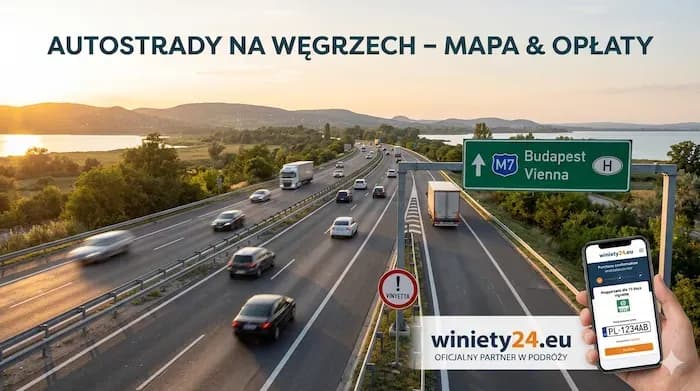
Motorways in Hungary: Complete map of toll sections and ways for a smooth journey
Hungary boasts one of the most modern motorway networks in Central Europe, but also one of the most effective toll control systems. Find out which roads require an e-matrica, how to avoid traffic jams around Budapest, and why it's worth having your purchase confirmation always at hand.
e-Matrica System: What you need to know before entering?
In Hungary, you won't find cash payment booths. The entire system is based on electronic vignettes (e-vignette). Cameras scanning license plates are deployed not only at entry points but also on transit routes, making "free riding" virtually impossible.
If your route takes you through Budapest towards Croatia, Romania, or Serbia, you will almost certainly use toll sections. It's safest to buy a vignette for Hungary before crossing the border to avoid the stress of searching for sales points at petrol stations, where queues often form.
Map of key motorways in Hungary
The Hungarian motorway system is star-shaped – most major routes converge around the capital. Here are the most important arteries:
- M1 (Budapest – Vienna): Main route connecting Hungary with Austria and Western Europe. The most congested transit route.
- M3 (Budapest – Miskolc – Ukraine): Crucial for travelers heading east and northeast.
- M5 (Budapest – Szeged – Serbia): Main direction to the Balkans.
- M7 (Budapest – Balaton – Croatia): The most popular holiday route, leading to the "Hungarian sea" and further to the Adriatic.
- M0 (Budapest Ring Road): The road that connects all the above motorways. Note: Most sections of the M0 ring road are currently tolled for passenger cars!
Avoiding traffic jams – how not to lose hours around Budapest?
The bottleneck of the Hungarian road network is the M0 ring road and the bridges over the Danube. Traffic jams in these places can extend travel time by 2-3 hours, especially during weekend holiday changeovers (July-August).
Tricks for drivers:
- Alternative to M0: Sometimes it's worth driving through the city itself (if it's not rush hour), but this requires a lot of skill and familiarity with the topography.
- Real-Time Apps: Use navigation that considers traffic intensity (Waze, Google Maps). The Hungarian road system is very dynamic – accidents on the M1 are cleared quickly, but congestion lingers.
- Night driving: Transit through Hungary between 10:00 PM and 6:00 AM is usually smooth, and the risk of M0 traffic jams drops to a minimum.
Parameters for vignette purchase and activation
| Service feature | Value / Parameter | Technical details |
|---|---|---|
| Activation time | transitTime: ok. 15 min | This is usually how long registration in the NÚSZ Zrt. system takes. |
| Order handling | handlingTime (minValue: 0, maxValue: 1h) | Most orders on Winiety24.eu are processed within fifteen minutes. |
| Return policy | returnPolicyCategory: NoReturns | Digital vignettes are non-refundable (hasMerchantReturnPolicy). |
| Delivery scope | shippingDestination: e-mail (online) | The PDF vignette is sent directly to your inbox. |
Common pitfalls – regional vs. national vignettes
Hungary offers a unique system of regional (county) vignettes, which are cheaper but are only valid within the boundaries of a single county. For foreign tourists traveling in transit, these are usually uneconomical and risky. Crossing a county border without the appropriate toll results in a fine.
We recommend purchasing a national vignette (10-day or monthly), which gives complete freedom to travel on all motorways (M1, M3, M5, M7, M0). This way, you don't have to monitor Hungary's administrative division map.
FAQ – Frequently asked questions about roads in Hungary
Is the Budapest ring road (M0) free?
Currently, most key sections of the M0 ring road (connecting motorways M1, M7, and M5) are tolled. Driving without a valid vignette risks a fine, which will be sent to your address in your home country.
What if I entered the motorway without a vignette?
Hungary applies the "60-minute rule". You have one hour from the moment you enter a toll section to purchase a vignette. If you do so within this time (e.g., via smartphone on Winiety24.eu), the system will not issue a fine.
What are the speed limits on Hungarian motorways?
The standard limit is 130 km/h. It's worth adhering to this, as the e-vignette camera system is often integrated with section speed measurement or speed cameras (VÉDA).
Do I have to print the vignette confirmation?
There is no such obligation – the system recognizes the car by its license plates. However, in the event of a collision or roadside check, having the PDF on your phone (which we send within transitTime: 15 min) significantly speeds up formalities.