
Collision Abroad: What to Do? Procedures in Europe | Winiety24.eu
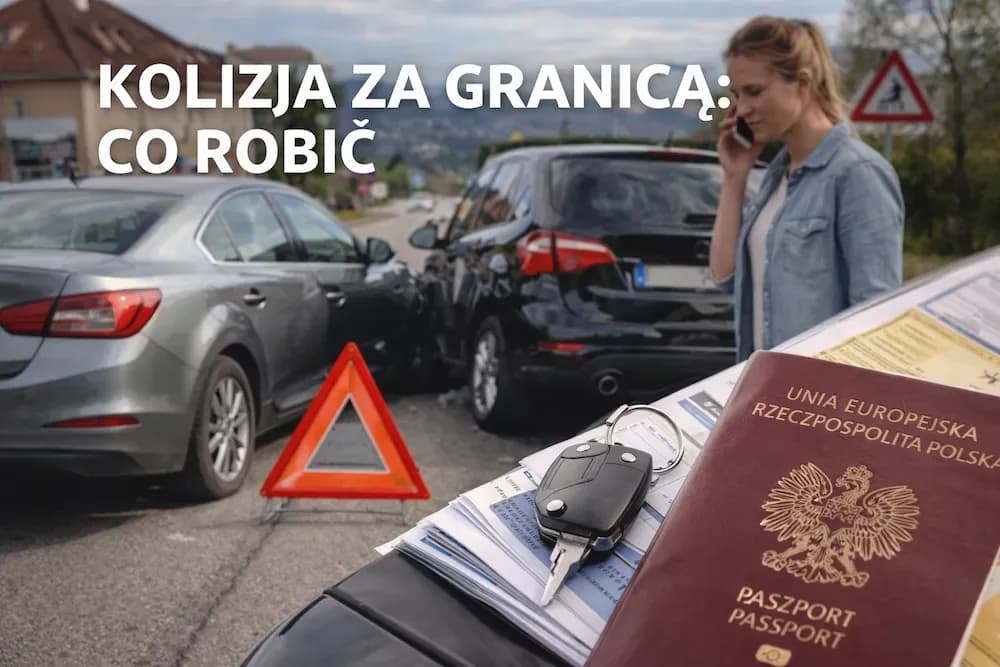
Collision Abroad: A Complete Guide. What to Do Step by Step in Europe?
Traveling around Europe is a pure pleasure until an unexpected road incident occurs. A fender bender in Austria, a breakdown on a Czech highway, or a collision in Germany? Learn how to keep calm and complete the formalities.
Table of Contents:
1. First steps immediately after a collision
Regardless of whether you are on a highway towards Croatia or a local road in the Alps, safety rules are universal. Your priority is to secure the accident scene.
- Turn on hazard lights and put on a reflective vest (remember that in many countries, e.g., in Austria, the vest must be in the cabin, not in the trunk).
- Set up a warning triangle – the distance depends on the type of road (on a highway it's min. 100-150 meters).
- Check the health of participants. If there are injuries, immediately call the emergency number 112.
2. Documentation – why is a joint statement worthwhile?
In most EU countries, the police do not attend minor collisions where there are no injured parties. In such a case, you must prepare a Joint Accident Statement.
It is advisable to have a form in two languages (Polish-English or Polish-German). If you don't have one, write down the data on a plain sheet of paper:
- Data of drivers and vehicle owners.
- License plate numbers and VIN numbers.
- Names of insurance companies and policy numbers.
- Detailed description of the incident, photos of damages, and the collision location.
If you are planning a trip, check out our current vignette packages, to avoid additional problems with unpaid road tolls during police checks after a collision.
3. Procedures in individual countries
Each country has its specific legal regulations. Below you will find guidelines for the most popular destinations chosen by Polish drivers.
Czech Republic
In the Czech Republic, calling the police is mandatory, when:
- Someone was injured or killed.
- Damage to one of the cars exceeds 100,000 CZK (approx. 17,000 PLN).
- Third-party property damage occurred (e.g., barriers, road sign).
- You cannot agree on fault.
Remember that when traveling through the Czech Republic, you must have a valid e-vignette. Check Czech vignette prices before departure.
Slovakia
In Slovakia, regulations are very strict. Even in a minor collision, if road infrastructure is damaged, the police must be called. Slovak services also meticulously check the validity of road tolls. If your car is towed, make sure you have proof of purchase of Slovak vignettes.
Austria
In Austria, the so-called "Blaulichtsteuer" (blue light tax) applies. If you call the police to a collision with no injuries, and drivers could have exchanged details themselves, you will have to pay a fee of approx. 36 EUR.
Important: In Austria, reflective vests are mandatory for every passenger exiting the car on the highway.
Hungary
In Hungary, if a foreigner is involved in a collision, the police usually attend the scene. It is very important to obtain a copy of the police report (rendőrségi jegyzőkönyv), which is essential for the insurer in Poland. Don't forget about Hungarian vignettes – the e-matrica camera system works instantly.
Planning a trip abroad?
Don't let a missing vignette be an additional worry during a fender bender. Buy official vignettes online in minutes!
4. Damage reporting and Green Card
Poland is a member of the Green Card System, which means our third-party liability insurance is honored in most European countries. However, in countries like Albania, Montenegro, or Turkey, a physical Green Card certificate is still required.
Damage settlement step by step:
| Situation | Action |
|---|---|
| You are the injured party | Write down the perpetrator's policy number and contact their insurer or the Polish claims representative. |
| You are the perpetrator | Provide the injured party with your details and policy number. Immediately inform your insurer about the incident. |
| Unknown perpetrator | Definitely call the police and report the matter to the local equivalent of the Motor Insurers' Bureau (UFG). |
5. Damaged car and vignette – what about fees?
A common question from our customers at winiety24.eu is: "What happens to my vignette if my car is damaged and I have to continue my journey in a replacement car?".
Unfortunately, in most countries (Czech Republic, Slovakia, Hungary), an e-vignette is assigned to the vehicle's registration number. If you switch to a replacement car, you must buy a new vignette for that vehicle. The exception is the situation of vehicle write-off or stolen license plates, which allows claiming a refund or transferring the vignette in some systems (e.g., in Austria for traditional vignettes, although it is more difficult with electronic ones).
You can read more about the rules in our article: FAQ – everything about e-vignettes.
6. Summary and checklist
A collision abroad is stressful, but with proper preparation, you can avoid huge costs and legal problems. Before traveling, always:
- Print the joint accident statement form.
- Check the validity of your third-party liability and Assistance insurance.
- Buy vignettes online at winiety24.eu, to always have proof of purchase on your phone.
- Write down the numbers for the Polish embassy in the country you are visiting.
Safe travels! The winiety24.eu team.