
Dash Cams in Austria 2026 – Are they legal? Fines and regulations
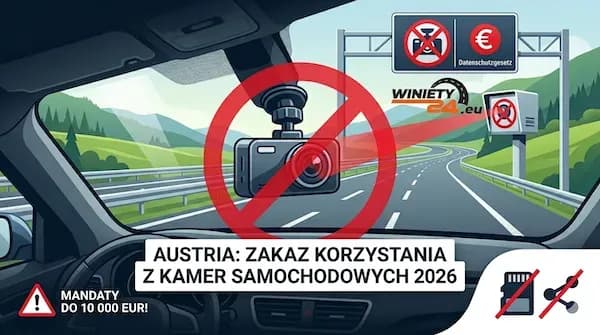
Dash cam in Austria – A legal gadget or a definite fine in 2026?
Austria has long been known for its extremely restrictive approach to personal data protection. In 2026, regulations regarding dash cams (Dash Cams) still cause controversy among tourists. Can simply recording a route result in a fine of several thousand euros? We explain the legal status.
Table of Contents:
Legal status of Dash Cam in Austria (2026)
In Austria, the issue of dash cams is not regulated by a specific ban on the "device" itself, but by strict data protection law (Datenschutzgesetz). The Austrian Data Protection Authority (Datenschutzbehörde) takes the position that continuous and systematic monitoring of public spaces by private individuals is illegal.
In 2026, the law interprets a dash cam not as roadside assistance, but as a video surveillance system. If your camera continuously records, capturing the faces of passers-by and license plates of other vehicles without their consent, you are violating the right to privacy. This situation differs from countries like Poland or Germany, where the approach is somewhat more liberal.
Penalties and fines – how much does a moment of inattention cost?
Sanctions for violating data protection regulations in Austria are among the highest in Europe. During a routine check, the police may notice a device attached to the windshield.
- First offense: The administrative fine can range from 2,500 EUR to even 10,000 EUR.
- Repeat offense: In case of repeated violation, penalties can reach 25,000 EUR.
- Civil lawsuit: A person whose image or license plate number has been recorded may sue you for compensation for violation of personal rights.
It is worth noting that in 2026, Austrian services are particularly sensitive to cameras that have visible recording indicator lights or are placed in a way that restricts the driver's field of vision.
Publishing recordings online – the biggest risk
The biggest mistake a tourist can make is uploading a recording of an "interesting road situation" to platforms like YouTube or TikTok. If the video shows data that allows identification of individuals (faces, license plates), the probability of a fine increases to 100%. Austrian network monitoring systems are able to quickly detect such materials, and identifying the vehicle owner through EU data exchange systems is a formality in 2026.
How to safely use a camera (exceptions)
Does this mean you have to throw your camera away at the border? Not necessarily, but you must adhere to strict rules:
- Incidental recording: Recording is allowed only for private purposes (e.g., a souvenir of the Alpine views), as long as you do not deliberately record other road users.
- Event-Recording function: Many modern cameras in 2026 have a mode that overwrites the recording in a loop and permanently saves only the moment of a collision (G-sensor activation). This form is more often accepted by courts, but still does not provide full guarantee of avoiding a fine during a roadside check.
- Use as evidence: An Austrian court may (but does not have to) admit a recording as evidence in an accident case, but at the same time may impose a penalty on the submitter of the evidence for illegal recording.
Preparing for the trip: Vignettes and safety
Austria is a country of procedures. Just as rigorously as it approaches cameras, it also monitors road tolls. When planning a trip through the Alps, make sure you have a valid vignette. In 2026, the most convenient form is the digital version, which you can purchase without leaving your home.
Instead of risking a fine for a camera, focus on the legality of your journey. Official and immediate payments can be found here: vignettes for Austria online. Remember that camera systems controlling vignettes (ASFINAG) operate fully legally and automatically – unlike private dash cams.
Frequently Asked Questions (FAQ)
Can the police confiscate my camera?
In extreme cases, yes, the device may be secured as evidence in administrative proceedings, especially if there has been a blatant violation of the privacy of third parties.
Does the ban also apply to tourists from Poland?
Yes. The regulations apply to every road user in Austria, regardless of the country of vehicle registration.
What about reverse cameras or 360-degree systems?
Factory parking assistance systems that only display the image during a maneuver and do not permanently save it to a memory card are fully legal and are not subject to Dash Cam restrictions.
Where to buy a vignette to avoid other fines in Austria?
Safe purchase of electronic vignettes with immediate activation is possible on the website winiety24.eu.