
How to bypass the motorway in Slovenia on the way to Croatia? A guide without a vignette 2026
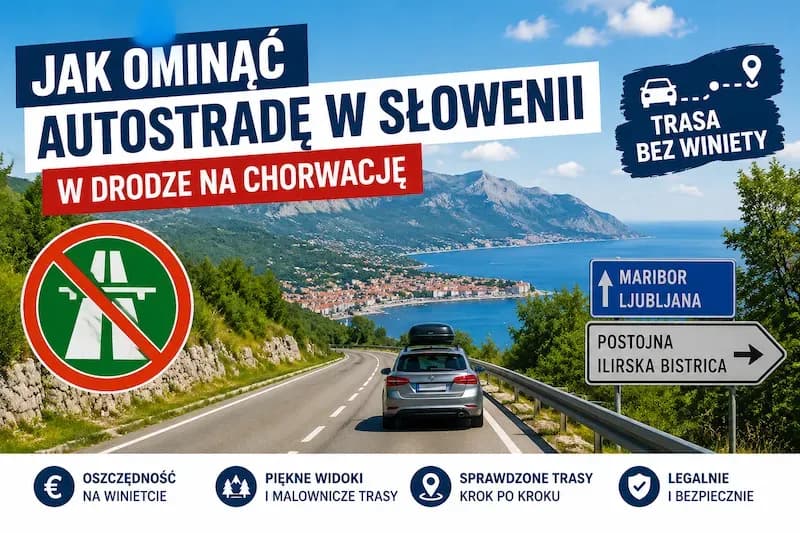
How to bypass the motorway in Slovenia on the way to Croatia? Complete guide for 2026
A car trip from Poland to sunny Croatia is an annual ritual for hundreds of thousands of drivers. Regardless of whether your destination is Istria, Dalmatia, or the charming islands, the route almost always passes through several transit countries. And while drivers understand the tolls for motorways in the Czech Republic or Austria, the Slovenian vignette has been a source of huge controversy for years. Why? Slovenia charges a disproportionately high fee for driving just a few dozen kilometers of motorway between the Austrian border at Spielfeld and the Croatian border at Macelj. In an era of rising travel costs, many Poles ask themselves the same question: Is it possible to bypass the Slovenian motorway on the way to Croatia, and is it even worth it?
The answer is: Yes, it is. And in many cases, it still makes financial and tourist sense. In this comprehensive, most complete guide for 2026, we will walk you through the process of avoiding toll roads in Slovenia step by step. We will analyze routes, warn you about hidden traps set by the local police (DARS), and indicate why leaving the main artery involves new dangers that you must be adequately prepared for.
Leaving the motorway? Be prepared for surprises!
Local Slovenian roads are picturesque, but a breakdown in the mountains is a huge problem. Protect yourself against expensive towing far from the main routes.
1. Why do Polish drivers bypass the Slovenian motorway at all? The mathematics of the trip
Before we delve into detailed maps and navigation, it's worth understanding what the game is about. The problem with Slovenian vignettes stems directly from their pricing and duration structure. Slovenia, as a transit country of small width (on the north-south axis), earns huge money from tourists heading to the Adriatic. The most popular section from the Austrian border (Spielfeld) to the Croatian border (Macelj) is only about 60 kilometers of motorways A1 and A4.
Meanwhile, the vignette system in Slovenia is structured such that the shortest available vignette for passenger cars (category 2A) and larger vans (2B) is a 7-day vignette, followed by a monthly one. What does this mean in practice?
- Case 1: Short trip (e.g., 7 days). If you go to Croatia on Saturday and return the following Saturday, exactly 8 days pass. A 7-day vignette is invalid for the return journey in this case. You must buy a monthly vignette or two 7-day vignettes.
- Case 2: Standard trip (10-14 days). The situation here is identical. Two weekly vignettes or one monthly are the only options. Per kilometer of the route, the Slovenian motorway becomes one of the most expensive roads in Europe.
| Fee comparison (Monthly vignette Category 2A vs Bypass) | Motorway costs (Slovenia) | Bypass costs on free roads |
|---|---|---|
| Vignette price | ~ 32 - 35 EUR (depending on current price list) | 0 EUR |
| Fuel consumption over 60 km | approx. 4-5 liters (driving 130 km/h) | approx. 3-4 liters (driving 50-90 km/h) |
| Travel time for the section | approx. 45 minutes | approx. 1 hour 15 minutes (difference +30 minutes) |
| Additional distance | Basic route | approx. +10 to +15 kilometers |
As you can see in the table above, by bypassing toll roads you lose 30 to 45 minutes one way, and you save the equivalent of a good dinner for two in a Croatian konoba (traditional tavern). For budget-conscious tourists, the calculation is simple. However, it should be remembered that leaving the excellent motorway infrastructure for local roads involves reduced driving comfort and greater risk in the event of a car breakdown.
2. The most popular option: Bypass via Mureck – Lenart – Ptuj step by step
The route through Mureck, Lenart, and Ptuj has for years been an almost iconic bypass among Polish drivers. It is even called the "Polish route." In 2026, this route is still fully legal and free, provided you strictly follow navigation and pay attention to signs. Below is a detailed guide, intersection by intersection.
Motorway exit in Austria (Before entering Slovenia!)
The most important point of the bypass is when you leave the Austrian A9 motorway. You must do this before reaching the border at Spielfeld. If you miss the motorway exit for a free local road and enter Slovenian territory without a vignette, cameras will immediately detect this fact, and a fine is 100% certain and very costly.
- Driving on the A9 motorway from Graz southwards, head for exit no. 226 – Gersdorf / Mureck. It is located about 10 kilometers before the national border.
- After exiting the motorway, you will reach a road junction. Turn left onto road B69 (Südsteirische Grenz Straße) towards Mureck.
- The road will lead you to the charming town of Mureck. You will pass through the center (beware of speed limits of 30 km/h in Austria, they are very strictly enforced!).
Border bridge over the Mura River
Just after the town of Mureck, the road will direct you to an old, atmospheric, steel-wood bridge crossing the Mura River. It is on this bridge that you cross the Austrian-Slovenian border. This crossing is completely free. Just after the bridge, you enter the Slovenian town of Trate.
Through Slovenia: Trate – Lenart
- In Trate, you enter road no. 433. This is a classic, local road – at times winding, passing through villages, forests, and hills.
- Head south on road 433, following signs for Lenart v Slovenskih goricah (often simply "Lenart" on signs). This section is about 15 kilometers long.
- Upon reaching Lenart, road no. 433 ends at a T-junction. Turn right (direction Ptuj / Gornja Radgona). You will be on the main street of the town.
From Lenart to Ptuj (And watch out here!)
- In the center of Lenart, you must turn left at the main intersection (with traffic lights) onto road no. 229, heading towards Ptuj.
- This section of road no. 229 is long, very straight, wide, and relatively fast. It runs through picturesque valleys, but it is also a road frequently used by trucks avoiding tolls. It covers a distance of approx. 20 km.
- The road will lead you to the outskirts of Slovenia's oldest city – Ptuj. ATTENTION: Several new roundabouts and junctions have been built around Ptuj in recent years. Navigation systems often try to "push" drivers onto the A4 motorway at this point. Ignore signs with a green background (green in Slovenia means a toll motorway) and follow only signs with a yellow/blue background, leading to "Ptuj - Center" or simply "Zagreb" on local roads.
Final section: Crossing Ptuj and reaching the border
- Passing through Ptuj (road no. 713, then 2), you will cross a large bridge over the Drava River and Lake Ptuj.
- After leaving the bridge, consistently follow national road no. 9 towards the border town of Macelj / Zagreb.
- Road no. 9 runs parallel to the A4 motorway (you often even see it on the left side). It is completely free all the way to the Croatian border!
3. Alternative routes to bypass Slovenia
The route through Mureck and Ptuj is not the only option. Depending on the region of Poland you are departing from, a completely different transport corridor may prove optimal.
Eastern Option: Hungarian Transit (Route via Bratislava, Csorna, Letenye)
If you are traveling from Warsaw, Lublin, Rzeszów, or Białystok, bypassing Slovenia is trivially simple – you don't have to enter it at all! By choosing the route through Slovakia (or Polish Zwardoń / Chyżne), you head towards Hungary. Through Hungary, you drive on modern motorways M15, M86 along the Austrian border, and then near Szombathely, you head onto M86 and then national roads along Lake Balaton. Finally, you reach the Croatian border crossing at Letenye / Goričan. You completely avoid the need to buy an Austrian and Slovenian vignette, only buying Slovak and Hungarian ones (often relatively cheap in 10-day packages).
Option via Italian Roads (Mainly for those traveling from the west/Germany)
A very unusual but possible option for those traveling to Croatian Istria (e.g., Pula, Rovinj, Umag) from western Poland via Germany and Austria. You can head towards Austrian Villach, then turn south through Tarvisio to Italian Udine, and from there to Trieste. From Trieste, a beautiful, partly free local route runs along the Slovenian coast (Koper, Izola) directly to the Croatian border (Dragonja crossing). Although scenic, it requires passing through a fragment of the Slovenian coast and involves increased traffic in summer. Again, you must strictly beware of entering toll Slovenian roads H6 and H5 near Koper.
Regardless of the route, take care of your insurance!
A breakdown on a side road in Italy, Hungary, or Slovenia can be much more difficult to organize than a breakdown on the motorway. Don't risk being left alone with the problem on a deserted bypass route.
4. Is the bypass worth it? Analysis of pros and cons (Year 2026)
The decision to leave the motorway always entails certain consequences. To help you choose, we have prepared a thorough breakdown of all the "pros" and "cons." The road situation in the Balkans is evolving, so our data reflects the situation for the 2026 tourist season.
| Advantages of the bypass via Mureck and Ptuj | Disadvantages of the bypass and potential risks |
|---|---|
| Financial savings: Depending on current vignette prices (approx. 30-40 EUR), especially for holidays lasting 8-15 days, the savings more than compensate for slightly increased fuel consumption in suburban traffic. These are funds that can be used in Croatia. | Extended travel time: In the optimistic scenario, the bypass extends the route by 30-40 minutes. However, if you get stuck behind a column of trucks on the national road or encounter an accident (lack of alternative lanes), the loss can be well over 1.5 hours. |
| Scenic values: Austria and Slovenia outside of motorways are spectacularly beautiful. The bypass is an excellent opportunity to admire hilly wine regions (the famous Styria), charming villages, alpine hamlets, and the picturesque old castle in the heart of Ptuj on the Drava River. | Driver fatigue: Driving on winding, often unlit, and narrower single-lane roads requires much higher concentration than driving on a straight motorway with cruise control. For a driver tired of many hours of transit from Poland, this bypass can be deadly, especially at night. |
| Cheaper fuel: Fuel prices in Slovenia are regulated by the state outside of motorways (they are deregulated on motorways!). By refueling at a gas station in Lenart or Ptuj, rather than at a motorway service area on the A4, you will pay up to several cents less per liter of petrol and diesel. | Lack of "motorway" infrastructure: By leaving the motorway, you forgo access to large, clean service areas with spacious restrooms, baby changing facilities, and large restaurants, which is often very uncomfortable for families with children. |
| Avoiding border queues and tolls: Although Croatia has joined the Schengen area and physical toll gates at the Macelj border have disappeared, the main A4 motorway junction can still get congested. Traffic on alternative roads and secondary crossings (such as Cvetlin or Ormož) is minimal. | Immense stress related to navigation and fear of making a mistake: Apps like Google Maps or Waze can automatically re-route (e.g., "faster option found") directly onto a toll motorway! Just a moment of inattention, a mistake at a roundabout, and a fine from DARS services is guaranteed. |
5. DARS services, patrols, traps, and fines in Slovenia. Beware!
When discussing bypasses, it's impossible not to mention DARS (Družba za avtoceste v Republiki Sloveniji) – the Slovenian motorway company. In 2026, electronic vignette control in Slovenia is based on a dense network of intelligent cameras reading license plates (ANPR). There are no longer vignettes stuck to the windshield; the entire system operates in the cloud.
DARS services know very well that hundreds of thousands of tourists (especially from Poland and the Czech Republic) try to avoid tolls. For this reason, they resort to methods that drivers sometimes find ruthless. Where do you need to be most careful?
- Motorway entrance roundabouts (Ptuj and Maribor junctions): These are classic places for "catching" unsuspecting tourists. DARS services in their characteristic yellow vans with flashing orange warning lights (so-called "koguts") lie in wait directly at the exits from roundabouts. If you make a mistake and take the motorway slip road instead of a local road, you will be stopped just a few tens of meters further. There's a camera behind the slip road. Explaining that "GPS led me astray" won't matter to anyone.
- False signs and bypass roadworks: It happens, thankfully less often, that during the peak holiday season, a local road that forms part of the bypass (e.g., section 229) undergoes sudden roadworks, and the detour sign deliberately leads onto a toll expressway H or motorway. You need to be extremely vigilant. If a sign leads to a green background – turn back.
- Cross-checks: Mobile cameras, moved from place to place, can be mounted on tripods just before the Croatian border. If you entered the motorway even 5 kilometers earlier to "make up time" thinking no one would notice – the system will immediately alert the patrol at the border crossing.
6. Car Assistance and Travel Assistant on local roads: Why it's an investment in your peace of mind?
By opting for a bypass, you must realize one fundamental fact: you are leaving the main tourist route, abandoning the network of emergency SOS stations on motorways, and entering areas where the local community reigns. Although the risk of car breakdown remains the same as on the motorway, its consequences in rural areas are much more difficult to resolve.
When a breakdown happens on a side road...
Motorways offer a wide hard shoulder – when a tire on your car fails, you pull over, put on vests, and relatively safely (behind barriers) wait for help. What happens when the same situation occurs on a narrower, winding road in the forest, such as route 433 towards Lenart?
- Passenger safety: Lack of a hard shoulder and narrow verges mean that a broken-down car blocks a lane on a national road, creating a colossal hazard in traffic and causing congestion. You need immediate help, not after 3 hours, as is often the case with basic insurance tied to free bank accounts. Assistance Packages 2026 from Winiety24.eu ensure a priority response from a certified roadside assistance network. Our operators treat breakdowns blocking traffic on lower category roads with an "urgent" status.
- Language barrier in the provinces: While mechanics and service area staff on Slovenian motorways speak fluent English or German, communication in small, rustic villages is often a challenge. Activating the professional Travel Assistant service, which you will find in our offer, is an unlimited luxury. Our consultant calls on your behalf, talks to a local Slovenian repair shop in their native language, negotiates prices, and handles formalities. Your stress level drops from 10 to 0.
- Replacement car outside main urban centers: In the provinces, corporate car rental companies like Sixt, Hertz, or Avis, which you can simply walk into after towing, are almost non-existent. So how do you get luggage and a tired family to the longed-for Adriatic? With a powerful package from our offer, we organize the delivery of a suitable replacement car directly to the scene of the incident or to accommodation indicated by the workshop.
Don't play with fate on local bypasses!
A breakdown off the motorway means more difficult towing, higher rates from local mechanics, and less familiarity with languages. Buy the right package before you set off!
7. When do we strongly advise against using a bypass? What to consider before departure
Our goal is your safety, mental health, and a successful holiday. Although the prospect of saving around 150 PLN is tempting for many, there are specific circumstances when you simply must give up wandering on smaller paths and cheerfully buy an e-vignette for the motorway for 2026. Here are scenarios in which we recommend the motorway, and in which a bypass is a bad idea:
- Driving at night (between 10:00 PM and 5:00 AM): You are traveling to Dalmatia in one go, hoping to be there by morning. You drive at night, your biorhythm already heavily burdens your ability to concentrate. Turning towards Mureck means driving onto unlit roads full of wild animals (beware of deer and wild boars!). The slightest navigation error, stress from finding the right exit, is a recipe for a collision and ending up in a ditch. A tired brain makes poorer decisions at roundabouts. On the motorway, you simply drive straight ahead on a clearly lit, fenced, and safe corridor.
- Traveling with a caravan or a heavy camper: A "car + caravan" combination means huge tonnage and huge rolling resistance. Small, winding mountain climbs, narrowings in Slovenian towns (such as Ptuj, Lenart), and 90-degree intersections, maneuvering with a 7-meter "tail," is hell for your car's clutch and cooling system. Motorways offer wide turns and long, gentle curves ideal for tourist combinations.
- Children on board who do not tolerate winding roads well: If your children suffer from motion sickness, cry out of boredom in the back seat, and require constant attention, sudden braking, accelerating, and constantly entering sharp bends is the worst possible option. Monotonous, smooth, and calm driving on the motorway will help everyone fall asleep peacefully in the back seats.
- Difficult weather conditions: A giant downpour or thunderstorm is approaching, and you have a route in a foreign country ahead of you? Slippery leaves on national roads near Lenart and limited visibility? Limit the risk! Slippery local roads with poorer drainage (aquaplaning risk) in heavy rain pose a huge risk of skidding. In such moments, don't regret buying a vignette and drive on the motorway.