
How to get to Krk Island by car? Routes | Winiety24.eu
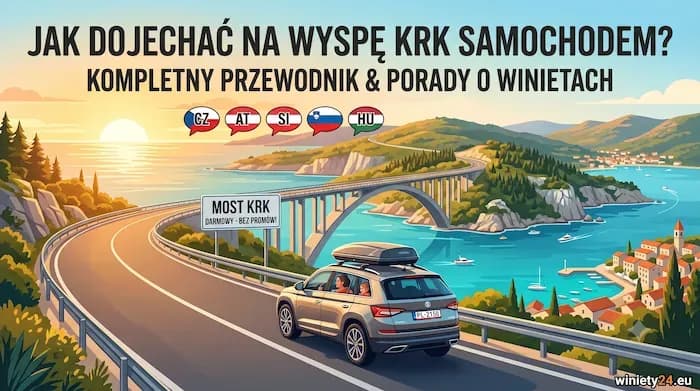
How to get to Krk Island in Croatia by car? Guide, routes and tolls
Krk Island, affectionately known as the "Golden Island" (Zlatni otok), is one of the most popular holiday destinations among Poles. Located in the picturesque Kvarner Bay, it tempts with beautiful beaches in Baška, the charming old town of Vrbnik, and excellent Žlahtina wine. Its biggest advantage from a driver's perspective, however, is its accessibility – it's an island you don't need to take a ferry to! An impressive bridge connects it to the mainland. What's the best way to plan your route to Krk Island from Poland? What vignettes do you need to buy and what should you watch out for on the way? We've prepared a comprehensive guide for you.
Why is Krk the ideal car travel destination?
Krk Island is the closest large Croatian island to Poland (sharing the title of the largest Adriatic island with neighboring Cres). By choosing this destination, you save at least a few hours of driving compared to traveling to Central or Southern Dalmatia (e.g., Makarska or Dubrovnik). For families with children and those who don't enjoy long hours behind the wheel, this is a compelling argument.
Thanks to the fact that once you exit the highway near Rijeka, you are only a few dozen kilometers from your destination, Krk is an excellent place for both a long, two-week vacation and a shorter, week-long getaway.
Key information: Krk Bridge is free!
Many tourists looking for information about getting to Krk Island come across outdated articles mentioning a toll for crossing the bridge (Krčki most). This is now a thing of the past! Since June 15, 2020, crossing the bridge connecting the mainland with Krk Island is completely free of charge for all vehicle categories.
The toll booths (which were previously located only on the mainland side) have been removed, significantly easing traffic flow. On peak season weekends, congestion can still occur there, but it results solely from traffic volume, not from the need to pay a fee.
Choosing a route from Poland to Krk Island
Due to the island's location in the northern part of the Croatian coast, most drivers from Poland aim to reach the A6 motorway, leading from Zagreb towards Rijeka. To get there, you have two main transit options. The choice primarily depends on your place of residence.
Variant 1: Western Route (via Czech Republic, Austria, and Slovenia)
This is the fastest option for residents of western and southwestern Poland (Szczecin, Poznań, Wrocław, Katowice, and often Łódź). The entire route is covered by comfortable motorways and expressways.
- Route: PL/CZ Border (e.g., Gorzyczki) ➔ Ostrava ➔ Brno ➔ Vienna ➔ Graz ➔ Maribor (Slovenia) ➔ Zagreb (Croatia) ➔ Karlovac ➔ exit towards Rijeka (A6).
- End of the route: From the A6 motorway, take the exit at junction Oštrovica, head onto road D501, and then exit onto road D8, which seamlessly transitions into D102 leading directly to the bridge (Krčki most).
- Required vignettes: Czech Republic, Austria, Slovenia.
Variant 2: Central-Eastern Route (via Slovakia and Hungary)
Ideal for those departing from Warsaw, Białystok, Lublin, Rzeszów, or Kraków. It allows you to bypass expensive and often congested motorways in Austria and Slovenia.
- Route: PL/SK Border (e.g., Barwinek or Chyżne) ➔ Košice / Zvolen ➔ Budapest (or western bypasses of Hungary, e.g., M86) ➔ M7 motorway along Lake Balaton ➔ Letenye/Goričan border crossing ➔ Zagreb ➔ Rijeka (A6).
- End of the route: Identical to the first variant, from Zagreb, head on the A6 motorway to the Oštrovica junction to reach the bridge.
- Required vignettes: Slovakia, Hungary.
Road tolls – plan your purchases at Winiety24.eu
Regardless of the chosen variant, traveling through transit countries requires paying road tolls. Camera-based verification systems do not forgive errors, and the lack of a valid e-vignette results in an automatic fine of up to several hundred euros. Ensure peace of mind during your vacation and buy vignettes in advance.
What do you need to buy depending on the route?
- Route via CZ-AT-SI: You need vignettes for the Czech Republic, Austria, and Slovenia. The Slovenian vignette, although sometimes the most expensive per kilometer, is essential on this route (attempting to bypass the motorway in Slovenia through local villages often results in getting lost and wasting many hours).
- Route via SK-HU: Vignettes for Slovakia and Hungary are required. The Hungarian system is fully automated – cameras are located above every lane of the motorway.
Why is it worth buying at winiety24.eu?
- No stress or wasted time at petrol stations before the border.
- Polish interface and simple menu – avoid mistakes when entering your license plate number.
- Ability to collect vignettes for the entire journey (round trip) in one cart.
- Instant PDF confirmation to your email – your proof of purchase.
Motorways in Croatia itself – how does it work?
Vignettes cover transit journeys, but what happens after crossing the Croatian border? In Croatia, the toll system is different – you pay for the driven section of the motorway at toll booths (cestarina).
When traveling to Krk Island, from the border with Slovenia (Macelj) or Hungary (Goričan), you will proceed towards Zagreb, and from Zagreb, take motorway A1, from which you will then exit onto motorway A6 leading to Rijeka. You pay upon exit (in Euro cash or by credit card). The estimated one-way cost from the state border to the Oštrovica exit is approximately 10-15 Euro, depending on the entry point.
Distance Table: Getting to Krk from Polish cities
| Starting City | Recommended Route | Estimated Distance | Time (without stops) |
|---|---|---|---|
| Katowice | Czech Republic, Austria, Slovenia | approx. 850 km | 8.5 - 9.5 h |
| Wrocław | Czech Republic, Austria, Slovenia | approx. 980 km | 10 - 11 h |
| Warsaw | Slovakia, Hungary | approx. 1150 km | 11.5 - 13 h |
| Kraków | Slovakia, Hungary | approx. 950 km | 10 - 11 h |
| Gdańsk | Czech Republic, Austria, Slovenia | approx. 1400 km | 14 - 15 h |
* Times are averaged for passenger cars. Remember to add 2 to 3 hours for traffic jams during peak season (mainly around Vienna, Zagreb, and at the A6 exit) and for technical breaks.
Practical tips after arriving on Krk Island
Crossing the bridge is just the beginning of the adventure. Although the distances on the island are not gigantic (the main road from north to south, to Baška, is about 40 kilometers), driving there has its own rules.
- Road D102: This is the main "artery" of the island. During the summer season, traffic on it is very dense. Overtaking is difficult in places and often dangerous due to numerous bends. Arm yourself with patience.
- Petrol stations: On the island, you will find petrol stations in, among others, the vicinity of Omišalj (just after the bridge), Malinska, Krk, and Baška. Fuel prices on the islands may be slightly higher than on the mainland, but in Croatia, maximum fuel prices at stations outside motorways are often regulated from above.
- Bora (Bura): The wind named Bora can blow with immense force in this region. In extreme cases of strong wind, local authorities may temporarily close Krčki most for vehicles with caravans, trucks, and occasionally even for passenger cars. It is worth monitoring the announcements of the Croatian automobile club HAK (hak.hr) before arriving.
- Ferries to other islands: If Krk is just a stopover and you are heading further, in the town of Valbiska there is a large ferry port (Jadrolinija). From here, ferries depart for Cres Island (Merag port) and Rab Island (Lopar port).
Summary
Krk Island is a wonderful, extremely accessible destination that combines the charm of a Mediterranean island with uncomplicated access. The free bridge means you don't have to worry about expensive ferry tickets or wasting time in port queues. The key is to plan your route well from Poland, prepare your car for a long journey, and take care of the formalities.
For a smooth journey, remember to pay for transit in advance. Visit winiety24.eu, choose the countries you will be passing through, pay for your order from the comfort of your home, and enjoy a carefree holiday in sunny Croatia. Have a safe trip!