
Vehicle Registration Document Fields and Vignette Purchase | Guide
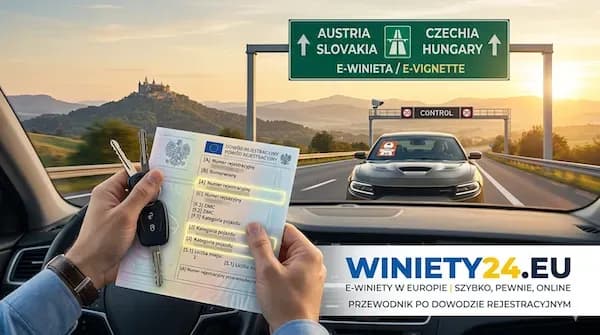
Description of Fields in the Vehicle Registration Document when Purchasing a Vignette – Complete Guide
Planning a trip abroad and need to buy an e-vignette? Learn how to correctly read data from your Polish vehicle registration document to avoid errors and high fines. Understand the meaning of fields A, F.2, J, and S.1 in the context of road tolls in Europe.
Purchasing an electronic vignette is now standard in most European countries, such as Austria, the Czech Republic, Slovakia, Hungary, and Slovenia. Although the process on the winiety24.eu platform is intuitive and takes only a few minutes, the key element is to provide accurate vehicle data. Control systems on motorways rely on automatic license plate recognition (OCR) and instant verification of the vehicle category in central databases.
The most common reason for penalties imposed on drivers is not the complete absence of a vignette, but its incorrect issuance – most often an error in the registration number or selecting the wrong weight category. All information needed for a correct transaction can be found in your vehicle registration document. In this article, we will guide you step-by-step through each important field, translating official codes into language understandable for every driver.
Why is vehicle registration document data so important for e-vignette systems?
Your vehicle registration document is the most important document for your car when traveling. When purchasing a vignette on winiety24.eu, the system asks for data that must be 100% consistent with the actual status recorded in your vehicle documents. For example, if your car is registered as a heavy goods vehicle (category N1), but you purchase a vignette for a passenger car (category M1), the vignette will be considered invalid during inspection, even though you physically made the payment.
Detailed description of fields in the vehicle registration document (Driver's Legend)
Below is a list of fields that directly influence the choice of the correct type of road toll in Europe:
Field [A] – Vehicle Registration Number
This is absolutely the most important information. The registration number must be entered without spaces and hyphens (unless the form explicitly states otherwise). Pay special attention to the difference between the letter "O" and the digit "0" and the letter "I" and the digit "1". Even a small error in one character means that the vignette is not assigned to your vehicle, which results in a fine.
Field [F.2] – Permissible Gross Vehicle Weight (GVW)
This field determines the price of the vignette! Field F.2 specifies the permissible gross vehicle weight in kilograms. In most European countries, the 3500 kg (3.5 tons) limit is a turning point. If F.2 exceeds 3500 kg, you usually cannot use a standard electronic vignette and must use kilometer-based billing systems (e.g., GO-Box in Austria or Myto in Slovakia).
Field [J] – Vehicle Category
The markings in this field provide information about the vehicle's purpose and design. The most popular codes are:
- M1: Passenger cars (designed for passenger transport, up to 9 seats).
- N1: Delivery/heavy goods vehicles up to 3.5t.
Note: In countries such as Hungary, category N1 (even if the car is light) requires the purchase of a D2 category vignette, which is more expensive than the standard D1 vignette for strictly passenger cars.
Field [S.1] – Number of Seats
Specifies the number of seats including the driver. This is crucial, for example, in Hungary, where passenger vehicles (M1) registered for more than 7 people fall into a higher price category (D2). Before purchasing on winiety24.eu, be sure to check exactly what is stated in your document.
Field [L] – Number of Axles
This data is mainly important when purchasing vignettes for heavy goods vehicles and in specific systems for trailers (e.g., in Bulgaria, Romania, or Switzerland).
Field [V.9] – Emission Class (EURO)
Although not all countries require this information for e-vignettes, some systems (e.g., German environmental zones or tolls in Austria for larger vehicles) base the price on the emission standard. If field V.9 in your document is empty, the EURO class is usually determined based on the vehicle's first registration year.
Country-specifics – What to look out for with your document in hand?
Czech Republic and Slovakia
In these countries, the most important parameter is field F.2 (GVW). If your car and trailer exceed 3.5 tons, the rules become more restrictive. In the Czech Republic, the vignette is purchased only for the car, while in Slovakia, an additional, separate vignette is required for the trailer if the total weight of the set exceeds 3500 kg.
Hungary (E-Matrica)
The Hungarian control system is very precise. You must check field J (category) and S.1 (number of seats) simultaneously. The most common mistake is buying a D1 vignette for SUV-type vehicles registered as heavy goods vehicles (N1) – such vehicles always require a D2 vignette.
How to order a vignette on winiety24.eu?
Thanks to the data from your document, the process on our website is instant:
- Select the destination country on winiety24.eu.
- Select the vehicle type (check J and F.2 in the document).
- Enter the registration number from field [A].
- Provide the country of registration (usually Poland - PL).
- Select the start date of your journey.
- Safely pay for your order (Blik, card, bank transfer).
Frequently Asked Questions (FAQ)
Where can I find the year of manufacture in the document?
The year of manufacture does not have a separate field, but in field [B] you will find the date of first registration, which for vignette systems is usually sufficient to determine the vehicle's age.
What if I have a temporary registration document (so-called "soft" document)?
You can easily purchase a vignette on winiety24.eu using a temporary registration document. Registration numbers and technical parameters (GVW, category) remain the same after receiving the permanent document.
Do I need to carry my registration document during inspection?
In most EU countries, it is mandatory to carry your vehicle registration document with you. Although in Poland the data is available in the mObywatel system, abroad you must have a physical document or its recognized digital form to confirm the vignette data.