Planning a ski trip to the Alps or a transit journey to Italy or Croatia? Austria is a country where the road toll system is more complex than it might seem. In addition to the standard vignette, drivers must remember about extra paid tunnels and strict environmental protection zones (IG-L). Find out how to avoid fines and why, when buying a digital vignette, it's worth paying attention to its activation time.
1. Vignettes in Austria 2026 – types and prices
In Austria, passage on motorways and expressways (S-Schnellstraße) is subject to a toll for vehicles up to 3.5 tonnes. Currently, the most convenient form is the digital vignette, which is assigned to the vehicle's registration number. You no longer need to stick anything on the windshield.
The following types of vignettes are available for passenger cars:
- 1-day vignette – new, ideal for people traveling in transit (e.g., to Croatia).
- 10-day vignette – the most common choice for tourists going on holiday.
- 2-month vignette.
- Annual vignette.
2. The "18-day trap" – how to get a vignette immediately?
This is the most important point for every driver! When buying an e-vignette directly from the Austrian motorway operator (as a consumer), you are subject to an 18-day cooling-off period related to the right of withdrawal. This means that your vignette will only be valid 18 days after purchase!
Solution: By purchasing a vignette through our service, you waive the waiting period. Thanks to this, we offer vignettes for Austria valid immediately after payment of the order. This is an ideal solution if you are leaving tomorrow or are already on the road.
3. Extra paid tunnels (Sectional toll collection)
The vignette alone is not enough for all roads. Crossing the main Alpine ranges involves high maintenance costs for tunnels, which is why a separate section toll (Streckenmaut) applies to six sections. In these places, a general vignette is not required, but you must buy a separate ticket.
| Motorway | Section / Tunnel name | Direction of travel |
|---|---|---|
| A13 | Brenner Pass | Main route to Italy (Verona, Garda) |
| A10 | Tauern & Katschberg | Main route to Croatia and Slovenia |
| A11 | Karawanken | Border tunnel with Slovenia |
| A9 | Pyhrn (Gleinalm & Bosruck) | Alternative route towards Graz/Slovenia |
| S16 | Arlberg | Route to Switzerland (Vorarlberg) |
Tip: Avoid traffic jams at the gates! By purchasing a digital tunnel ticket from us (the so-called Digital Toll), you pass through the lane marked in green (often with the sign VIDEO TOLL), where the barrier automatically opens after scanning your registration.
4. IG-L Zones – beware of drastic fines!
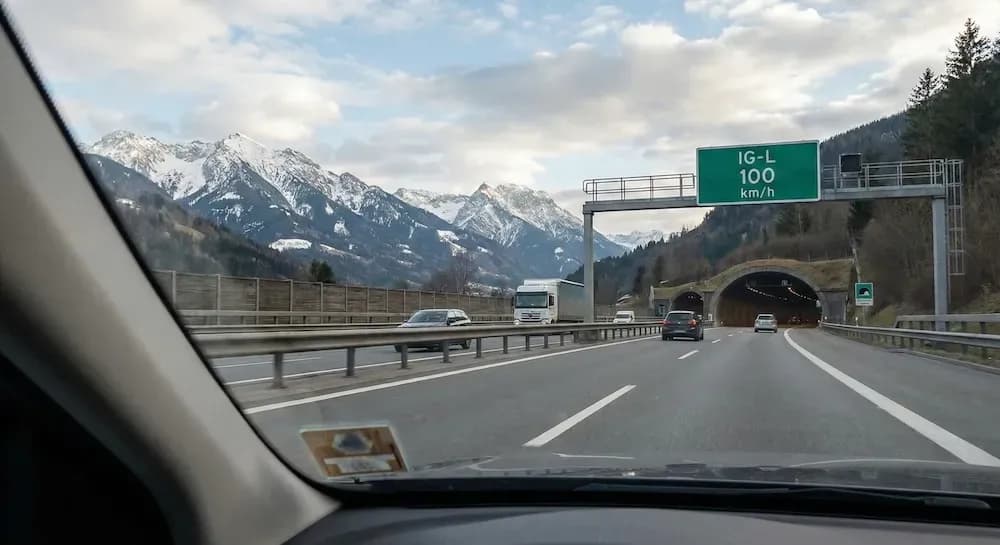
Traveling through Tyrol or the vicinity of Salzburg, you will see speed limit signs with the addition IG-L (Immissionsschutzgesetz-Luft). These indicate an air pollution control zone.
Why is IG-L dangerous for your wallet?
- High penalties: Speeding in an IG-L zone is not treated as a regular traffic offense, but as an environmental crime. Fines are several times higher than standard.
- No tolerance: Speed cameras in these zones are set very strictly.
- Electric cars: Owners of electric cars (with green license plates) in some IG-L zones are exempt from restrictions and can travel faster (usually 130 km/h instead of 100 km/h).
5. Planning a longer journey? Check neighbors' vignettes
Austria is rarely the only travel destination. If you are going further south in Europe, remember that most of Austria's neighbors also require electronic vignettes. In our service, you can buy them all in one order:
- Czech Republic: Traveling from Poland, you usually cross the border in Ostrava or Gorzyczki. Check vignettes for the Czech Republic.
- Slovenia: Essential on the way to Croatia. Remember that a Slovenian vignette is required even for a short stretch of road leading to the border. See vignettes for Slovenia.
- Hungary: An alternative route to the south. Buy vignettes for Hungary.
- Slovakia: A route often chosen by drivers from eastern Poland. See vignettes for Slovakia.
6. Mandatory equipment and dashcams
Austrian police are very meticulous. In the car, you must have:
- A reflective vest for the driver (in the cabin, not in the trunk!). Vests for all passengers are recommended.
- Warning triangle.
- First aid kit (in a solid box, not a plastic bag).
Attention to dashcams (car cameras): Austria has very strict data protection regulations. Using cameras "just in case" is risky. Publishing footage showing someone's license plate or face can result in a high fine.