
Weight Points in Austria - where will they weigh your vehicle? [Map + Fines]
Weight Points in Austria – Where will they weigh your vehicle and what you need to know before traveling?
Are you traveling to Austria by bus, camper, or delivery van? Or perhaps you're planning a longer transit to southern Europe? Besides the obligation to have a valid vignette, you must prepare for one of Europe's most rigorous controls – vehicle weight control. The Austrian system of weighing points (both stationary and hidden in the asphalt) is merciless towards overloaded vehicles. See where in Austria your vehicle will most often be weighed, how modern systems work, and how to avoid vacation-ruining fines.
Table of Contents
- 1. Why is Austria so strict about vehicle weight?
- 2. Who is most often subject to weight control in Austria?
- 3. GVW and road tolls – what connects weight with vignettes?
- 4. How do weighing points work in Austria? (VKP and WIM)
- 5. Where are the main stationary weighing points (VKP) in Austria located? [Road Map]
- 6. Penalties for vehicle overloading in Austria
- 7. What to do if stopped and found to be overloaded?
- 8. Campers and vans up to 3.5t – targeted by authorities
- 9. Summary and tips before departure
- 10. Frequently Asked Questions (FAQ) – Weighing in Austria
1. Why is Austria so strict about vehicle weight?
Austria, due to its Alpine location, has one of the most demanding and expensive to maintain motorway networks in the world. There are more tunnels, viaducts, bridges, and steep ascents here than in most European countries. For this reason, the company ASFINAG (responsible for motorways) and the Austrian police (Polizei) are very strict about regulations concerning Gross Vehicle Weight (GVW).
An overloaded vehicle is not just a hazard in the form of extended braking distances on mountain descents. It is primarily an enormous burden on the infrastructure. Studies show that one heavy goods vehicle overloaded by 20% wears out the road surface to the same extent as thousands of passenger cars. For this reason, over recent years, Austria has invested tens of millions of euros in state-of-the-art weighing systems, becoming a European leader in catching "heavy" road offenders.
2. Who is most often subject to weight control in Austria?
Although technically any vehicle can be weighed, the authorities in Austria have strictly defined priorities. If you are driving a regular passenger car (sedan, station wagon, hatchback) with your family on board, the chance of being directed to a weigh station is close to zero. Who, then, should be on their guard?
- Delivery vans and buses (so-called panel vans and tarpaulins) up to 3.5t: This is the highest risk category. Transport companies often use vehicles up to 3.5t to avoid tachographs and tolls, leading to drastic overloading. Austrians are fully aware of this.
- Campers (RVs) and recreational vehicles: Caravanning tourism is booming, and most popular campers have a GVW of 3.5t. After loading the family, bicycles, a full water tank, gas cylinders, and luggage, a huge proportion of these vehicles exceed the allowed weight even before leaving home.
- Vehicles with trailers (light and heavy): Holiday trips with a boat, car trailer, or large caravan are a guaranteed "scan" in the eyes of Austrian patrols.
- Heavy goods vehicles over 3.5t (lorries): Are subject to systematic, routine checks at main control points.
Many drivers forget that when entering Austria, for example, from the Czech Republic, they encounter a different specificity of how services operate. While checks also occur in the Czech Republic (where vignettes for the Czech Republic will be useful), in Austria, the system is automated to an unprecedented extent.
3. GVW and road tolls – what connects weight with vignettes?
Vehicle weight is not only a matter of safety but also a basic criterion for dividing road toll systems in Austria. The boundary that determines everything is the Gross Vehicle Weight (GVW) of 3500 kg (3.5t).
Vehicles up to 3.5t (inclusive)
Require a standard time-based vignette (1-day, 10-day, 2-month, or annual). The vignette comes in the form of a sticker on the windshield or an increasingly popular digital (electronic) vignette, linked to the license plate number. If your bus or camper's registration document states a GVW of up to 3.5t, you must buy an Austrian vignette.
Vehicles over 3.5t
Vignettes do not apply here. Every vehicle (even a large private camper, e.g., built on a bus chassis), whose GVW exceeds 3500 kg, must be equipped with an on-board unit GO-Box. Tolls are collected electronically for each kilometer driven using microwave gantry systems.
Beware of the trap! What happens if you have a car with a GVW of 3.5t (you bought a vignette), but you load it so that it weighs, for example, 3900 kg? In this case, the fine only concerns "overloading." Austrians base their assessment on the entry in the registration document (field F.1 and F.2), which specifies the maximum weight. Nevertheless, exceeding the weight limit is severely penalized, as we describe later in the article.
4. How do weighing points work in Austria? (VKP and WIM)
If you think you can bypass the weigh station by pulling into a gas station the moment you see a police car, you are mistaken. Austria uses a three-stage system for verifying vehicle weight:
A. WIM (Weigh-In-Motion) System – Weighing in motion
This is the invisible enemy of overloaded vehicles. WIM is an advanced system of piezoelectric sensors built directly into the motorway surface (often near gantry structures). When you drive over these sensors at motorway speeds (e.g., 130 km/h), the system calculates the pressure on each axle and sums the total weight in a fraction of a second. Then a camera reads your license plates (ANPR). If the system detects that a bus or camper is significantly heavier than the average assigned weight for that vehicle type, the information is immediately sent to patrols located a few kilometers away. You are detected before you even realize you have been weighed.
B. Stationary traffic control points (Verkehrskontrollplätze - VKP)
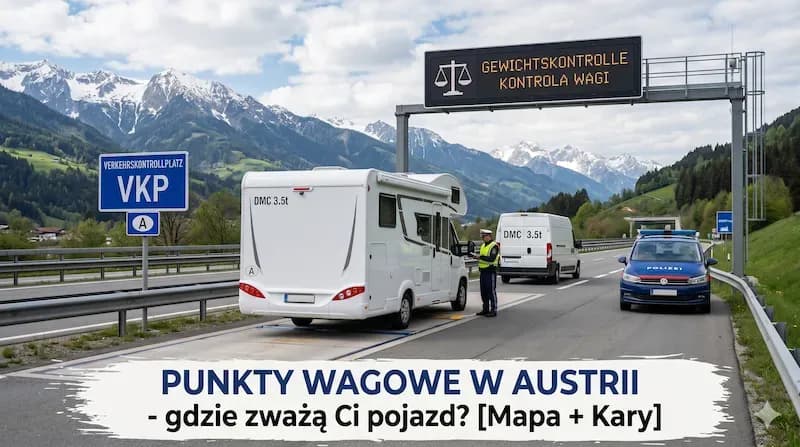
These are huge, dedicated areas (resembling rest stops) built exclusively for vehicle inspections. They are located along major motorways. They feature integrated, highly precise drive-on scales with calibration certificates, equipment for emission control, inspection pits for checking technical condition, and office spaces for handling fines. When a VKP is "active," illuminated signs on the motorway direct selected vehicles (often all vans, campers, and trucks) to exit directly to the control area. Bypassing this exit incurs a gigantic fine and a pursuit.
C. Mobile patrols with weighing scales (Radlastwaagen)
Both ASFINAG and the Austrian Polizei have patrol cars equipped with thin, portable weighing mats. They can stop you in any parking lot, gas station (e.g., when you stop to check a map before the border, before continuing your journey using vignettes in Slovenia or Italy) and order you to drive onto these mats. The process takes 5 minutes.
5. Where are the main stationary weighing points (VKP) in Austria located? [Road Map]
Austria has a dozen ultra-modern stationary control points (VKP). They are strategically located at the most important transit hubs. If you are traveling through Austria, you will most likely pass at least one of them.
| Motorway | Name / VKP Location | Direction and characteristics |
|---|---|---|
| A1 Westautobahn | Haag | Direction Salzburg/Linz. One of the largest points in the country. Very frequent controls of vans coming from Eastern Europe. |
| A1 Westautobahn | Kematen an der Ybbs | Direction Vienna. Advanced diagnostic stations. |
| A1 Westautobahn | Enns | Handles traffic to and from Germany. Often catches tourists returning from holidays. |
| A2 Südautobahn | Ilz | Direction Vienna, an important point for those returning from Slovenia and Italy. Frequent post-holiday camper checks. |
| A2 Südautobahn | Hönigsberg | Southern Austria, a very critical Alpine section. |
| A4 Ostautobahn | Bruck an der Leitha | Direction to/from Hungary and Slovakia. When passing shortly after purchasing vignettes for Slovakia, expect increased surveillance. |
| A8 Innkreisautobahn | Kematen | Route to Passau (Germany). Huge transit traffic, daily weigh checks. |
| A9 Pyhrnautobahn | Straß in Steiermark | Near the border with Slovenia. A key point before or after the famous Bosruck and Gleinalm tunnels. |
| A10 Tauernautobahn | Kellerberg | Route to Villach/Italy. Due to long tunnels and descents (e.g., Katschberg), ASFINAG rigorously ensures that overloaded vehicles posing a fire hazard do not enter here. |
| A10 Tauernautobahn | Kemmelbach | Additional control point towards Salzburg. |
| A11 Karawankenautobahn | Rosenbach | Before entering the Karawanken Tunnel, connecting Austria with Slovenia. |
| A12 Inntalautobahn | Kundl / Radfeld | Both points are located close to each other on the key route along the Inn River, on the border with Bavaria and the route to the Brenner Pass (Italy). An area with the strictest ecological (IG-L) and weight regulations. |
6. Penalties for vehicle overloading in Austria
The Austrian fine schedule is designed to effectively deter drivers from trying to cut corners. Penalties for overloading depend on the percentage by which the GVW is exceeded. Important: unlike in Poland or Germany, in Austria, the **tolerance for measurement error is minimal**.
Typically, 0 to 2% (depending on the type of scale used) is deducted from the weighing result for measurement error. Everything else is treated as overloading.
Example fine schedule for overloading (vehicles up to 3.5t):
- Exceeding by up to 2%: Sometimes results in a warning, but the officer may impose a fine of approx. 30 - 50 EUR.
- Exceeding by 2% to 5%: Fines start to increase. Expect a fine of 90 - 150 EUR.
- Exceeding by 6% to 10%: This is where seriousness begins. Fines range from 150 to even 300 EUR.
- Exceeding by over 10%: This is treated as a blatant violation of safety regulations. Fines start at 350 EUR and can easily reach 1000 EUR, and in extreme cases (e.g., a vehicle up to 3.5t weighing 5 tons) even 5000 EUR.
Attention! Fines can be double! It should be noted that a fine can be imposed on the driver (for creating a road hazard) and on the vehicle owner / transport company (administrative proceedings for violating KFG - Kraftfahrgesetz regulations). Therefore, in the case of commercial transport, the total costs of an "incident" are enormous.
7. What to do if stopped and found to be overloaded?
The scenario where you are directed to a weigh station on an Austrian motorway and the display shows a red number significantly above your GVW (e.g., 4100 kg for a 3.5t camper) is stressful. Here's what you can expect:
- Immediate payment of the fine: Austrian police usually require payment on the spot (they are often equipped with payment terminals). If you refuse or do not have the funds, they may seize a valuable deposit (e.g., electronic equipment), and in the worst case, detain the vehicle until payment is made.
- Prohibition of further travel (Zwangsentladung - forced unloading): This is the most painful element of the control. The police will not let you leave the control point until the vehicle's weight returns to normal. Paying the fine does not grant permission to continue your journey!
- Need for unloading: You must get rid of excess baggage. In the case of delivery vans, this means calling a second van from the company and reloading the goods (which generates costs and delays).
- What do campers do? If you are a tourist in an overloaded camper, you must improvise. This often ends with dumping clean (and grey) water into drains at the rest stop, leaving behind boxes of food, tools, and sometimes even... ordering a taxi for some passengers and their heaviest suitcases to cross the border.
8. Campers and vans up to 3.5t – targeted by authorities
Why have Austrian authorities singled out vehicles in the "B" category (up to 3.5t)? The reason is simple – these vehicles exhibit the greatest disproportion between their physical load capacities and legal regulations.
A typical tarpaulin van (often colloquially called an "International Van"), especially with an added sleeping cabin, lift, and reinforced suspension (so-called leaf springs and air bags), can weigh 2800 kg "empty" itself. Legally, it can only carry 700 kg of goods. Physically, it carries 2 tons, weighing almost 5 tons. For road infrastructure (especially Alpine bridges) and the safety of others, this is a deadly threat – brakes in vehicles up to 3.5t are not designed for a mass of 5 tons descending a 10% grade from the Brenner Pass.
Similarly with campers (so-called semi-integrated and integrated). The unladen weight of such a vehicle is often 3100 kg. 4 people, a full water tank (100L = 100kg), electric bicycles (50kg), luggage, provisions, camping equipment, and an awning – all this easily adds another 600-700 kg. A holiday trip quickly turns into a financial nightmare at the first ASFINAG control point, e.g., in Haag or Kundl.
9. Summary and tips before departure
Austria has every right to protect its mountain motorways and rigorously enforce road traffic law. The WIM (Weigh-In-Motion) system and the network of stationary VKP points make driving through this country in an overloaded vehicle a game of Russian roulette, where the chances of winning are close to zero.
Remember the two fundamental pillars of safe travel through Austria:
- Road tolls: Regardless of physical weight, make sure you have settled your tolls according to your vehicle's registration document. For vehicles up to 3.5t (F.1 / F.2 in the document), a vignette is mandatory – do it online by visiting the Vignettes Austria page. For vehicles over 3.5t – you must obtain a GO-Box before crossing the border.
- Physical weight: Never exceed the maximum total weight specified by the vehicle manufacturer and entered in the registration document. Pack wisely, empty water tanks before transit travel with a camper, and avoid "forcing" pallets into a van.
A safe, stress-free journey over Alpine viaducts with a correctly packed and tolled vehicle is a guarantee of a successful holiday or smooth transport without detriment to your household (and company) budget.
10. Frequently Asked Questions (FAQ) – Weighing in Austria
1. Are there weigh stations for passenger cars in Austria?
Physically, every VKP point and the WIM system on the motorway reads and analyzes the weight of every passing vehicle, including passenger cars. However, in practice, the police focus on high-risk vehicles (delivery vans, heavy goods vehicles, campers, vehicles with trailers). Overloading a typical station wagon or SUV (e.g., 5 people and a full trunk) rarely constitutes a reason for immediate redirection to a stationary point.