Pay for your vignettes online and be sure that everything is handled for you Order conveniently and securely
Winiety24.eu
16.03.2026
Back to article list

Winter Tires in Switzerland 2026: Regulations, Fines, and Tips

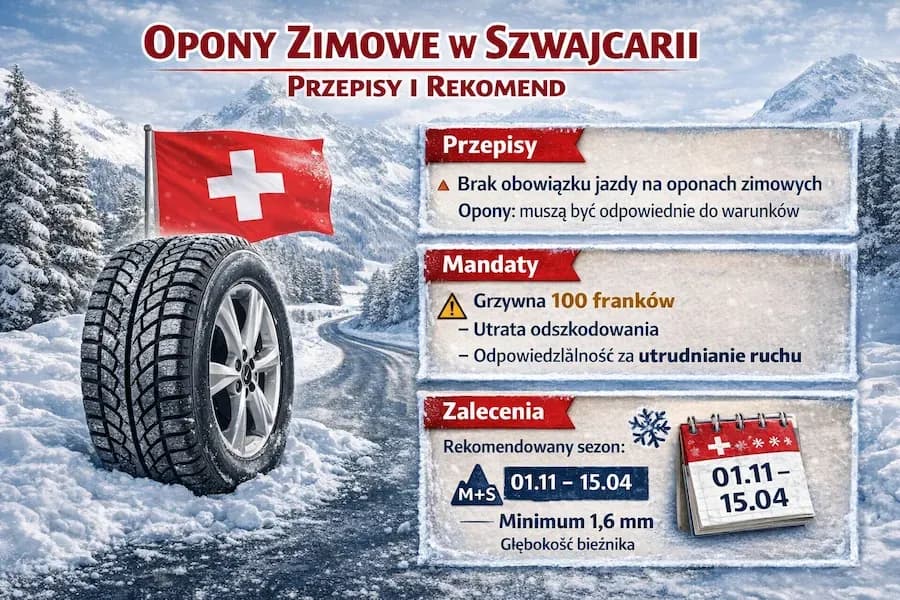
A car winter tire on a snowy road with the Swiss flag and winter tire regulations for Switzerland.

Winter Tires in Switzerland: Regulations and Guidelines 2026

Expert guide on driving in the Swiss Alps in winter conditions.

Switzerland, although associated with a harsh alpine climate, has some of the most specific winter tire regulations in Europe. Unlike neighboring Germany or Austria, there is no strict, calendar-based obligation to use winter tires in Switzerland. The responsibility for the technical condition of the vehicle rests entirely with the driver, which, however, entails very severe financial consequences in the event of deficiencies.

General rule in Switzerland:

Situational obligation

No specific dates, but the driver must ensure full vehicle control in all conditions.

Are winter tires mandatory?

Formally – no. Practically – yes. According to Swiss road traffic law, the vehicle must be technically sound and prepared for the prevailing road conditions. If you drive on a snowy road with summer tires, you are breaking the law because your car does not ensure safety for you or other road users.

Key fact: If due to a lack of winter tires you block a road or cause a collision, you will be fined a very high amount, and your insurance company may completely refuse to pay compensation.

Technical Requirements – Standards 2026

Although the regulations are flexible regarding deadlines, they are very strict regarding tire quality:

1. Tread depth – Recommended 4 mm

The legal minimum in Switzerland is 1.6 mm (same as for summer tires), but the Swiss police and motoring organizations (like TCS) unequivocally state that a winter tire with a tread depth of less than 4 mm is not suitable for safe driving in the mountains. In the event of a road incident, having a tread depth below 4 mm is treated as an aggravating circumstance.

2. Tire markings

Fully effective winter tires are considered those with the 3PMSF symbol (a snowflake on a three-peak mountain). Tires with only the M+S marking are acceptable, but in difficult high-mountain conditions, they may not provide sufficient traction required by local services.

ItemRegulation / RecommendationConsequence of lack
DeadlineNone (recommended X-IV)Risk of fine in snow
Min. tread1.6 mm (recommended 4 mm)Loss of insurance (regress)
ChainsMandatory with signFine approx. 100 CHF

Snow chains: Sign "Chaînes à neige obligatoires"

In Switzerland, snow chains are crucial. A blue, round sign with a tire symbol in chains means an absolute obligation to install them on at least two drive wheels. This also applies to 4x4 vehicles, unless a sign below indicates otherwise ("4x4 except").

Fines and insurance

Switzerland is known for having some of the highest fines in the world. Penalties are often dependent on the driver's income, but standardized fines for tires are also severe:

  • Blocking traffic due to improper tires: approx. 80 - 150 CHF + towing costs.
  • Driving on summer tires in snow: fine and risk of vehicle impoundment.
  • Insurance recourse: This is the biggest risk. If you cause an accident with summer tires in winter, the insurer will pay compensation to the injured parties, but will demand reimbursement of the full amount from you (this can be hundreds of thousands of francs).

Knowledge for Drivers

Before you hit the road, check out the latest posts on our blog! You'll find practical advice on buying electronic vignettes, current fuel price information, travel planning tips, and many other topics that will help you save time and money.

Loading...