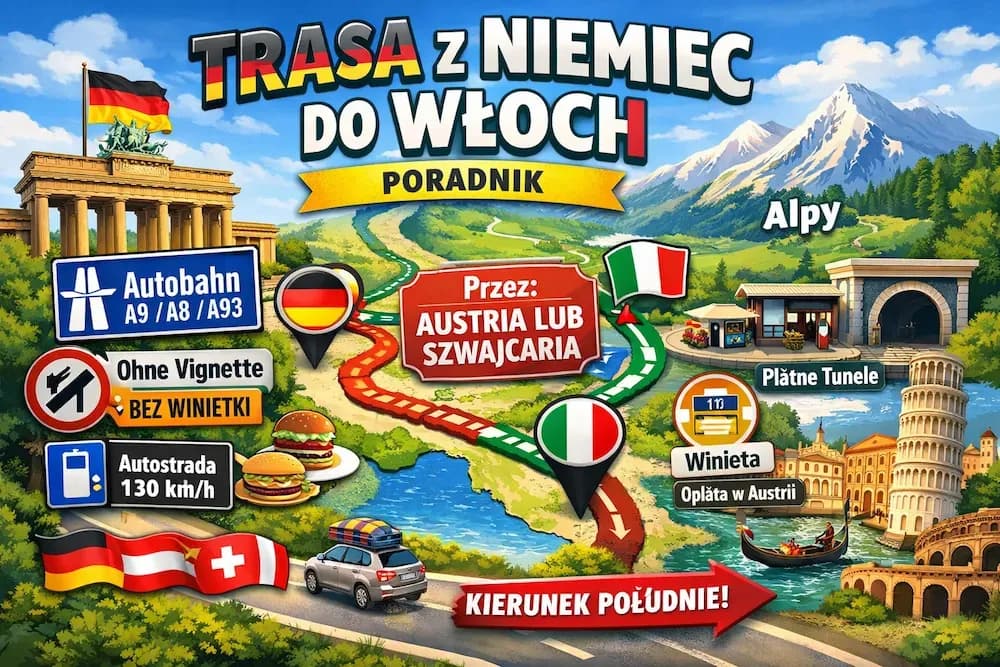
Traveling from Germany to Italy is one of the most popular holiday routes in Europe. It crosses the picturesque Alps, leading through charming landscapes of Austria or Switzerland, before reaching the warm heart of Italy. For a smooth journey without unpleasant surprises, it is crucial to understand the toll system and choose the optimal route. In 2026, no revolutionary changes were introduced, but it is worth refreshing your knowledge to avoid fines and unnecessary costs.
Vignettes and road tolls on the route from Germany to Italy 2026
Traveling from Germany to Italy, you will have to pass through at least one transit country that requires tolls for using motorways. The two most commonly chosen options are through Austria or through Switzerland. Each of these routes involves different requirements for vignettes and additional tolls.
Route through Austria: Vignettes and additional tolls
Austria is the most frequently chosen transit country due to its well-developed motorway network and relatively simple rules. An e-vignette system is in place here, which can be easily purchased online, for example, on Winiety24.eu. Remember that in Austria, in addition to the vignette, there are also additional tolls for using selected road sections and tunnels.
E-vignette Austria 2026
Electronic vignettes are mandatory for all vehicles up to 3.5 tonnes, including passenger cars and motorcycles, traveling on motorways (marked with the letter A) and expressways (marked with the letter S).
Types of Austrian vignettes 2026:
- 10-day: Ideal for a short holiday or a single trip.
- 2-month: A good option for longer stays or more frequent travel.
- Annual: Most cost-effective for those regularly traveling through Austria.
Buy your vignette in advance to avoid problems at the border. Remember the 18-day consumer protection period (if you buy a vignette as a private person). If you need immediate validity, indicate this in the purchase form with the seller.
Additional tolls for travel in Austria:
Regardless of the vignette, additional tolls (so-called Mautstrecken) are charged for using certain road sections and tunnels. The most important ones on the route to Italy are:
- A13 Brenner Motorway (Brenner Autobahn): This is a key section connecting Austria with Italy via the Brenner Pass. It costs approximately 11.50 EUR for a passenger car (in 2026). You can pay in cash, by card, or use the digital toll ticket option (Flex-Maut), which is activated online.
- Arlberg Tunnel (S16 Arlberg Schnellstraße): If you plan to travel through western Austria, e.g., towards Switzerland, and then to Italy, this tunnel will require an additional toll (approx. 11.50 EUR).
It is always worth checking current prices before traveling, as they may change slightly.
Route through Switzerland: One vignette, high price
Switzerland is an alternative route, often chosen by people traveling to north-western Italy, e.g., to Milan or Lake Maggiore. In Switzerland, only one type of vignette is valid – the annual vignette.
Vignette Switzerland 2026
The Swiss vignette is mandatory for all vehicles up to 3.5 tonnes. It is only available as an annual vignette and is significantly more expensive than its Austrian counterpart (approximately 42 EUR/40 CHF in 2026). If you only plan a single trip, this can be a costly option.
Important information about Swiss vignettes:
- Annual only: There are no short-term vignettes (one-day, weekly, monthly).
- Validity period: Valid from December 1st of the preceding year to January 31st of the following year (i.e., the 2026 vignette is valid from 01.12.2025 to 31.01.2027).
- E-vignette: Since 2023, an e-vignette is also available, which can be purchased online. It is assigned to the license plate number, eliminating the need for sticking.
Additional tunnel tolls in Switzerland:
The Swiss vignette covers most roads, but there are two tunnels that require an additional toll:
- Gotthard Road Tunnel (Gotthard-Strassentunnel): The vignette is sufficient.
- Great St. Bernard Tunnel: Connects Switzerland with Italy, but it is a private tunnel that requires an additional toll (approximately 31 EUR one way for a passenger car).
- Munt la Schera Tunnel: Connects Switzerland with the Italian town of Livigno. The toll depends on the season and day of the week (approx. 20-30 EUR).
Choosing the route through Switzerland is often more expensive, but it offers spectacular views and can be faster if your destination in Italy is further west.
Road tolls in Italy 2026
Italy, like many European countries, uses a system of toll motorways (Autostrade). There are no vignettes here – tolls are collected at toll booths or through electronic systems.
Types of toll systems in Italy:
- Closed system (Sistema chiuso): The most popular. The toll is collected at the exit gate based on the distance traveled. A ticket is taken upon entering the motorway.
- Open system (Sistema aperto): Less common. A fixed toll is collected at entry or exit gates, regardless of the distance traveled (e.g., around large cities).
- Free Flow: Few sections (e.g., A36, A58, A59). The system monitors license plates, and drivers must pay the toll online within 15 days.
Payment methods on Italian motorways:
- Cash: The simplest method, accepted at all toll booths.
- Credit/debit card: Accepted in specially marked lanes.
- ViaCard: A prepaid card available at petrol stations and motorway service points.
- Telepass: An electronic system (transponder) for regular travelers, enabling automatic payments without stopping at toll booths.
Motorway costs in Italy vary and depend on the length of the route and the type of vehicle. For example, traveling from Brenner (Austrian border) to Verona costs approximately 12-15 EUR for a passenger car.
Best routes from Germany to Italy – suggestions for 2026
The choice of route depends on your starting point in Germany and your destination in Italy. Below we present the most popular and efficient options.
1. Route through Austria (Brenner Pass) – Most popular
For whom: Travelers from southern Germany (Munich, Nuremberg) to northern and central Italy (Verona, Bologna, Tuscany, Rome).
Route details:
You depart from Germany (e.g., Munich) and head south on the A8/A93 motorway towards Kufstein/Innsbruck. Then you enter the Austrian A12 motorway, and then the A13 (Brenner Autobahn), which leads through the famous Brenner Pass directly to Italy (A22 Brennerautobahn).
Advantages: The fastest and most direct route. Well-maintained roads, spectacular Alpine views, many places to stop. The Austrian vignette is cheaper than the Swiss annual one, and the additional toll for Brenner is a one-time fee.
Disadvantages: Can be very busy during the season, especially around Innsbruck and on the Brenner itself. Requires purchasing an Austrian vignette and paying the toll for the Brennerautobahn.
Remember: If you are traveling from Munich, you can consider an alternative route via the Felbertauernstraße (A12, then B108) or the Grossglockner High Alpine Road. These are scenic roads, but they require additional tolls and are slower.
2. Route through Austria (Reschen Pass/Timmelsjoch) – Scenic alternative
For whom: For those looking for an alternative to Brenner and wanting to admire the Alps, traveling to northern Italy (Dolomites, South Tyrol).
Route details:
From Germany, you head to western Austria, and then south. The Reschen Pass or Timmelsjoch (Passo del Rombo) are picturesque roads that connect Austria with the Italian South Tyrol.
Advantages: Unforgettable views, less crowded than Brenner, unique mountain experiences.
Disadvantages: Expensive tolls (especially Timmelsjoch), roads are winding and slower. Passes may be closed in winter. An Austrian vignette is still required.
3. Route through Switzerland – to western Italy
For whom: Travelers from western Germany (Stuttgart, Freiburg) to north-western Italy (Milan, Turin, Lake Como/Maggiore).
Route details:
From Germany (e.g., Stuttgart) you head towards Basel, and then through Switzerland (e.g., via the Gotthard Tunnel or passes such as Simplon or Bernardino). Then you enter Italy, often near Milan.
Advantages: Direct route to western Italy, opportunity to admire the beauty of Switzerland.
Disadvantages: Obligation to purchase an expensive annual Swiss vignette, additional tolls for some tunnels (e.g., Great St. Bernard). Roads in the Alps can be challenging for less experienced drivers.
Practical tips before traveling to Italy 2026
For your trip from Germany to Italy to go smoothly, it's worth remembering a few key aspects.
Car preparation
- Checking technical condition: Brakes, tires (especially important in the mountains), fluid levels.
- Mandatory equipment: In Germany and Austria/Switzerland, as well as in Italy, a reflective vest, warning triangle, and first aid kit are required. In Italy, it is also recommended to have a fire extinguisher, but it is not mandatory for passenger cars.
- Tires: During the winter period (from November 1st to April 15th) in Austria and some regions of Italy (e.g., in the Alps), winter tires or snow chains are mandatory.
Documents
- Driver's license: Valid Polish driver's license is accepted.
- Vehicle registration document: Current.
- Third-party liability insurance: Green Card is not mandatory, but it is worth having.
- Passport/ID card: Valid identification document.
- Vignette purchase confirmation: Keep the PDF or e-vignette confirmation.
On the road
- Speed limits: In Germany, often no limits on motorways (recommended 130 km/h), in Austria and Italy 130 km/h (on some sections 110 km/h in rain), in Switzerland 120 km/h. On roads outside motorways: 100 km/h (Austria), 90 km/h (Switzerland, Italy), 50 km/h in built-up areas.
- Fuel prices: Fuel in Italy is more expensive than in Germany and Austria. It is worth filling up in Austria before entering Italy.
- Lane usage: Italians often use the left lane to overtake and then return to the right. Be vigilant!
- Breaks: Plan regular breaks every 2-3 hours, especially for long journeys.
Alternative routes and scenic passes
If you have more time and want to admire the Alpine views without rushing, consider driving through some of the picturesque passes. Remember, however, that these roads are slower, often winding, and may be closed in winter.
- Timmelsjoch Pass (Passo del Rombo): A spectacular route connecting the Austrian Ötztal valley with the Italian Passeiertal. High tolls, but breathtaking views.
- Grossglockner High Alpine Road: One of the most famous scenic roads in Austria, leading to Austria's highest peak. Requires a high toll, but it's an unforgettable experience. Can be part of the route if you're traveling to eastern Italy.
- San Bernardino Pass (Switzerland): An alternative to the Gotthard Tunnel, offering magnificent views, but a slower journey.
Summary and recommendations
Planning a route from Germany to Italy requires considering vignettes, tunnel tolls, and motorway tolls. The most frequently chosen route is through Austria (Brenner), which is the most efficient in terms of time and cost, especially if you buy an e-vignette online in advance.
Key points to remember:
- Vignettes: Always buy an Austrian or Swiss vignette before entering toll roads. You can do this online at Winiety24.eu.
- Additional tolls: Plan for tunnel costs (Brenner, Arlberg, Great St. Bernard) and Italian motorways.
- Preparation: Check your car and documents.
- Safety: Drive carefully in the mountains and on motorways.
We wish you a pleasant and safe journey to sunny Italy! Enjoy the Alpine landscapes and Italian atmosphere!