Czech Police Seize License Plates – What About Leased Cars? Regulations 2026
Seizure of Polish License Plates by Czech Police – Leasing, No Inspection, and New Regulations 2026
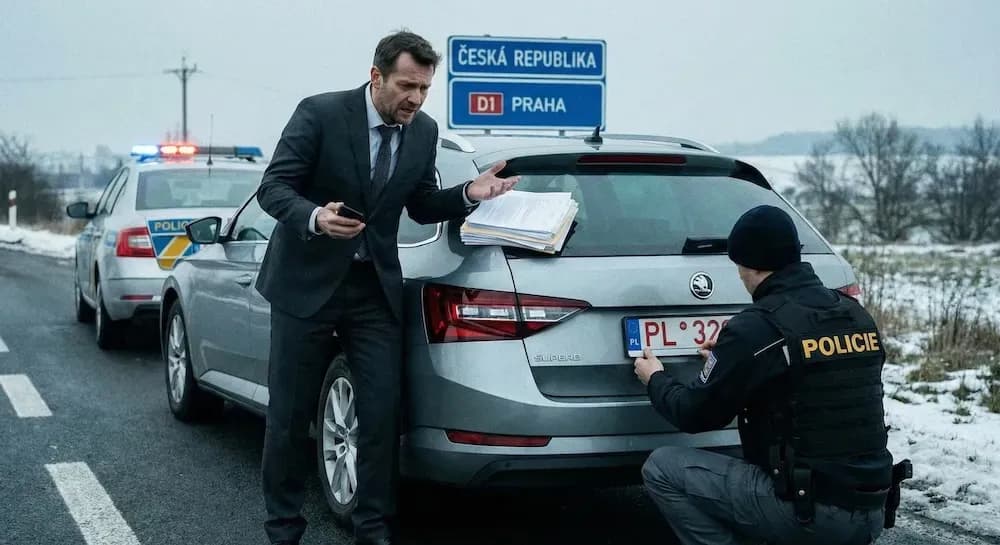
The scenario sounds like a nightmare: a family ski trip or a business trip to Prague ends up on the shoulder of a Czech highway. But the police officer doesn't just issue a fine. He reaches for a screwdriver, unscrews the license plates, and announces that the vehicle cannot proceed. Since 2024, Czech authorities (Policie ČR and Celní správa) have drastically tightened regulations. The most affected by this procedure are drivers of leased and company cars. Why? Because recovering plates by an entity that is not the owner of the car on the registration document is a bureaucratic nightmare lasting weeks.
Many Polish drivers mistakenly believe that the "Vienna Convention" protects them from technical restrictions abroad. While this convention regulates vehicle equipment issues (e.g., first-aid kit, fire extinguisher), it does not protect against the consequences of driving a technically unsound or unregistered vehicle. For a Czech officer, the lack of a valid technical inspection stamped in the registration document is equivalent to the vehicle posing a threat. In this article, winiety24.eu experts analyze the procedures, costs, and legal pitfalls that await unprepared drivers in 2026.
Why Do Czechs Seize Polish Plates? Legal Basis
Czech road traffic law has undergone a revolution in recent years. Regulations have been introduced that give the police and customs service (often encountered on highways checking vignettes) a powerful tool: the ability to immediately prevent further travel. This is not about wheel clamping but about physically confiscating license plates and the "small" registration document.
Main reasons you might lose your plates:
- Lack of a valid technical inspection: This is the most common cause. If the validity date of the inspection in the registration document has expired by even one day, the vehicle is considered unroadworthy under Czech law. Explanations like "Poland has a 30-day tolerance" (which is a myth) or "I forgot" don't work.
- Unpaid past fines: The Czech system is airtight. During a routine vignette check, the system scans the plates. If the vehicle or driver has outstanding fines for speeding (even from 2-3 years ago), the police have the right to confiscate the plates until the debt is settled on the spot.
- Visible poor technical condition: Fluid leaks, a cracked windshield in the field of vision, bald tires, or faulty lighting. Czechs are much more sensitive to this than Polish traffic police.
Leased Car – Bureaucratic Trap
Here we come to the core of the problem affecting thousands of Polish entrepreneurs. When the police confiscate license plates from a private individual who owns the car, the procedure is painful but simple: you fix the fault (or get an inspection – more on that below), pay the fine, go to the office (Magistrát) with your ID, and collect the plates.
In the case of leasing, the situation becomes dramatic. Why?
- Driver is not a party: For the Czech office, the owner of the vehicle is a bank or a leasing company (e.g., PKO Leasing, Santander, Arval, etc.). The driver is only a user.
- Plate collection only by owner: To collect deposited plates from the Czech municipal office (the relevant office for the control location), you must present proof of ownership or a notarized power of attorney from the owner.
- Lessor's procedure: Banks don't work on weekends, and the procedures for issuing a power of attorney to collect plates from a foreign deposit take time. They often require certified translations of documents.
In practice, it looks like this: it's Friday evening, you lose your plates on the D1 highway near Brno. The car is towed to the police parking lot (paid). You call the lessor. The helpline is open until 6:00 PM. You wait until Monday. On Monday, the lessor begins the procedure. They must send the authorization by post or courier (the original is often required). Days pass. Parking costs increase. You have to return to Poland, and the car remains in the Czech Republic.
No Inspection in the Czech Republic – Can It Be Done On-Site?
This is another popular question asked by desperate drivers calling the Winiety24.eu hotline. "My inspection expired, the police took my registration. Can I go to a Czech vehicle inspection station (STK) and get an inspection to retrieve my documents?"
The answer is: NO.
A Czech diagnostic station (STK) is not authorized to extend the validity of technical inspections in Polish registration documents. Polish law requires that the inspection be performed at a Polish Vehicle Inspection Station (SKP). This creates a Catch-22:
- You don't have an inspection, so the police took your plates and forbade you to drive.
- To get your plates back, you must show a valid inspection.
- To get an inspection, you must drive the car back to Poland.
- You cannot drive back to Poland because you don't have plates.
The only solution is a tow truck. You must hire a tow truck to take the car to Poland, where you will get an inspection, and then (with the new entry in the document) you must return (by another car) to the Czech office to collect the plates. The costs of such an operation run into thousands of zlotys (a tow truck from deep in the Czech Republic costs around 3000-6000 PLN).
Avoid unnecessary checks
Czech police and customs most often stop cars for vignette checks. Having a valid digital vignette is the first line of defense. Don't give them a pretext to stop you.
Vienna Convention – A Myth That Lulls into Complacency
Many drivers try to argue with Czech police, citing the Vienna Convention on Road Traffic. They argue: "The car is registered in Poland, it meets Polish requirements, you cannot question its condition".
Unfortunately, this interpretation is incorrect in the context of road safety. The Vienna Convention states that police cannot fine for lack of equipment that is not mandatory in the country of registration (e.g., a different type of fire extinguisher), but they have the full right to remove from traffic a vehicle that endangers safety.
Lack of valid technical inspections is treated as a presumption of vehicle unfitness. Without a diagnostician's stamp, the vehicle is, by law, "unfit for traffic." A Czech officer does not have to prove that the brakes are not working. It is enough that the document states that the roadworthiness expired.
Table of Costs and Fines (Simulation 2026)
| Offense Type / Cost | Estimated Amount (CZK / PLN) | Additional Consequences |
|---|---|---|
| Lack of valid inspection | up to 10 000 CZK (approx. 1750 PLN) | Registration document retention, plate removal |
| Driving a technically unsound car | 5 000 - 10 000 CZK | Immediate prohibition of further driving |
| Towing to a deposit parking lot | 3 000 - 5 000 CZK + daily rate | Rate increases with each day |
| Tow truck to Poland (e.g., from Prague) | approx. 4 000 - 6 000 PLN | Market price, no refund from OC/AC* |
| Bail (Kauce) | up to 50 000 CZK | Collected towards future proceedings |
*Most standard Assistance insurances DO NOT cover towing in case of an expired technical inspection. The insurer will refuse to pay benefits.
FAQ – Frequently Asked Questions About Plate Loss
Does the police have the right to unscrew the plates themselves?
Yes. If the driver refuses to remove the plates upon request, the officer has the right to use tools and force to remove them. Resistance may result in an additional fine for non-compliance with orders.
Is a "soft" registration document (temporary) honored in the Czech Republic?
Yes, provided it is valid. A temporary permit ("miękki dowód") is a document authorizing traffic. However, if its validity date has expired, it is treated the same as a lack of inspection.
What is "Kauce" and why do I have to pay it?
If the police officer determines there is a risk that the driver (foreigner) will evade administrative proceedings, they may demand a deposit (Kauce). This is financial security. It often ranges from 5,000 to even 50,000 CZK. If you do not pay the deposit on the spot (cash or card), the police may impound the car.
I have a company car. What documents do I need in the Czech Republic?
In addition to the registration document and third-party liability insurance, we strongly recommend having authorization from the lessor/owner to use the vehicle abroad (translated into Czech or English). Although it is rarely required during routine checks, in a crisis situation (accident, plate confiscation), it is crucial for quick action.
Step-by-step procedure – What to do if your plates are confiscated?
If the worst happens, keep calm. Shouting and arguing with the Czech police will only make things worse.
- Accept the fine and protocol: Refusing to accept the fine results in an administrative court case and the necessity of paying a high bail.
- Ask about the deposit location: Find out exactly which office (Městský úřad or Magistrát) the plates will go to. Ask for the exact address and opening hours.
- Secure the car: If the police do not tow the car, you must secure it off the public road. You cannot leave it on the emergency lane.
- Contact leasing: If the car is not yours, immediately report the matter to the owner. Demand the priority sending of authorization to collect items from deposit.
- Tow truck: If the reason is a lack of inspection, order transport to Poland. Do not count on "negotiating."
Summary – How to prepare?
Traveling in Europe in 2026 requires more attention to formalities than a decade ago. Information exchange systems between countries work instantly, and the police have access to databases on vehicle technical condition.
Your pre-trip checklist:
- Check the technical inspection date in the registration document (stamp section). If it expires during your trip – get the inspection done earlier!
- Check the condition of lighting and tires (tread depth minimum 1.6 mm in summer, 4 mm in winter in the Czech Republic).
- Make sure you have valid third-party liability insurance.
- If you drive a leased car – check if you have permission for foreign travel (some companies require this in their T&C).
- Buy a vignette in advance to avoid being stopped by customs, who will also check the car's condition.
A safe journey is a legal journey. Take care of your documents, and we will take care of your vignettes.