Assistance for Holidays and Long Weekends 2026: Limits, Prices, and Advice
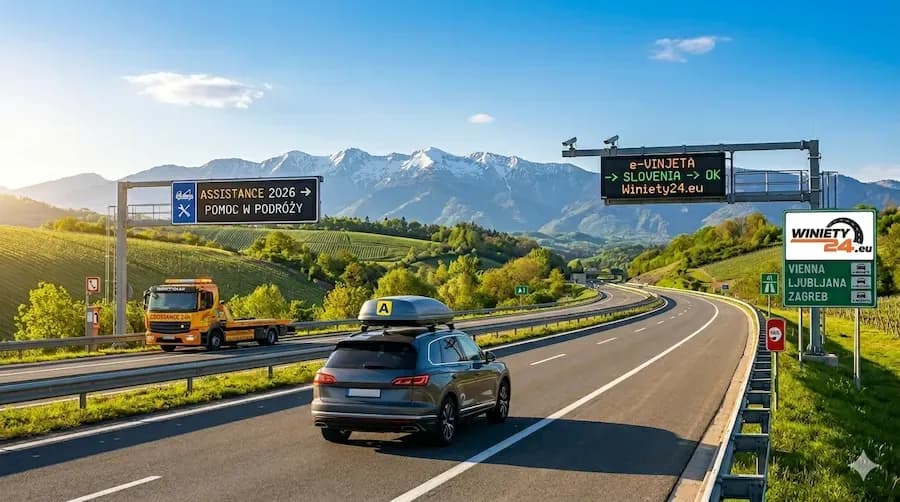
Expert Edition: Season 2026
Assistance Package for Holidays and Long Weekends 2026: Complete Market Analysis
Traveling by car across Europe in 2026 offers freedom but comes with new challenges. From digital toll systems to drastic increases in service costs in the EU – learn how to effectively protect your budget from unforeseen events.
1. The new reality on Europe's roads in 2026
2026 is a moment when technology and economics have strongly influenced how we travel on European highways. Inflation, which has affected the service sector throughout the European Union, has made a **traditional approach to motor insurance insufficient**.
Currently, when passing through transit countries, drivers must contend not only with restrictive regulations but also with enormous technical service costs. For example, a breakdown in the famous Karawanken Tunnel on the Austrian-Slovenian border now involves a rescue procedure, the cost of which starts at four-digit euro sums.
Before you set off, make sure your formalities are perfectly in order. Not only insurance, but also road tolls are crucial. Check the current price list for Slovenia vignettes 2026 and Austria vignettes, to avoid fines, which are automatically generated in digital systems within seconds.
2. Types of assistance packages: What does the market offer?
In 2026, insurers have divided their offers into very precise segments. The choice of the right one depends on the vehicle's age, destination, and the number of passengers.
Basic Variant (Basic)
Usually added free of charge to the third-party liability policy. In 2026, its usefulness abroad is almost zero.
- Towing: only up to 50-100 km.
- Help with tire change (cost of parts covered by the client).
- No replacement car abroad.
Extended Variant (Midi)
Optimal balance between price and scope of protection for trips up to 2000 km from Poland.
- Towing: up to 800-1000 km.
- Replacement car: up to 5 working days.
- Hotel accommodation: up to 2 nights for all passengers.
Premium Variant (Full Europe)
Essential for those traveling to the ends of the continent (Portugal, Greece, Norway).
- Towing: Unlimited kilometers (to place of residence).
- Repatriation of vehicle and passengers.
- Medical assistance and pet care.
3. Anatomy of OWU: Where are the pitfalls hidden?
General Terms and Conditions of Insurance (OWU) is a document that no one reads until they are stuck on the roadside on a rainy night near Munich. In 2026, insurers introduced several new provisions that you should pay attention to:
Monetary limit vs. kilometer limit
This is the most common misunderstanding. Your policy may offer "towing up to 1000 km," but at the same time have a monetary limit of 1500 EUR. In Swiss or Scandinavian conditions, 1500 EUR may only be enough for 200-300 km of towing, considering loading fees and night rates.
Definition of a breakdown
Is a discharged electric car battery a breakdown? In 2026, most Premium policies already treat it as such, but cheaper packages may refuse assistance, considering it an "operational neglect." The same applies to two flat tires at once – make sure your assistance covers such events.
Waiting period – a silent killer of plans
Buying a policy on the day of departure is a huge risk. Most short-term products have a **waiting period of 3 to 7 days**. This means that if you buy a policy on Monday and depart on Wednesday, the insurer may refuse to cover the costs of a breakdown that occurs at the beginning of the journey.
4. Real costs of lacking a policy in 2026
To understand the value of assistance insurance for about 150 PLN, it is worth comparing it with market prices for services in popular holiday countries:
| Country | Towing (highway) | Mechanic's hourly rate | Replacement car (per day) |
|---|---|---|---|
| Austria | 450 - 800 EUR | 120 - 180 EUR | 80 EUR |
| Slovenia | 300 - 600 EUR | 90 - 140 EUR | 60 EUR |
| Germany | 400 - 900 EUR | 110 - 200 EUR | 75 EUR |
| Croatia | 250 - 500 EUR | 70 - 120 EUR | 55 EUR |
Remember that in many countries (e.g., Austria), you cannot call a friend with a tow rope to the highway yourself. You must use licensed roadside assistance, which drastically increases costs.
5. Not just insurance: The digital driver's essential kit
A safe long weekend or holiday in 2026 also means navigating smoothly through a maze of regulations. Europe has moved away from windshield stickers. Currently, everything is based on your license plate number.
When planning a route, e.g., from Warsaw to Split, you must ensure:
- Electronic vignettes: Czech Republic, Slovakia, Austria, and Slovenia – all these countries require registration of your license plate number in the system.
- Operator apps: It's worth having the DARS (Slovenia) and ASFINAG (Austria) apps installed to receive real-time notifications about traffic jams and accidents.
- Green Card: Although a third-party liability policy is sufficient in most EU countries, travel to countries like Albania or Montenegro still requires a physical document.
6. What to do in case of a breakdown? Step-by-step procedure
Stress at the moment of a breakdown on a busy highway is immense. Here's a procedure that can save your life and wallet:
- Secure the scene: Reflective vests for ALL passengers, warning triangle (at least 100m further on the highway).
- Evacuation: All passengers move behind the crash barriers. Never stay in the car on the shoulder!
- Contact the insurer: Call the number from your assistance policy. Do not order a tow truck on your own if you want cost reimbursement!
- Location: Use Google Maps or kilometer markers to precisely provide your position.
Advantages of Short-Term Assistance
- Cost similar to 2-3 coffees at a gas station for peace of mind for 2 weeks.
- No need for foreign language knowledge (you speak with a Polish operator).
- Possibility to continue the journey with a replacement car.
Disadvantages and limitations
- Strict vehicle age limits (often up to 15 years).
- Exclusions for cars with LPG systems in some countries (rare, but happens).
- No protection in countries affected by conflicts or high risk.
Summary: Is it worth it?
In 2026, the question is not "is it worth buying assistance," but "which package to choose." The risk of breakdown with modern, complex electronic systems is higher than ever, and the costs of their repair abroad can ruin a household budget for many months.
Take care of your comfort. Buy insurance, check technical condition, and order vignettes online. Have a safe trip!
Frequently Asked Questions (FAQ)
Does assistance also cover a caravan?
Most standard policies only cover the car. If you are traveling with a caravan, you must purchase a special extension; otherwise, the tow truck will take the car, and the caravan will be left on the highway.
Can I buy assistance for only 7 days?
Yes, the market in 2026 offers 7, 15, and 30-day packages. This is an ideal solution for a long weekend or a short vacation.
Does the insurance work if I run out of fuel?
In extended packages – yes. The insurer will arrange fuel delivery, but you will have to pay the mechanic for the fuel on the spot.
What does "towing to the nearest workshop" mean?
This is the cheapest variant of assistance. It means that the car will not return to Poland but will be taken to a local service center in the country where the breakdown occurred. If the repair takes 2 weeks, you will have to return for it at your own expense.