Brenner Pass & A13 Roadworks 2026: Traffic, Delays & Tips
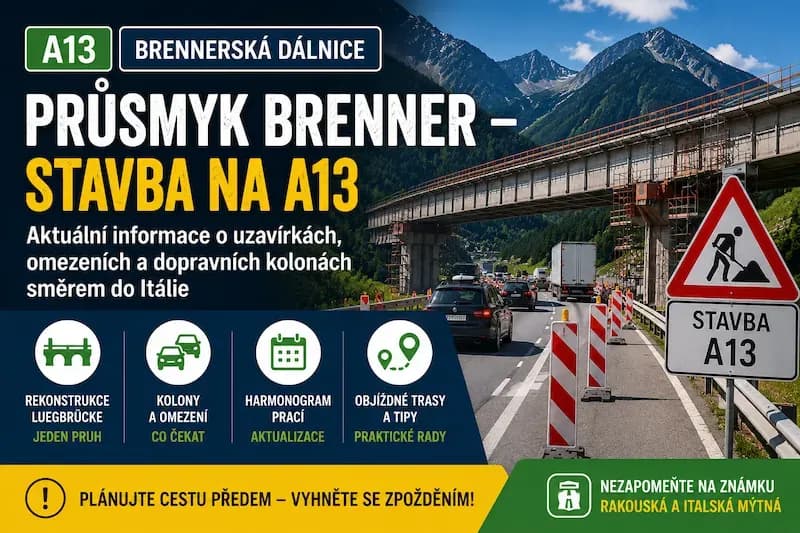
The Brenner Pass and the A13 roadworks in 2026: delays, traffic jams and how to prepare for the drive
The route across the Brenner Pass is one of the most important road connections between Austria and Italy. It is used by drivers travelling from Poland and across Europe to the Dolomites, Lake Garda, Verona, Venice, Tuscany and further south into Italy. In 2026, however, the crossing calls for more careful planning. The single biggest factor is the reconstruction of the Luegbrücke bridge on the Austrian A13 motorway, but work is also underway around Innsbruck and on the Italian side along the A22 motorway.
Why is the route across the Brenner Pass so important?
The Brenner Pass lies on the border between Austria and Italy and has for many years been one of the most important transport corridors in the Alps. On the Austrian side it is reached via the A13 motorway, which begins near Innsbruck. After crossing the border, the road continues as the Italian A22 motorway, running through Vipiteno (Sterzing), Bolzano, Trento and Verona towards Modena.
For anyone driving from Poland it is the natural choice, especially when the destination is northern or central Italy. The route is convenient, well signposted and runs on motorways for most of the way. The problem is that even a small reduction in capacity around the Brenner quickly translates into traffic jams several kilometres long. The narrow Alpine corridor offers few easy detour options, and passenger-car traffic is layered on top of very heavy lorry traffic.
In summer, thousands of holidaymakers' cars are added to the daily flow of freight. The heaviest load occurs during weekend holiday changeovers, before public holidays, at the end of the school holidays in the various countries, and on days when additional restrictions apply to lorries. Some hauliers then try to get through just before a driving ban begins or immediately after it ends, which can also cause a sudden build-up of traffic.
The Luegbrücke bridge reconstruction on the A13 motorway
The single most important project affecting the drive across the Brenner is the construction of the new Luegbrücke bridge. The structure is on the Austrian A13, south of Innsbruck, near the town of Gries am Brenner. The previous structure had been in service for more than half a century and had reached the end of its planned service life. For this reason it became necessary to limit the load on it and to begin a comprehensive reconstruction.
Since 1 January 2025, traffic on the bridge has essentially been reduced to one lane in each direction. This is not a short-term narrowing to repair the road surface, but part of a multi-year project. Drivers should therefore treat the reduced capacity as a permanent feature of the drive across the Brenner in 2026, rather than an occasional inconvenience.
The new crossing is being built in stages so as not to close this key link between Austria and Italy. The first new structure is to take over traffic before the demolition of further parts of the old bridge begins. Ultimately there will be two separate structures, one for each direction. This way of carrying out the work keeps traffic moving, but it requires numerous changes to the traffic layout, speed limits and temporary lane shifts.
What does the reconstruction mean for passenger cars?
Above all, reduced capacity and the risk of a jam forming suddenly. Even when traffic looks free-flowing before the bridge, the queue can come to a halt at the narrowing, while an extra lane is being merged, or after a minor collision.
Why can't two lanes be kept open all the time?
The old structure has to be protected from excessive load. The operator uses a special traffic arrangement and allows a wider cross-section only on specific dates and under set rules.
When two lanes are opened, a system of separating vehicles by weight is used. Heavier vehicles are guided in a way that limits the load on the structure, while lighter vehicles can use an additional part of the carriageway. Drivers should therefore watch the variable-message signs and the overhead lane signage, rather than relying solely on their navigation system.
Extra care is needed when driving a motorhome, a van, a car with a trailer or a large SUV. Lane assignment is determined by the traffic arrangement and the road signs. Do not change lanes at the last moment simply because the neighbouring lane is moving faster. In the roadworks area the lanes are often narrower and the margin for error is much smaller than on an ordinary stretch of motorway.
How is traffic organised on the Luegbrücke in 2026?
ASFINAG publishes an annual calendar for crossing the Luegbrücke. It sets out the days with single-lane traffic, the planned dates for opening two lanes, additional restrictions for heavy goods vehicles and possible traffic-metering measures. The calendar is an important point of reference, but it does not replace checking the situation immediately before you set off.
Conditions can change because of an accident, a breakdown, bad weather, the need for an urgent repair or a greater-than-expected influx of vehicles. Two open lanes do not guarantee a smooth crossing, because narrowings also occur before and after the bridge, and traffic is controlled so as to protect the structure. At high volumes, even a slight slowdown can create a jam several kilometres long.
| Situation | What the driver may encounter | How to prepare |
|---|---|---|
| An ordinary weekday | One lane in each direction, a speed limit, short slowdowns before the narrowing. | Add at least an extra half hour of buffer and check the traffic before Innsbruck. |
| A summer Saturday | Heavy tourist traffic and the possibility of jams several kilometres long on both sides of the pass. | Consider travelling at night, very early in the morning, or changing your travel day. |
| Two lanes open | Greater capacity, but the special split of vehicles and the restrictions still apply. | Choose the correct lane early and follow the signage without exception. |
| An accident or breakdown | The jam builds quickly, exit options are limited and clearing the obstruction takes a long time. | Keep a fuel reserve and water, and don't schedule onward bookings with no margin. |
| A lorry driving-ban period | Fewer lorries during the ban, but a possible build-up before and after it applies. | Check not only the ban hours but also the expected traffic along the whole corridor. |
The Sillbrücke reconstruction at the Innsbruck Süd interchange
The Luegbrücke is not the only structure being rebuilt on the A13. In 2026, the reconstruction of the Sillbrücke bridge near the Innsbruck Süd interchange is also underway. It is a roughly two-hundred-metre structure set high above the valley of the River Sill, on an important part of the approach to the Brenner motorway.
According to the operator, two lanes in each direction are to be available during the main part of the work. That is good news, but drivers may still encounter narrower lanes, a modified carriageway alignment, lower speed limits and short-term works requiring extra protective measures. At peak times, a slowdown at the Sillbrücke may merge with a queue forming further south before the Luegbrücke.
The Innsbruck Süd interchange is also relevant for tolls. Drivers joining the A13 at this point can use the tolled Brenner section without driving on the Austrian A12 motorway. Those reaching the interchange via the A12, however, must remember the requirement to hold a valid vignette for the sections covered by the vignette system.
Roadworks on the Italian side: the A22 Brenner–Vipiteno motorway
After crossing the border, the Austrian A13 becomes the Italian A22. Roadworks and temporary traffic shifts can occur on this section too. In July 2026, the A22 operator reported, among other things, a change of arrangement on the section between Brennero Paese and Vipiteno, where traffic was shifted onto a single carriageway and run in both directions on designated lanes.
This kind of arrangement does not always cause a permanent jam, but it significantly increases the risk of congestion on busy days. The problem becomes particularly noticeable when the queue from the Austrian A13 pushes across the border, or when a collision occurs on the Italian section. You can then clear the Luegbrücke and still get stuck again before Vipiteno.
Further south, roadworks are also being carried out on other parts of the A22. Their location and scope change during the season, so it is not worth basing your plan solely on information read a few weeks earlier. Before setting off, check the announcements from the Autostrada del Brennero operator, the traffic forecast and current road incidents.
The A22 is tolled using a barrier (ticket) system. You take a ticket on entry and pay when you leave the motorway. During heavy traffic, queues can also form at the toll booths, especially if some drivers choose the wrong lane or only start looking for their payment card at the booth. It is worth having your card or cash ready in advance and watching the signs above the booths.
When do the worst traffic jams form on the Brenner route?
The heaviest traffic is to be expected on summer weekends. Heading towards Italy, Saturday mornings and late mornings can be especially difficult, when tourists from Germany, Austria, the Czech Republic, Poland and other countries head south. In the northbound direction, jams often appear on Saturday afternoons and on Sundays, when holiday rentals end and people begin their journeys home.
There is no single hour that guarantees an empty road. Setting off very early in the morning can help, but on popular dates some drivers use the same strategy. Driving at night can be calmer, but you need to allow for possible night-time works, restrictions on heavy vehicles and driver fatigue. Safety matters more than trying to save half an hour.
Higher-risk dates
- the first weekends of the school holidays in Germany, Austria, the Czech Republic and Poland,
- Saturdays at the turn of July and August,
- long weekends and public holidays in Austria, Germany and Italy,
- the start and end days of popular holiday rental periods in northern Italy,
- periods just after a lorry driving ban ends,
- days with heavy rain, thunderstorms or a sudden drop in visibility.
Bear in mind that a jam can start far before the pass itself. From the north, queues form as early as the approach to Innsbruck, on the A12 and before the merge onto the A13. From the south, the slowdown can stretch from Vipiteno towards the border. Navigation information referring only to the "Brenner Pass" point therefore does not show the full picture.
Is it worth avoiding the A13 and the Brenner Pass?
The decision to take a detour should depend on the current situation, the type of vehicle, your starting point and your destination in Italy. Not every detour that looks attractive on the map actually saves time. Local roads in Tyrol are often narrow, pass through towns and can be subject to seasonal restrictions intended to protect residents from through traffic.
The Austrian authorities periodically introduce bans on leaving the motorways for through traffic. Your navigation may suggest leaving the A12 or A13, but a road sign or a police instruction takes precedence over the planned route. Trying to bypass a few kilometres of jam through local villages can end with you being turned back and rejoining the same queue.
The alternative via Salzburg and Villach
Drivers heading to the eastern part of Italy — for example the areas around Venice, Udine, Grado or Trieste — may consider the route via Salzburg, the A10 motorway, Villach and the crossing at Tarvisio. This is, however, an option that depends on your starting point. The A10 also has section tolls and can suffer jams too, especially at the Tauern and Katschberg tunnels.
The alternative via Switzerland
For those heading to western Italy, the route through Switzerland sometimes makes sense. You do need to factor in the cost of the Swiss vignette, possible jams at the Gotthard tunnel and the greater distance. This option is rarely worthwhile purely to avoid a short jam on the A13, but it can be reasonable in the event of very serious disruption and a suitably located destination.
The B182 main road over the Brenner
The B182 road runs parallel to the A13. However, it should not be treated as a reliable way to bypass a jam. It passes through towns, has much lower capacity, and during heavy traffic through-traffic restrictions may apply. After leaving the motorway you may run into even slower traffic and make life harder for the residents of the valley.
The Austrian vignette and the A13 Brenner toll
The A13 Brenner motorway is covered by an Austrian section toll. This means you pay separately to use this stretch. The A13 itself can be used without an Austrian vignette if you join it at the Innsbruck Süd interchange and do not use any earlier sections of motorway or expressway covered by the vignette requirement.
In practice, most drivers travelling from Poland reach Innsbruck via the Austrian motorway network, including the A12, and therefore need both a valid vignette and the section toll for the A13. Before setting off you can buy an Austrian vignette online, entering the correct registration number and the vehicle's country of registration.
Check the details carefully before confirming your order. A digit mistaken for a letter, a missing character or the wrong country of registration can mean that the enforcement system does not recognise your payment. It is worth keeping the purchase confirmation on your phone and also downloading it as a file, so you can access it even with a weak signal.
On the Italian side, the A22 operates a separate toll system. There is no Italian vignette. You take a ticket on entry and pay for the distance actually driven when you leave. If you lose the ticket, the operator may charge a fee according to the rules for travelling without a ticket, so it is best to keep it in a safe and easily accessible place.
How to prepare for the drive across the Brenner in 2026?
Good preparation won't remove the roadworks, but it can reduce stress and the risk of being late. The most common mistake is to plan the route based on the time shown by the map at the moment you plan the trip, with no buffer for jams. When crossing the A13 in summer it is worth leaving a flexible margin, especially if your plans include checking into an apartment, catching a ferry or picking up keys at a set time.
Before you set off
- check the traffic-arrangement calendar for the Luegbrücke,
- look at the latest announcements from ASFINAG and the A22 operator,
- buy the correct vignette and section toll,
- save an alternative route, but don't leave the motorway without confirmation,
- plan refuelling before the busiest section.
In the car
- have water for all passengers,
- charge your phone and take a cable or power bank,
- prepare any regularly taken medication,
- make sure you have a fuel reserve or battery charge,
- don't leave your break until the last moment.
1. Check the situation on the day of departure
Announcements from a week ago may already be out of date. In the morning, check the ASFINAG traffic map, the road cameras and the A22 information. Repeat the check at a stop before Innsbruck. If you have a passenger with you, they can monitor the updates in real time. The driver should not operate a phone while driving.
2. Don't plan to refuel on fumes
In a jam a car burns fuel, and in summer the air conditioning is working as well. Electric cars also use energy to cool the cabin and the drivetrain. It is worth joining the A13 with a suitable reserve. Chargers at popular points may be occupied, so it is better not to make the rest of your journey depend on one specific location.
3. Keep your distance in the narrowings
On the bridges under reconstruction and where traffic is shifted, the lanes are narrower. Driving too close to the vehicle in front increases the risk of a shunt, which can block the entire corridor. Avoid sudden lane changes and let vehicles merge using the zip-merge principle where a lane ends.
4. Form a rescue lane
When traffic slows or stops, drivers in Austria and Italy are required to leave a passage for the emergency services. On a carriageway with two lanes, vehicles in the left lane move as far left as possible and those in the right lane as far right as possible. The rescue lane is formed straight away, not only once you hear a siren.
5. Don't stop where it is not permitted
Stopping on the hard shoulder is allowed only in the event of a genuine breakdown or hazard. Stopping to use your phone, swap drivers or take a photo of the mountains can be dangerous and can hinder the emergency services. Take your break at a car park or a service area.
6. Prepare children for a longer stretch
Travelling with children calls for a bigger buffer. It is worth taking a break before Innsbruck or before joining the A13, so you're not looking for a toilet just as the car gets stuck in a stationary queue. Keep drinks, a light snack and anything needed during a stop within reach, not at the bottom of the boot.
7. Allow for the weather in the Alps
Even in summer, the weather around the Brenner can change quickly. Heavy rain, a thunderstorm and a low cloud base reduce visibility and, with narrowed lanes, call for even greater care. The temperature at the pass can be much lower than in the Po Valley, so for a longer stop it is worth having a light hoodie or jacket in the cabin.
Driving a motorhome, a van or with a trailer
Drivers of larger vehicles should pay particular attention to lane widths and the signage before the Luegbrücke. During the special traffic arrangement, individual categories of vehicle may be directed into specific lanes. The information on the variable-message signs is more important than the suggestions of a navigation app.
Before the trip, check the actual gross vehicle weight of the vehicle and combination. This matters not only for the traffic arrangement on the bridge but also for the level of tolls, restrictions and road obligations. With a motorhome, make sure the load is properly secured. Sudden braking in a jam can shift loose items in the living area.
Driving with a caravan requires a bigger gap and calm manoeuvres. At a narrowing, don't try to overtake just to gain a few places. The time difference will be small, while the risk of contact with a barrier or a neighbouring vehicle is much greater.
What to do in the event of a breakdown on the A13 or A22?
In the event of a breakdown, stop the vehicle in a lay-by or on the hard shoulder if possible, switch on your hazard lights and secure the area in accordance with the regulations. Passengers should leave the car on the side away from traffic and move behind the barrier if it is possible and safe to do so. Reflective vests are best kept in the cabin, not under the luggage.
On a section under reconstruction, the options for stopping may be limited. In a tunnel or on a bridge, use the emergency phone or call 112 and state precisely your direction of travel, the road number and the nearest kilometre marker or a distinctive landmark. Do not walk along the carriageway yourself looking for help.
Before travelling abroad it is worth checking the scope of assistance in your insurance policy. Not every basic service covers long-distance towing, a replacement car, accommodation and help for a caravan. Your insurer's details and policy number should also be available offline.
The Brenner Pass and the A13 roadworks – frequently asked questions
Is the A13 Brenner motorway closed?
No. The route remains passable, but on the Luegbrücke the standard arrangement is one lane in each direction. On selected days additional lanes are opened. The situation can change depending on the works and road incidents.
How much extra time should I allow for the journey?
On a quiet day the delay may be small, while on a summer weekend it can be considerably longer. There is no single figure. It is safer to assume at least an extra half hour of buffer, and at the peak of the season to be prepared for a longer wait.
Is the drive across the Brenner jam-free at night?
Traffic is usually lighter at night, but this is no guarantee. Works requiring additional restrictions may be carried out at night. You also need to take driver fatigue into account and take regular breaks.
Do I need a vignette for the A13?
The A13 itself is covered by a section toll. You can join it at Innsbruck Süd without a vignette, provided you have not previously used the vignette-tolled network. Most drivers coming from Poland, however, use the A12 and therefore also need an Austrian vignette.
Does the A13 toll cover the Italian A22?
No. These are two separate systems. For the Austrian A13 you pay a section toll, while on the Italian A22 you take a ticket and pay for the distance driven when you leave.
Can I avoid the jam using the B182 road?
Not always. The road passes through towns, has lower capacity and may be subject to through-traffic restrictions. Leaving the motorway only makes sense after checking the official announcements and the signage.
Do the roadworks only affect the Luegbrücke?
No. The Sillbrücke bridge near Innsbruck Süd is also being rebuilt on the A13, and on the Italian side further works and traffic shifts are appearing on the A22. Their exact scope changes during the season.
Where can I check the current situation?
The most reliable sources are the current ASFINAG announcements, the cameras on the Austrian motorways, information from the A22 operator and the announcements from the South Tyrol traffic control centre. It is worth comparing these with navigation showing current traffic levels.
Key takeaways before your journey
The route across the Brenner remains open and is still the most convenient connection to many regions of Italy. The Luegbrücke reconstruction, however, means you can no longer plan the crossing without allowing extra time. One lane in each direction, the periodic opening of a second lane, the work at the Sillbrücke and the roadworks on the A22 mean the situation can change from hour to hour.
The best strategy is to choose a less busy date, check the announcements immediately before setting off, fill up the car and prepare your documents and road tolls. Trying to improvise a detour along local roads often brings no savings and can end with you being turned back by the authorities.
Sort out your road tolls before you leave
Driving through the Czech Republic and Austria towards the Brenner Pass? Check the required tolls before you begin your journey. At Winiety24.eu you can order vignettes online, including a Czech vignette and an Austrian vignette. Before buying, make sure you enter the correct registration number, country of registration and the right validity period.
This article is for information purposes only. Traffic arrangements, work schedules and restrictions may change. Before travelling, check the current announcements from the road operators and the signage along your route.