
Digital revolution and errors in 2026
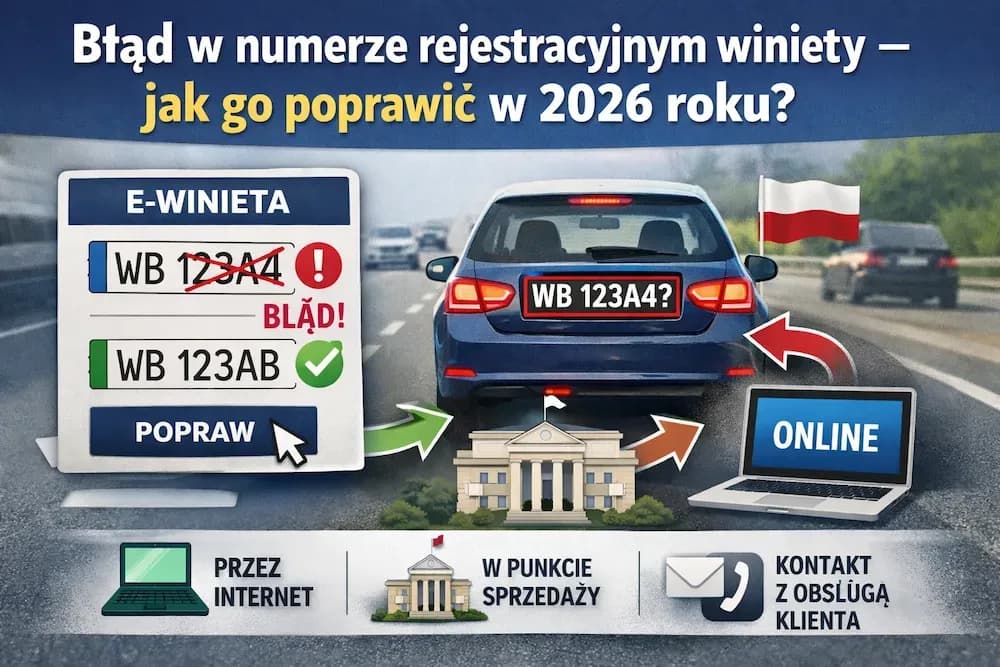
Traveling in Europe in 2026 has become almost fully automated. Traditional windshield stickers are a thing of the past, replaced by advanced e-vignette systems directly linked to the vehicle's license plate number. While this is a huge convenience, it carries one key risk: a printing error is a system error. Just one wrong click on a smartphone screen can turn your trip through Austria, the Czech Republic, or Hungary into a costly bureaucracy lesson.
In 2026, control systems have become merciless. Thanks to the integration of databases within the European Union, fines for not having a valid vignette are automatically sent to the vehicle owner's country of residence within just a few days. Therefore, it is crucial to know how to react the moment you realize your license plate number contains a typo.
Common mistakes: Zero or O? And if 1?
Despite technological progress, certain errors remain constant. Analyzing thousands of reports from our customers in 2025 and early 2026, we have identified the most problematic character pairs that cause difficulties for license plate reading systems (OCR):
- Digit "0" and letter "O": In the Polish license plate numbering system, the letter "O" does not appear in the vehicle identifier part (except for the district identifier in specific cases), but drivers often forget this. Systems in Austria and Hungary treat these two characters as completely different data units.
- Digit "1" and letter "I" or "L": Narrow letters are a nightmare when entering data on mobile devices with small keyboards.
- Swapping digit "8" for letter "B": Especially with dirty license plates, if the OCR system had to verify your data, an error in the database could prevent automatic matching.
- Incorrect character order: A classic "Czech mistake", e.g., "WA12345" instead of "AW12345".
German Special Characters (Ä, Ö, Ü, ß) – A Trap for Poles
If you rent a car in Germany or bought a car across the western border and are driving with local plates, you must pay attention to the so-called Umlauts and the characteristic letter ß (Eszett). In 2026, most European vignette forms have been standardized, but the devil is in the details.
How to correctly enter these characters in e-vignette systems?
| Character | Name | How to enter (Standard 2026) | Notes |
|---|---|---|---|
| Ä / ä | A-Umlaut | AE | Never enter "A" alone, unless the system explicitly requests it. |
| Ö / ö | O-Umlaut | OE | In Austrian systems, "OE" is the standard conversion. |
| Ü / ü | U-Umlaut | UE | Often confused with "V" or "Y" in older systems. |
| ß | Eszett / Sharp S | SS | Rarely appears on license plates, but common in company names. |
Remember: if the plate shows "MÜ" and you enter "MU", your vignette is **invalid**. In 2026, systems are configured to look for an exact binary match. Any discrepancy is treated as non-payment.
Correction procedures: Country by country
1. Austria (ASFINAG)
Austria remains the country with the most restrictive approach. If you purchased a vignette as a private individual, you have an 18-day waiting period. During this time, changing the number is possible free of charge through the customer panel. However, for vignettes valid immediately (purchased for a company or at a station), a change is only possible before entering the highway. If a camera registers you – you face a substitute toll of 120 EUR.
2. Czech Republic (Edalnice)
In 2026, the Czech Republic introduced a "quick correction" system. If you notice an error within 15 minutes of purchase at a physical point of sale, the seller must correct it. For online purchases, you have time until the vignette is activated. If the vignette is already active, changing the number requires submitting an application with a certificate from the office about the license plate change or proof of an obvious clerical error.
3. Hungary (Nezzeti Utidij)
In Hungary, a so-called "license plate number correction" (rendszámelírás) is permitted. You can change up to 3 characters in the number, paying a small administrative fee (approx. 6-10 EUR equivalent). You have 60 days from receiving a payment request to do this, but it's better to do it before the request is even issued.
OCR Camera Technology and Fines in 2026
Control systems in 2026 are no longer based solely on static photos. They use a neural network to analyze video in real-time. This means the system "sees" your car from several meters away, analyzes environmental stickers, the license plate number, and even the presence of onboard units for trucks.
An error in registration means the system does not find your record in the "cloud" of paid journeys. At this point, a verification procedure is initiated. If your number is "PO 12345", but the vignette is for "P0 12345", the system may reject your payment. In 2026, appeals against fines are processed digitally, and the time to submit them is short – usually 7-14 days.
Frequently Asked Questions (FAQ)
1. Can I drive if I noticed an error but have no way to correct it?
No. Entering a toll road with an incorrect number is equivalent to not having a vignette. It's better to buy a second, correct vignette and try to get a refund for the first one, rather than paying a fine.
2. What if I confused the country of registration?
This is a very serious error. Systems first filter the database by country (e.g., PL, DE, CZ). If you entered a Polish number but selected the Czech Republic – the system will not find you.
3. Does Winiety24.eu support help at night?
Yes, our hotline operates 24/7. We understand that travel happens at all hours, and road stress knows no office hours.
Buy without stress at Winiety24.eu
Avoid the above problems. Our sales system has built-in validation mechanisms that verify the most common errors in license plate numbers before payment. However, if you do make a mistake – we won't leave you alone.
- 24/7 Phone support: We will help you contact a foreign operator.
- Character verification: Our system suggests the correct format for a given country.
- Fast shipping: Vignette by email in minutes.