Can You Drive into Venice by Car?
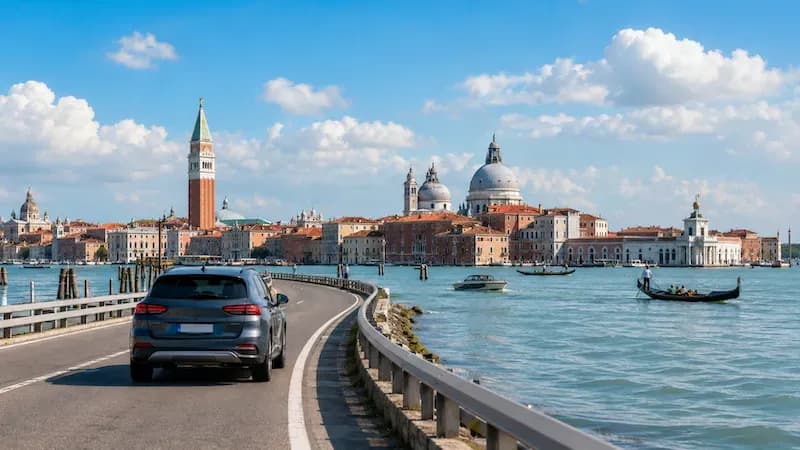
Can you drive into Venice by car? 2026 guide: parking, getting there and fees
Venice is one of the most extraordinary cities in Europe – built on more than a hundred islands, threaded with canals, with no ordinary streets in its centre. It is no wonder that almost everyone planning a road trip asks the question: "can you drive into Venice by car?" The short answer is: you cannot enter the historic centre, but you can drive right to the edge of the city, where you leave the car in a car park and continue on your own two feet or by water bus. In this guide we explain exactly how far you can drive, where to park, what it costs in 2026 and how to plan the whole route.
Can you drive into Venice by car – the short answer
You can reach Venice by car, but you cannot drive into its historic centre. This distinction is crucial and worth understanding before you enter a destination into your sat nav. The island city is connected to the mainland by a single causeway – the Ponte della Libertà. It leads to the square Piazzale Roma and to the neighbouring island of Tronchetto. And that is where driving ends. Beyond it stretches a labyrinth of canals and lanes through which you move only on foot or by boat.
In practice this means the car serves as a means of transport up to the edge of the city, not around it. The driver leaves the vehicle in one of the paid car parks and then walks across the bridge or uses the water bus (vaporetto), the water taxi or the People Mover. If you are after comfort and savings, it is often best to park before Venice, on the mainland in Mestre, and reach the centre by train or tram.
Why Venice is a car-free city
Venice grew up on an archipelago of more than a hundred small islands in the lagoon, and its "streets" have for centuries been the canals. The main artery is the Grand Canal, while the network of smaller canals serves the function of ordinary roads. Where cars drive in other cities, in Venice boats sail: water buses, water taxis, delivery barges and even ambulances and police boats. Foot traffic runs along narrow lanes (calli) and countless bridges, many of which have steps. That alone rules out car traffic.
The historic centre, the so-called centro storico, was never designed for cars. There are no carriageways here, no pavements in the classic sense and no places where a car could move or turn around. That is why cars stop at the edge of the city, in specially adapted places, and the rest of the way is covered on foot or by water. This uniqueness is at once Venice's greatest attraction and its greatest logistical challenge for visitors.
It is also worth remembering that Venice is not only the islands of the lagoon. The municipality administratively also includes districts on the mainland – above all Mestre and Marghera – where car traffic looks entirely normal. For a driver this is important information, because it is precisely in this part that you can park comfortably and more cheaply and then reach the historic centre by public transport in about fifteen minutes.
How far exactly you can drive
By car you reach two main points at the edge of island Venice, plus any location on the mainland. The first point is Piazzale Roma – a square at the mouth of the causeway that is also the city's largest transport hub. This is where the roads end and pedestrian and waterborne Venice begins. The second point is the island of Tronchetto, an artificial parking island right next door, connected to Piazzale Roma by the People Mover.
Both places lie in the western part of historic Venice and form the natural "doors" into the city. From Piazzale Roma you can reach St Mark's Square on foot in about 35–45 minutes, walking across the Ponte degli Scalzi and through the Santa Croce and San Polo districts. You can also board the water bus line 1 or 2, which sails along the Grand Canal and serves at once as transport and a mini sightseeing cruise.
The third option is to stop before the causeway, on the mainland in Mestre. Then you reach the centre of Venice by train (a few minutes on the Venezia Mestre – Venezia Santa Lucia line), by tram line T1 or by bus. This option is usually the cheapest and lets you avoid the most expensive car parks right next to the city.
Piazzale Roma
Closest to the centre, right at the mouth of the causeway. Large but expensive multi-storey car parks. A great starting point on foot or by water bus.
Tronchetto
An artificial parking island next to Piazzale Roma. A little cheaper, connected by the People Mover and a water-bus stop. The ferry to the Lido also departs from here.
Mestre (mainland)
The cheapest car parks and park & ride. Reach the centre by train, tram T1 or bus in about fifteen minutes.
Lido and Fusina
Alternative directions: you can take the car to the Lido by ferry, and a seasonal ferry runs to the centre from Fusina. Solutions for specific travel plans.
The Ponte della Libertà causeway – the only road into Venice
The Ponte della Libertà, the Bridge of Freedom, is a nearly four-kilometre causeway connecting the mainland with island Venice. It runs parallel to the older railway bridge, and it is over this causeway that all cars heading for the city drive. The causeway ends at Piazzale Roma, with a branch leading to the island of Tronchetto. There is simply no other road route into Venice.
Driving across the causeway can be a bottleneck, especially in high season, at weekends and during major events such as the carnival or the film festival. At such times queues can form even before the on-ramp to the bridge, and the car parks themselves can fill up as early as the morning. So if you plan to drive directly to Piazzale Roma or Tronchetto, it is worth setting off early and having a backup plan in case there are no spaces.
Parking at Piazzale Roma – closest to the centre
Piazzale Roma is the most "urban" point you can reach by car. There are two large multi-storey garages here. The first is the Autorimessa Comunale, the municipal car park, where a day usually costs about €30–35. The second is the private Garage San Marco, where you pay roughly €39–45 per day. Prices may vary with the season and occupancy and are higher at peak times.
The advantage of Piazzale Roma is its unbeatable location – you step out of the car and you are practically in the city straight away. That is convenient especially when you have heavy luggage, are travelling with small children or with someone with reduced mobility. Numerous water-bus lines depart from the square, there is also a stop for the T1 tram from Mestre and the People Mover station from Tronchetto.
The downside is above all the price and the limited number of spaces. In practice, if you stay in Venice for more than one day, the cost of several days' parking at Piazzale Roma adds up quickly. That is why this solution works mainly for short, one-day visits or when maximum comfort, rather than saving money, is the priority. Check the current prices and the individual car parks before your trip.
Parking at Tronchetto and the People Mover
Tronchetto is an artificial island created specifically for parking. It is home to one of the largest car parks in the Venice area – the Venezia Tronchetto Parking – where a day usually costs about €25–28 and the first hours around €3–4 per hour. This makes Tronchetto a slightly cheaper alternative to the garages at Piazzale Roma while staying close to the centre.
From Tronchetto you reach Piazzale Roma on the People Mover – a small, automatic urban railway that covers the route in about 4 minutes. A one-way ticket costs €1.50. It is a fast and convenient link that saves you walking with luggage. Water buses towards the centre also depart from Tronchetto and – important for some travellers – so does the car ferry to the island of Lido.
Tronchetto is a good choice when you want a slightly lower price than at Piazzale Roma while still being right next to the city. As at Piazzale Roma, in season it is worth arriving early or reserving a space, because occupancy is very high. Make sure you use the official car park – touts sometimes appear in the area offering "car parks" that are in fact more expensive or less reliable.
Parking in Mestre – the cheapest and most sensible option
Mestre is the mainland part of the municipality of Venice and, for many travellers, the most practical choice. Car parks here are significantly cheaper than right by the city. For a day at facilities such as the SABA Venezia Mestre or Gregory Parking you pay roughly €15–18, and at some car parks, such as Ca' Marcello, a day can even cost under €10. That is an enormous difference compared with Piazzale Roma, especially on a longer stay.
From Mestre you can reach the historic centre of Venice in several ways. The fastest is the train from Venezia Mestre station to Venezia Santa Lucia – the journey takes just a few minutes and you get off in the very heart of the city, on the Grand Canal. Alternatives are the T1 tram and buses, which take you to Piazzale Roma. So you park cheaply and are still in the centre within about fifteen minutes.
Mestre has one more advantage for drivers: an easier and calmer approach than the narrow causeway leading straight to the crowded car parks by the city. You leave the car in a quiet car park, do not worry about a free space in season and avoid the most expensive fees. This solution is recommended especially for families, for travellers with a bigger budget for attractions than for parking, and for anyone planning a longer stay.
Comparison of car parks and ways to get there
The table below compares the most popular options for leaving your car on the way to Venice. The prices given are approximate and may vary depending on the season, the day of the week and current availability. Treat them as a reference point and check the exact rates directly with the car-park operators before your trip.
| Place | Approximate price per day | Getting to the centre | Who it suits |
|---|---|---|---|
| Piazzale Roma (Autorimessa Comunale) | approx. €30–35 | On foot or water bus, on the spot | Short visit, maximum comfort |
| Piazzale Roma (Garage San Marco) | approx. €39–45 | On foot or water bus, on the spot | Comfort regardless of price |
| Tronchetto | approx. €25–28 | People Mover (€1.50) or water bus | Close to the centre, a little cheaper |
| Mestre (SABA, Gregory) | approx. €15–18 | Train, tram T1 or bus | Sensible balance of price and time |
| Mestre (Ca' Marcello) | under €10 | Train or tram to the centre | Cheapest longer stay |
| Fusina / Parco San Giuliano | approx. €10–15 | Seasonal ferry or public transport | Specific plans and the summer season |
The Venice access fee (contributo di accesso) in 2026
Besides the cost of parking, it is worth remembering a separate fee that has nothing to do with the car and yet affects most tourists: the access fee for the historic centre, in Italian contributo di accesso. It was introduced to curb excessive tourist traffic on the busiest days. If you arrive by car and enter the centro storico, it will most likely apply to you as well.
In 2026 the fee applies on selected days – mainly Fridays, Saturdays and Sundays from the beginning of April to the end of July – on several dozen days of the season in total. On the days the fee applies, the check concerns day-trippers entering the historic centre, usually between roughly 08:30 and 16:00. The rate is €5 if you register in advance (more than four days before your visit) or €10 if you register later, less than four days before arrival.
Importantly, the fee applies to people, not vehicles, and also covers those who arrived by car and parked at Tronchetto or Piazzale Roma and then entered the centre. Exempt from paying are, among others, people staying overnight in hotels and other accommodation in Venice, children under 14 and people with disabilities. Note: even exempt people usually have to register and obtain a QR code in order to prove their entitlement to the exemption during any inspection.
Limited traffic zones (ZTL) and driving rules
In island Venice itself there are no limited traffic zones in the classic sense, because there is no car traffic there at all. The concept of the ZTL (Zona a Traffico Limitato) does, however, become relevant on the mainland and in other Italian cities you might visit along the way. ZTLs are zones where entry is restricted and monitored by cameras, and an unauthorised pass ends with a fine sent later to the vehicle owner's address.
Around Venice, for example in Mestre, restrictions apply to some streets and lanes, including bus lanes. When driving through the mainland part of the municipality, pay attention to the signs and road markings. If your route runs through cities such as Verona, Padua or Bologna, remember that their historic centres are often covered by ZTL zones – entering without authorisation risks a penalty, even if the sat nav routes you through them.
The safest rule is simple: leave the car in designated car parks on the outskirts of cities and enter historic centres on foot or by public transport. In the case of Venice the problem disappears by itself, because you cannot drive into the centre anyway. But when planning a whole trip around Italy, it is worth knowing how limited traffic zones work so that a fine does not surprise you a few weeks after you return.
The island of Lido – where cars do drive
Although you will not see a single car in the historic centre of Venice, the lagoon has one important exception: Lido di Venezia, the long island separating the lagoon from the open sea. The Lido is famous for its beaches, elegant hotels and the film festival, and cars, scooters and buses move normally along its streets. For many travellers this is a surprise, but it is precisely why the Lido is a destination for those who want to combine a beach holiday with proximity to Venice without giving up the car entirely.
You take the car to the Lido by ferry, which departs from Tronchetto. It is a paid service and it is worth checking the timetable and prices in advance, especially in season. You do have to remember, though, that having a car on the Lido does not change the rules in Venice itself – you still cannot drive onto the islands of the historic centre, and water buses run between the Lido and St Mark's Square. So treat the Lido as a base, not as a way to drive into the heart of the city.
How to reach Venice by car
Venice lies in the north-east of Italy and is one of the most common destinations for travellers heading south by car. The most popular route runs through Austria and the Brenner Pass, then along the Italian A22 motorway to the A4 towards Venice. Alternatively, depending on your starting point and the current traffic situation, you can travel through the Czech Republic, or via Slovenia.
The key thing for drivers is the road tolls, which work differently in each country. In Austria and the Czech Republic a vignette system applies – you must have a valid vignette before you enter the tolled network. You can buy the vignette for Austria and the vignette for the Czech Republic online before you set off, entering the correct registration number and the vehicle's country of registration. In Italy, by contrast, there is no vignette – tolls are collected at toll booths, where you take a ticket on entry and pay on exit.
If your route runs over the Brenner Pass, bear in mind that in 2026 a major reconstruction of the Luegbrücke bridge is underway on the Austrian A13 motorway, which can lengthen the journey, especially on summer weekends. It is worth allowing a time buffer and checking the current situation before you leave. It is also good practice to prepare all road tolls in advance, so you do not lose time and do not risk a fine for a missing vignette.
What driving to Venice costs
The total cost of driving to Venice depends on several items: fuel, vignettes, motorway tolls in Italy and parking on the spot. Although it is hard to give a single figure, it is worth planning your budget with all these elements in mind to avoid surprises. Drivers often remember fuel but forget the road tolls and parking costs, which on a longer stay can noticeably raise the bill.
The first expense is fuel – its cost depends on the length of the route, the car's consumption and the number of passengers among whom the outlay can be shared. The second is the vignettes in Austria and the Czech Republic, which you buy in advance for a chosen period. The third is the Italian motorway tolls charged at the booths for the distance actually driven. The fourth, finally, is parking in the Venice area, where the difference between Piazzale Roma and Mestre can amount to several dozen euros over a multi-day stay.
On top of this comes the possible access fee for the historic centre on the days it applies, plus tickets for transport – the water bus, People Mover or the train from Mestre. If you want to optimise costs, you save the most by parking on the mainland and reaching the centre by train, and by buying vignettes online with a validity matched to the length of your trip. With such a plan you can enjoy Venice without overpaying for merely leaving the car.
- fuel for the whole route there and back,
- the Austrian and Czech vignette (bought online in advance),
- Italian motorway tolls collected at the booths,
- parking in the Venice area (Piazzale Roma, Tronchetto or Mestre),
- a possible access fee for the centre on selected days,
- transport tickets: water bus, People Mover, train from Mestre.
Is it worth driving to Venice by car?
The answer depends on what your whole trip looks like. If Venice is the sole destination of the trip, the car tends to be a burden rather than a convenience – you will not drive around the city anyway, and the vehicle has to be left somewhere for no small amount of money. In this scenario, some travellers consider arriving by train or plane and see Venice on foot and by water bus. Inside the city the car offers no advantage here.
The situation looks quite different when Venice is just one of several points on a larger route around Italy or Europe. Then the car becomes an enormous asset: it lets you freely explore the Veneto region, drive to Lake Garda, to Verona, to the Dolomites or further south. In this light you simply drive up to Venice itself, leave the car at the edge and enter the city, while doing the rest of your trip with the full freedom that your own car provides.
Advantages of driving
Freedom to explore the region, flexible timing, the ability to bring more luggage, comfort when travelling with family and the easy combination of Venice with other cities.
Disadvantages of driving
Expensive car parks by the city, no driving in the centre, the risk of queues on the causeway, the need to plan road tolls and vignettes, and the access fee on selected days.
Practical tips for drivers heading to Venice
Good preparation makes driving to Venice a stress-free affair. The following tips will help you avoid the most common pitfalls and save both time and money. Most of them follow a simple rule: in Venice the car is a guest on the outskirts, so the sooner you plan where to leave it, the calmer the whole trip will be.
- Set a specific destination in the sat nav: Piazzale Roma, Tronchetto or the name of a car park in Mestre.
- In season, reserve a parking space online to avoid the "completo" status.
- Consider parking in Mestre and travelling by train – it is usually the cheapest option.
- Buy the Austrian and Czech vignette in advance and enter the correct registration number.
- Check whether the access fee applies on your visit day and register in advance if needed.
- Allow a time buffer, especially if the route runs over the Brenner Pass under reconstruction.
- Take cash and a card – they come in handy at toll booths, car parks and on transport.
- Note where you parked the car, because garages and parking islands can be sprawling.
Common driver mistakes on the way to Venice
Many problems can be avoided by knowing the typical mistakes. The first and most common is the assumption that you can drive into the centre of Venice and park "somewhere in the middle". You cannot – the city ends at Piazzale Roma and Tronchetto. The second mistake is driving onto the causeway at peak times without a reservation and a backup plan, which often ends in circling between full car parks and turning back.
Another mistake is underestimating road tolls: a missing valid vignette in Austria or the Czech Republic risks a fine, and in Italy the toll booths come as a surprise if you have not got a card or cash ready. Visitors also sometimes overlook the access fee for the centre on the days it applies – even though it also covers people arriving by car. Finally, a frequent oversight is underestimating the cost of parking by the city on a longer stay, where several days at Piazzale Roma can cost more than the expected budget.
Can you drive into Venice by car – frequently asked questions
Can you drive into Venice by car?
You cannot drive into the historic centre of Venice, because instead of streets it has canals and narrow lanes. By car you only reach the edge of the city via the Ponte della Libertà causeway, at Piazzale Roma or on the island of Tronchetto, where the car parks are. From there you continue on foot or by water bus.
Where do you leave the car when going to Venice?
The closest car parks to the centre are at Piazzale Roma and on the island of Tronchetto, but they are expensive. It is cheaper to park on the mainland in Mestre and reach Venice by train, tram T1 or bus in about fifteen minutes.
How much does parking in Venice cost?
At Piazzale Roma a day usually costs about €30–45, at Tronchetto around €25–28, and in Mestre from a few up to around €15 per day. Prices are approximate, vary by season and are higher at peak times.
Do you have to pay to enter Venice?
In 2026 an access fee applies on selected days to day-trippers entering the centre. It is €5 if you register in advance or €10 if you book less than four days before your visit. It also applies to people arriving by car. Overnight hotel guests, children under 14 and some other groups are exempt but must register.
Can you drive onto the island of Lido?
Yes. Lido di Venezia is one of the few islands in the lagoon where cars are allowed. The vehicle is taken across by ferry from Tronchetto. You still cannot drive into the historic centre of Venice itself.
How do you get to Venice by car?
Most often via Austria and the Brenner Pass on the A22 motorway to the A4 towards Venice. A vignette is required in Austria and the Czech Republic, while in Italy tolls are collected at toll booths. Alternatively you can travel via Slovenia.
Is it worth driving to Venice by car?
A car is convenient for the journey and for exploring the region, but in the city itself it becomes a problem: parking is expensive and in the centre you move around on foot or by boat. A good compromise is to park in Mestre and reach the centre by public transport.
Will the sat nav take me all the way into central Venice?
No. Set Piazzale Roma, Tronchetto or a specific car park in Mestre in the sat nav. You cannot drive any further, because the roads end and the canals begin.
Summary – the car at the gate, then on foot or by water
You can reach Venice by car, but you cannot drive into the historic centre. You leave the car at the edge of the city – at Piazzale Roma, on the island of Tronchetto or, more cheaply, on the mainland in Mestre – and continue on foot, by water bus, on the People Mover or by train. It is precisely this uniqueness, the absence of cars and the rhythm of water that rules over everything, that makes Venice so extraordinary.
For drivers, good planning matters most: choosing the parking spot to match the length of the stay, preparing the Austrian and Czech vignette in advance, checking the access fee on your visit day and allowing a time buffer on the route, especially around the Brenner Pass under reconstruction. With such a plan, driving to Venice is comfortable, and the city itself rewards you with impressions no other place in the world can offer.
Get your vignettes ready before you drive to Italy
Driving to Venice through Austria and the Czech Republic? Take care of the road tolls before you even set off. At Winiety24.eu you can order vignettes online, including the Czech vignette and the Austrian vignette. Before buying, make sure you enter the correct registration number, country of registration and the right validity period, so the enforcement system recognises your payment without any problem.
This article is for information purposes only. Car-park prices, the rules of the access fee, its hours and the days it applies, as well as the traffic arrangements, may change. Before travelling, check the current information with the car-park operators and on the official pages of the city of Venice.