Croatia or Italy in 2026? Full Holiday Price Comparison
2026 Holiday Guide
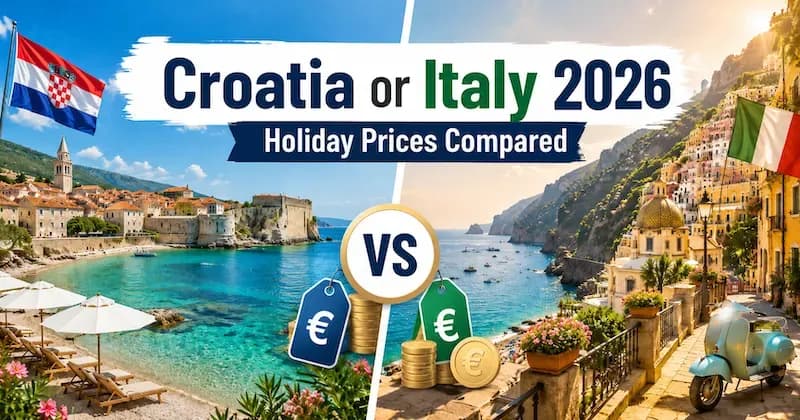
Croatia or Italy? Comparing 2026 Holiday Prices
Just a few years ago the answer seemed obvious: Croatia was chosen by people looking for cheaper holidays by a warm sea, while Italy was seen as a pricier destination that demanded a bigger budget. In 2026 that divide is no longer so clear-cut. Accommodation, food and service prices on the Croatian coast have risen, while in Italy there are still regions where a family holiday doesn't have to cost a fortune. We look at where a holiday is currently cheaper and how to plan a budget for a week-long trip.
Croatia or Italy in 2026 – key takeaways
It's no longer honestly true to say that Croatia is always cheaper than Italy. In popular Dalmatian towns such as Split, Trogir, Makarska, Brela, Baška Voda, Vodice or the Dubrovnik area, peak-season prices can be comparable to those on Italy's Adriatic coast. This applies especially to apartments close to the sea, restaurants along the promenade, car parks and tours organised for tourists.
Croatia does, however, retain several important advantages. It can be reached from Poland faster than many regions of southern Italy. A large share of tourists rent apartments with a kitchen, which helps limit restaurant spending. Access to most beaches is free, and renting a sunbed is usually not necessary.
Italy, on the other hand, offers far greater price variation. A holiday in Venice, Rimini, Tuscany, Liguria, on the Amalfi Coast or by Lake Garda can be expensive, but staying in a smaller town in Abruzzo, Apulia, Calabria or on the northern stretch of the Adriatic can turn out to be price-competitive with Croatia. Italian supermarkets also offer a very wide range of products, and prices of pasta, bread, vegetables, local cheeses and basic goods aren't always higher than in Croatian resorts.
Croatia will be more cost-effective when:
- you're travelling from southern or central Poland,
- you rent an apartment with a kitchen,
- you choose June or September,
- you mainly use free beaches,
- you don't plan to eat out every day,
- you choose a smaller town rather than Dubrovnik or central Split.
Italy may be more cost-effective when:
- you find a hotel or campsite with meals included,
- you travel outside the August peak,
- you choose Abruzzo, Calabria or a less popular part of Apulia,
- a sandy beach and facilities for children matter to you,
- you book accommodation well in advance,
- you don't use a paid beach club every day.
| Category | Croatia | Italy | Usually more cost-effective |
|---|---|---|---|
| Journey from Poland | Usually shorter | Longer, especially to the south of the country | Croatia |
| Fuel on the spot | Usually cheaper | Usually more expensive | Croatia |
| Accommodation by the beach | Expensive in well-known resorts | Very large regional differences | Tie |
| Restaurants | High prices in resorts | Wider choice of venues and cheaper snacks | Italy or tie |
| Grocery shopping | More expensive in coastal shops | Strong supermarket competition | Italy |
| Beach access | Usually free | Often paid lido | Croatia |
| Sandy beaches | Less common | Very wide choice | Italy |
| Holidays with small children | Good, but entry into the water is often stony | Extensive family-oriented facilities | Italy |
| Self-catering holidays | Very popular apartments | Plenty of hotels, campsites and residences | Croatia |
Cost of driving from Poland
When comparing holiday prices in Croatia and Italy, you need to consider not only the on-the-spot expenses. For families travelling by car, a significant part of the budget consists of fuel, vignettes, motorway tolls, transit car parks, meals along the way and a possible stopover.
From southern Poland you can reach Rijeka, Pula or northern Dalmatia after covering roughly 850–1200 kilometres, depending on your starting point and destination. The trip to Split, Makarska or Dubrovnik will be longer. For Italy, the distance to Venice or the coast around Grado and Lignano Sabbiadoro can be comparable to the route to northern Croatia, but reaching Rimini, Tuscany, Rome, Apulia or Calabria means a considerably longer drive.
| Sample destination | Approximate distance from Katowice | Approximate driving time without long stops |
|---|---|---|
| Rijeka | about 850–950 km | about 9–11 hours |
| Zadar | about 1000–1100 km | about 11–13 hours |
| Split | about 1150–1250 km | about 12–14 hours |
| Dubrovnik | about 1350–1450 km | about 15–17 hours |
| Venice | about 900–1000 km | about 10–12 hours |
| Rimini | about 1150–1250 km | about 12–14 hours |
| Rome | about 1450–1550 km | about 16–18 hours |
| Bari | about 1650–1800 km | about 18–21 hours |
For a car averaging 7 litres of fuel per 100 kilometres, every additional 500 kilometres there and back means burning around 35 litres of fuel. At a price of around 1.70–2.00 euro per litre, that's an extra cost of about 60–70 euro. On top of that come further stretches of paid Italian motorways.
From the point of view of the journey alone, Croatia most often beats out southern and central Italy. The exception is north-eastern Italy, above all the area around Venice, Bibione, Caorle, Grado and Lignano Sabbiadoro. The trip from Poland to these places may be only slightly longer than the drive to Istria.
Vignettes and road tolls on the way to your holiday
Whether travelling to Croatia or to Italy, Polish drivers most often pass through several countries. The chosen route has a direct impact on the final cost of the holiday. Before setting off, it's worth checking not only the fuel price but also the validity period of each vignette and the rules for using toll roads.
Travelling via Czechia and Austria
A popular route runs from Poland through Czechia, Austria and Slovenia. Before entering Czech motorways you need to buy the appropriate Czech vignette. Czechia uses an electronic toll system, so the driver does not receive a windscreen sticker. The right to use the motorway is linked to the vehicle's registration number.
The next cost is the Austrian vignette. It's worth remembering that the Austrian vignette alone does not cover all possible charges. On selected routes, tunnels and mountain passes additional section tolls may apply. This is particularly relevant when travelling to Italy via the Brenner Pass.
Continuing on to the Croatian coast or to north-eastern Italy, a driver may also need a Slovenian vignette. Slovenia is a small country, but its motorways form an important transit corridor between Austria, Croatia and Italy.
Travelling via Slovakia and Hungary
An alternative route to Croatia can run through Slovakia and Hungary. In that case you should buy a Slovak vignette in advance and check the current rules for using Hungarian motorways. This route can be advantageous for people setting off from eastern or south-eastern Poland.
Motorway tolls in Croatia
Croatia does not use a classic vignette for passenger cars. On most main motorways the toll depends on the vehicle category and the length of the section driven. The driver takes a ticket when entering the toll road and then pays on exiting. Electronic toll-collection systems also operate on some routes.
Driving the motorway from around Zagreb towards Zadar, Šibenik or Split is a noticeable expense. For a round trip, the family budget needs to be increased by several dozen euro. The exact amount depends on the chosen exit, the vehicle category and the applicable tariff.
Motorway tolls in Italy
In Italy most main motorways are tolled by section. The principle is similar to that used in Croatia: the cost depends on the distance covered and the vehicle class. A short drive around Venice or Trieste doesn't have to be especially costly, but a long journey through a large part of the country can add several dozen, or even more than a hundred, euro to the cost of the holiday for a round trip.
Particularly costly can be the combination of Austrian special tolls, the Brenner crossing and Italian motorways running further south. When planning a holiday in Tuscany, Lazio, Campania, Apulia or Calabria, it's worth calculating the full cost of the journey, not just the price of fuel.
Fuel prices in Croatia and Italy in 2026
Fuel is one of the areas where the difference between Croatia and Italy remains clear. According to data published in mid-July 2026 as part of European fuel-price monitoring, petrol and diesel were on average more expensive in Italy.
| Country | 95 petrol – approximate | Diesel – approximate |
|---|---|---|
| Croatia | about 1.60 euro per litre | about 1.66 euro per litre |
| Italy | about 1.86 euro per litre | about 1.96 euro per litre |
This means that filling up with 50 litres of petrol can be around 13 euro more expensive in Italy. For diesel, the difference on the same fill-up can be about 15 euro. On a long trip to central or southern Italy, where the car needs several fill-ups, the difference becomes clearly noticeable.
It's also worth remembering that petrol stations on Italian motorways are usually among the most expensive. Prices can be noticeably higher than at stations located in towns or on local roads. Italy also uses two service models: self-service and staffed pumps. The staffed service, often labelled "servito", can be more expensive than the "self" option.
In Croatia, differences between stations also occur, but the average price level remains more favourable. People driving to Italy via Austria might consider filling up before the Italian motorway. It's not worth driving many kilometres out of your way, however, just to save a few cents per litre.
Accommodation prices in Croatia and Italy
Accommodation is usually the biggest expense of a holiday. It's also the category with the biggest differences. The same apartment can cost significantly less in the first half of June than at the turn of July and August. The price rises with the standard, the sea view, pool access, the availability of free parking and the distance from the beach.
Croatia – approximate accommodation prices
Croatia's tourism market relies heavily on private apartments. For Polish families this is a convenient solution, since the property usually has a kitchen or kitchenette, a fridge, a balcony and a parking space. In 2026, however, prices in popular towns are much higher than before the period of Croatia's rapid rise in popularity.
| Type of accommodation in Croatia | June or September | July and August |
|---|---|---|
| Simple double room | 45–75 euro per night | 65–110 euro per night |
| Apartment for 2–4 people | 65–110 euro per night | 90–170 euro per night |
| Apartment close to the beach | 90–150 euro per night | 130–230 euro per night |
| Three-star hotel | 90–150 euro per night | 130–220 euro per night |
| Four-star hotel | 140–240 euro per night | 190–350 euro per night |
| Campsite pitch | 35–65 euro per day | 55–100 euro per day |
| Mobile home at a campsite | 80–150 euro per night | 140–280 euro per night |
The most expensive properties are in Dubrovnik, central Split, Hvar and the best-known towns of the Makarska Riviera. More favourable prices can be found in smaller towns a few or a dozen or so kilometres from a popular resort. Sometimes it's enough to choose a location on the other side of the bay, or an apartment 800–1200 metres from the sea, to cut the cost of the stay by several hundred euro.
Italy – approximate accommodation prices
In Italy the choice of properties is wider. Besides hotels and apartments, there are family-run guesthouses, agritourism farms, residences, holiday villages and large campsites. Some properties offer breakfast, two meals or full board, which makes it harder to directly compare the price of the accommodation alone.
| Type of accommodation in Italy | June or September | July and August |
|---|---|---|
| Simple double room | 55–90 euro per night | 75–130 euro per night |
| Apartment for 2–4 people | 70–120 euro per night | 100–190 euro per night |
| Apartment close to the beach | 90–160 euro per night | 140–250 euro per night |
| Three-star hotel | 75–140 euro per night | 110–210 euro per night |
| Four-star hotel | 130–230 euro per night | 180–340 euro per night |
| Campsite pitch | 35–70 euro per day | 55–110 euro per day |
| Mobile home at a campsite | 80–160 euro per night | 150–300 euro per night |
Italian prices depend heavily on the region. Liguria, the area around Lake Garda, Venice, Florence, Rome, the Amalfi Coast and the best-known parts of Tuscany are among the expensive ones. Meanwhile, in Abruzzo, Molise, Calabria, parts of Apulia and less popular towns on the Adriatic, you can find competitive deals.
Which country has cheaper accommodation?
For a simple apartment with a kitchen, Croatia often keeps a slight edge, especially outside the biggest resorts. In the hotel segment with breakfast or full board, Italy can perform similarly, and sometimes even better. Italian family hotels on the Adriatic often sell packages that include meals, beach access and facilities for children. Once everything is added up, the offer can turn out cheaper than a Croatian apartment plus daily restaurant visits.
When comparing offers, you should check whether the price includes final cleaning, bed linen, towels, air conditioning, parking and the local tourist tax. A cheap-looking deal can stop being a good one once all the fees are added.
Restaurant prices – Croatia or Italy?
In 2026, prices in Croatian restaurants are one of the biggest surprises for people who remember cheap holidays from a dozen or so years ago. In the most touristy locations, a family dinner bill can be close to the bill in Italy. Restaurants located directly by marinas, old towns and seafront promenades are especially expensive.
| Product or meal | Croatia | Italy |
|---|---|---|
| Espresso | 1.80–3.00 euro | 1.20–2.00 euro at the bar |
| Cappuccino | 2.50–4.00 euro | 1.70–3.00 euro |
| 0.5 l beer | 4.00–6.50 euro | 4.00–7.00 euro |
| Glass of local wine | 3.50–6.00 euro | 4.00–7.00 euro |
| Pizza | 9–16 euro | 7–15 euro |
| Pasta or risotto | 12–20 euro | 10–18 euro |
| Burger with fries | 12–19 euro | 12–20 euro |
| Fish dish | 18–35 euro | 18–38 euro |
| Seafood | 18–35 euro | 18–40 euro |
| Ice cream – one scoop | 2.00–3.50 euro | 2.50–4.00 euro |
| Dinner for two | 45–80 euro | 45–85 euro |
| Dinner for a family of 2+2 | 70–130 euro | 75–140 euro |
Italy has the edge in the category of quick, simple meals. A coffee drunk at the bar, a slice of pizza, focaccia, a panino or a portion of pasta at a place away from the main square can be reasonably priced. In Italy it's also easier to find a place aimed at locals rather than solely at tourists.
In restaurants in Italy, though, you need to watch out for the extra "coperto" charge. This is a cover charge for the table setting, bread or service, usually charged per person. Its amount should be stated on the menu. For a family of four, even 2–4 euro per person adds another 8–16 euro to the bill.
In Croatia a similar charge is not as common, but the restaurant may add bread, side dishes or water to the bill. It's always worth checking the menu and prices before ordering fish sold by weight. A price given per kilogram can mean the final bill is much higher than initially expected.
Is pizza cheaper in Italy?
In many cases, yes. Italian pizza at an ordinary pizzeria, especially away from the busiest tourist centre, can cost less than pizza at a Croatian resort. This applies especially to simple varieties such as margherita or marinara. In venues near the main attractions, by Lake Garda, in Venice or in the resorts of Liguria, prices will, however, be considerably higher.
Prices in supermarkets and grocery shops
People renting an apartment can significantly cut the cost of their holiday by preparing some meals themselves. This applies especially to breakfasts, beach snacks and simple dinners. In this category Italy often performs better than its general image as an expensive country would suggest.
| Product | Croatia | Italy |
|---|---|---|
| Bread or a large baguette | 1.50–3.00 euro | 1.50–3.50 euro |
| Milk 1 l | 1.20–1.80 euro | 1.20–1.80 euro |
| Eggs, 10 pieces | 2.80–4.50 euro | 2.80–4.50 euro |
| Pasta 500 g | 1.20–2.80 euro | 0.90–2.50 euro |
| Water 1.5 l | 0.70–1.50 euro | 0.40–1.00 euro |
| Local cheese, 1 kg | 10–22 euro | 10–25 euro |
| Tomatoes, 1 kg | 2–4 euro | 2–4 euro |
| Chicken, 1 kg | 7–12 euro | 7–12 euro |
| Beer at the shop | 1.20–2.20 euro | 1.00–2.20 euro |
| Table wine | 4–10 euro | 3–10 euro |
In Croatian tourist towns, small shops by the beach can be noticeably more expensive than large supermarkets located on the main road or on the outskirts of town. The difference is especially visible for drinks, ice cream, beer, bread and beach items.
In Italy there are many competing grocery chains and discount stores. Buying own-brand products makes it possible to prepare simple meals without overloading the budget. Pasta, tomato sauces, cheeses, seasonal vegetables, bread, focaccia and local wines are often good value.
The most expensive solution in both countries is doing daily shopping at a small shop a few dozen metres from the beach. It's worth doing one bigger shop every few days at a supermarket and keeping water, drinks and breakfast items in the apartment.
Beaches, sunbeds, umbrellas and car parks
Access to the sea itself is one of the most important elements when comparing Croatia and Italy. In Croatia, most tourists use publicly accessible pebble, shingle or rocky beaches. You can lay out your own towel, mat or sunbed without incurring extra charges.
Renting a set of two sunbeds and an umbrella on a Croatian beach can cost around 15–35 euro a day, depending on the town and location. This is not, however, a mandatory expense. On many beaches there is space that can be used free of charge.
In Italy, private bathing establishments known as "lido", "bagno" or "stabilimento balneare" are very popular. They offer sunbeds, umbrellas, showers, toilets, changing rooms, bars, playgrounds and lifeguards. The comfort level is high, but using such a beach every day can significantly increase the budget.
| Beach expense | Croatia | Italy |
|---|---|---|
| Entry to a public beach | Usually free | Free on public beaches |
| Two sunbeds and an umbrella | 15–35 euro a day | 20–50 euro a day |
| Set at a prestigious location | 30–60 euro or more | 50–100 euro or more |
| Shower and toilet | Depends on the beach | Usually included in a private lido |
| Parking by the beach | 1–4 euro per hour or a daily rate | 1.50–5 euro per hour or a daily rate |
A family using an Italian lido for seven days can spend 140–350 euro on the beach set alone. In exclusive locations the amount will be even higher. In Croatia this cost is easier to eliminate entirely by bringing your own mat, umbrella and water shoes.
Italy, however, offers far more wide, sandy beaches with a gentle slope into the sea. For families with small children this may be a more important factor than price alone. Croatian beaches are often very picturesque with clear water, but the stones and rocky entry points mean it's worth using swimming shoes.
Parking by the beach
In both countries, free parking spaces near popular beaches are limited. The highest rates usually apply in old town centres, by marinas and at the best-known bathing spots. When booking accommodation, it's worth choosing a property with its own parking and the option of walking to the beach.
In Italian towns you need to pay attention to restricted traffic zones, known as ZTL. Entering such a zone without authorisation can result in a fine. The signs and cameras aren't always obvious to a foreign driver, so before entering a historic centre it's best to leave the car in an official car park.
Prices of tourist attractions and excursions
The holiday budget can grow significantly if you plan boat trips, national parks, water parks, sightseeing and guided tours. In both countries many natural attractions can be seen free of charge, but the best-known sites are paid.
Attractions in Croatia
Popular expenses include tickets to national parks, boat trips to islands, excursions to the Blue Cave, rafting, diving and full-day boat trips. National park prices can vary by season, and are usually highest during the summer holidays.
- short sightseeing cruise: about 20–45 euro per person,
- full-day cruise with a meal: about 40–80 euro per person,
- kayak or SUP board rental: about 10–25 euro per hour,
- water park: about 25–40 euro per person,
- organised excursion: about 40–100 euro per person.
Attractions in Italy
In Italy the choice of paid attractions is huge. Museums, historic sites, amusement parks, water parks, boat trips, cable cars and sightseeing in historic towns can significantly raise the cost of a holiday. In popular places it's worth buying tickets in advance, since the cheapest entry slots can sell out quickly.
- museum or historic site: about 10–30 euro per person,
- large amusement park: about 35–65 euro per person,
- water park: about 25–45 euro per person,
- boat trip on a lake or along the coast: about 15–50 euro per person,
- guided tour: about 35–100 euro per person.
A family with two children who visit an amusement park, a water park and several paid historic sites can spend several hundred euro above the basic cost of the holiday in Italy. In Croatia a similar rise in the budget might come from a few boat trips and visits to national parks.
Those looking to save money can, in both countries, base the itinerary on free attractions: beaches, viewpoints, walks around old towns, local markets, hiking trails and evening events in town.
Croatia or Italy for a holiday with children?
From a family's perspective, not just the final price matters, but also convenience. Croatia is popular with families travelling by car, since the large number of apartments allows them to prepare meals themselves, store children's products and plan the day flexibly.
A problem can be a stony beach, a steep entry into the sea, or having to negotiate steps. A photo of a property with an Adriatic view doesn't always show that reaching the beach requires walking down a steep hill. With a pushchair and carrying beach gear every day, this matters a great deal.
Italy offers many resorts designed with families in mind. Wide sandy beaches, shallow water, playgrounds, entertainment programmes, cycle paths and family hotels make the stay comfortable. The cost can, however, be higher if you have to pay for a lido, parking and extra attractions every day.
Croatia with children – advantages
- shorter journey to many regions,
- plenty of family apartments,
- easy meal preparation,
- free beaches,
- clean, clear water,
- a wide choice of quiet towns.
Italy with children – advantages
- wide, sandy beaches,
- a gentle entry into the sea,
- hotels with entertainment programmes and meals included,
- plenty of amusement parks and water parks,
- extensive cycling infrastructure,
- a wide choice of simple food that children enjoy.
For a family with a small child, an Italian resort on the northern Adriatic may be more convenient. For a family with older children who enjoy swimming, snorkelling, boat trips and exploring islands, Croatia may be more appealing.
Sample budgets for a 7-day holiday in 2026
The figures below relate to seven nights for a family of two adults and two children, travelling in their own car from southern Poland. The amounts are indicative and do not include souvenir shopping or travel insurance costs.
Economy option – apartment and self-catering
| Expense | Croatia | Italy – northern Adriatic |
|---|---|---|
| Accommodation – 7 nights | 630–900 euro | 700–1000 euro |
| Fuel there and back and on the spot | 250–340 euro | 290–390 euro |
| Vignettes and motorways | 90–150 euro | 110–190 euro |
| Grocery shopping | 250–350 euro | 230–340 euro |
| Two dinners at a restaurant | 140–220 euro | 150–230 euro |
| Beaches and car parks | 20–80 euro | 60–180 euro |
| Attractions | 80–180 euro | 100–220 euro |
| Total | 1460–2220 euro | 1640–2550 euro |
Comfort option – better apartment and frequent restaurant meals
| Expense | Croatia | Italy |
|---|---|---|
| Accommodation – 7 nights | 1050–1550 euro | 1150–1750 euro |
| Fuel and road tolls | 360–490 euro | 420–600 euro |
| Grocery shopping | 180–280 euro | 180–280 euro |
| Restaurants and cafés | 500–850 euro | 520–900 euro |
| Beaches and car parks | 100–220 euro | 180–380 euro |
| Attractions and excursions | 250–500 euro | 300–600 euro |
| Total | 2440–3890 euro | 2750–4510 euro |
Hotel option
Choosing a hotel with breakfast or full board can narrow the final differences. Italian family hotels often offer packages including meals, a beach spot, bikes and an entertainment programme. A Croatian hotel of a similar standard may be more expensive than a private apartment, but it provides greater convenience.
A week-long hotel trip for a family of 2+2 can cost, in both countries, from around 2800 euro to over 5000 euro including the journey, road tolls, attractions and extra expenses. In prestigious towns and hotels located directly by the sea, the upper limit can be considerably higher.
Holidays outside peak season
Travelling in the first half of June or in September often allows you to cut the cost of accommodation by 20–40 percent. For a family that means savings of anywhere from a few hundred to over a thousand euro. Outside the season it's also easier to find free parking, a spot on the beach and a table at a restaurant.
In September, sea temperature in both countries can still be suitable for swimming, and days are usually warm. You do, however, need to allow for a greater risk of rain and shorter daylight than in July.
Where is a holiday cheaper in 2026?
In the typical scenario of travelling by car, staying in an apartment with a kitchen and using free beaches, Croatia still usually turns out cheaper. The difference, however, is not as large as it used to be. For a comparable standard of accommodation, a week-long family trip can be cheaper by around 150–500 euro.
Croatia's advantage stems mainly from a shorter route, lower fuel prices and easier access to free beaches. People choosing an apartment, preparing their own breakfasts and avoiding the best-known towns can keep costs at a reasonable level.
Italy, however, doesn't have to mean a more expensive holiday. A well-chosen family hotel with meals and a beach spot can be more cost-effective than a Croatian apartment plus daily restaurant meals and paid excursions. The region matters a great deal. Italy shouldn't be judged solely through the lens of Venice, Tuscany, Lake Garda and the Amalfi Coast.
Final verdict
Cheapest holiday by car: most often Croatia, away from the main resorts.
Best value for family facilities: the northern coast of Italy outside the August peak.
Cheapest access to the sea: Croatia, using free beaches.
Widest choice of hotels with meals included: Italy.
Greatest scope for cutting costs: an apartment with a kitchen in Croatia, or an Italian full-board hotel package.
How to cut the cost of a holiday in Croatia or Italy?
1. Avoid the turn of July and August
This is the period of greatest demand, the highest prices and the heaviest road traffic. In Italy, August in particular tends to be expensive and crowded, as many residents go on holiday. June and September allow you to get much better prices.
2. Compare the total price of accommodation
Check the charge for cleaning, air conditioning, parking, bed linen, towels, tourist tax and any deposit. Some platforms initially show a price without some of the mandatory fees.
3. Choose accommodation in the second or third row from the sea
An apartment located a kilometre from the beach can be noticeably cheaper than a similar property on the promenade. If the town has convenient pavements or local transport, a greater distance from the sea doesn't have to be a problem.
4. Book a property with parking
Paying for parking every day can cost several dozen or over a hundred euro over the course of a week. In historic towns, being able to leave the car at the property also reduces the risk of accidentally driving into a paid or restricted zone.
5. Buy vignettes before the trip
Buying the right vignettes before setting off lets you avoid a nervous search for a sales point at the border. In one place you can check the available vignettes online and match them to the planned route.
6. Don't eat at the main promenade every day
Places one or two streets back can offer similar quality at a lower price. It's worth checking where locals eat, and choosing restaurants with a short menu and clearly stated prices.
7. Do bigger shops away from the resort centre
Water, drinks, snacks and breakfast items bought every day near the beach are much more expensive. One bigger shop at a supermarket helps limit impulse spending.
8. Make use of free beaches
In Croatia you can bring your own mat, umbrella and light beach chairs. In Italy you should check in advance the location of public beaches, marked as "spiaggia libera". They are often found between private bathing establishments.
9. Calculate your car's real fuel consumption
A car with a full load of passengers, a roof box and the air conditioning on can burn more fuel than during everyday driving. When planning costs, it's better to assume a figure 0.5–1 litre per 100 kilometres higher than standard consumption.
10. Leave a reserve in the budget
It's good practice to leave a reserve of at least 10–15 percent of the planned costs. It may be needed for more expensive fuel, extra parking, a change of route, medicine, a car repair or an unplanned attraction.
Prepare your road tolls before departure
Whichever you choose, Croatia or Italy, check your route carefully. Depending on the option, you may need vignettes for Czechia, Austria, Slovakia or Slovenia. Preparing road tolls in advance helps you avoid unnecessary stops and the risk of entering a toll motorway without a valid permit.
Frequently asked questions
Is Croatia cheaper than Italy in 2026?
For a trip by car, an apartment stay and the use of free beaches, Croatia is usually still a little cheaper. The difference narrows, however, in popular Dalmatian resorts, where accommodation and restaurant prices are comparable to many regions of Italy.
Where is accommodation cheaper – Croatia or Italy?
Simple apartments with a kitchen are more often cheaper in Croatia. Italy can offer better-value family hotels with meals and beach access. Much depends on the region and the time of year.
Where is food cheaper?
Grocery shopping can be slightly cheaper in Italian supermarkets, especially for pasta, bread, vegetables and own-brand products. Prices of full meals in restaurants are similar, though in Italy it's easier to find inexpensive pizza, focaccia or panino.
Where is fuel cheaper?
In mid-2026, fuel was on average cheaper in Croatia. In Italy, particularly high prices can apply at stations located directly on motorways.
Do you need a vignette for Croatia?
Croatia does not use a single vignette for passenger cars. On the main motorways a toll applies depending on the section driven and the vehicle category. Vignettes may, however, be required in transit countries.
Is there a vignette in Italy?
In Italy, passenger cars do not use a nationwide vignette. Most main motorways are tolled by section. Additional vignettes or fees may be needed when passing through Czechia, Austria, Slovakia or Slovenia.
Where are the beaches better for children?
Italy has a wider choice of broad, sandy beaches with a gentle slope into the sea. Croatia offers very clear water, but many beaches are pebbly or covered with shingle.
How much does a week's holiday for a family of 2+2 cost?
An economy week-long trip by car can cost around 1460–2220 euro in Croatia and around 1640–2550 euro in Italy. With better accommodation, frequent restaurant meals and paid attractions, the cost can exceed 4000 euro.
When is the best time to travel to pay less?
The most favourable prices are usually found in June and September. The turn of July and August is the most expensive, and in Italy demand is especially high in August.
Is it worth bringing food from Poland?
There's no need to bring large supplies. Both countries have well-stocked supermarkets. You can bring favourite children's products, snacks for the journey and items you'll need right after arrival.
Sources and methodology
The price ranges given were compiled based on accommodation listings, tourist service price lists, prices found in popular holiday regions and data available in July 2026. Fuel prices are based on weekly European data. Road-toll rules were verified on the websites of the motorway operators.
- European Commission – Weekly Oil Bulletin
- Hrvatske autoceste – toll rules and rates
- Autostrade per l'Italia – motorway tolls
- Croatian government portal – tourist tax
This article is for informational purposes. Before travelling, check the current prices, tariffs and regulations that apply on your chosen route.