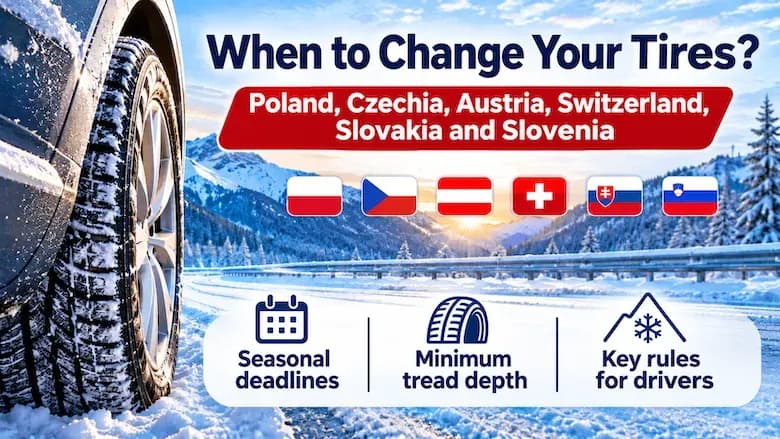
When to Switch to Winter Tyres? Dates and Minimum Tread Depth in Poland and Europe – 2026/2027 Season
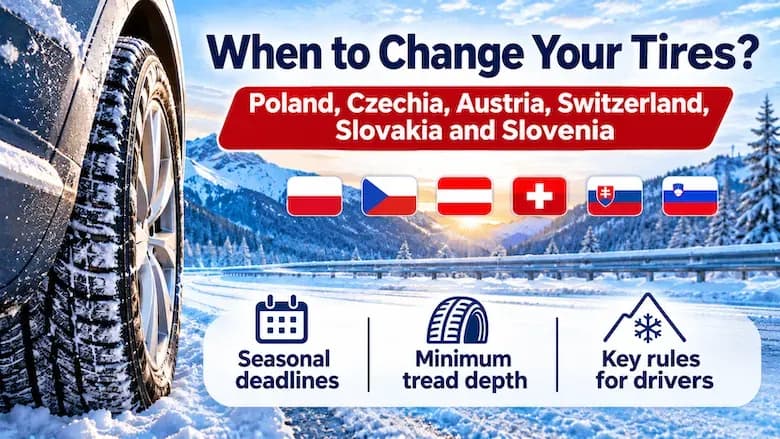
Planning a winter road trip to the Czech Republic, Austria, Switzerland, Slovakia or Slovenia? Before you set off, check not only the weather and road conditions but also the rules on winter tyres. Each country has its own dates, minimum tread depths and requirements for how your car must be equipped.
In Poland, switching to winter tyres is not mandatory. In several other European countries, however, driving on unsuitable tyres can result in a fine – and, after a collision, in problems with liability.
Find out when to switch to winter tyres in the 2026/2027 season and how to prepare your car for a trip abroad.
Winter tyres in Europe 2026/2027 – dates and minimum tread depth
The table below applies mainly to passenger cars and light vehicles up to 3.5 tonnes.
| Country | When are winter tyres required? | Minimum winter tread depth |
|---|---|---|
| Poland | No legal requirement to change tyres seasonally | 1.6 mm (recommended minimum 4 mm) |
| Czech Republic | 1 November – 31 March, when winter conditions are present or expected; also on signposted sections | 4 mm |
| Austria | 1 November – 15 April, in winter conditions | 4 mm for radial tyres; 5 mm for cross-ply tyres |
| Switzerland | No legal period and no general requirement | 1.6 mm (recommended minimum 4 mm) |
| Slovakia | No fixed period for cars – required in snow, ice or icy conditions, and when such conditions can be expected along the route | 3 mm when winter tyres are required |
| Slovenia | 15 November – 15 March, and outside this period in winter conditions | 3 mm |
Important: In some countries, the rules allow a suitably equipped vehicle to use summer tyres together with snow chains. That does not mean this option is allowed at all times or on every road surface.
Poland – when do you have to switch to winter tyres?
Poland has no rules requiring drivers of passenger cars to change tyres seasonally. In theory, you can drive on summer tyres in December, January or February, as long as the vehicle meets all other technical requirements.
That does not mean it is safe, though.
When is the best time to change tyres?
The usual advice is to switch to winter tyres once temperatures regularly drop to around 7 °C or below. This is a rule of thumb, not a legal threshold.
In Poland, that usually means October or November, depending on the region and the weather.
Minimum tread depth in Poland
- 1.6 mm – the legal minimum for standard passenger car tyres.
- 4 mm – the recommended minimum tread depth for winter tyres.
A winter tyre with 2 mm of tread may still meet the Polish legal minimum, but its performance on snow and slush will be significantly reduced.
Czech Republic – winter tyres required from 1 November to 31 March
The rules in the Czech Republic are stricter than in Poland.
From 1 November to 31 March, a passenger car must have winter tyres if there is snow, ice or frost on the road, or if such conditions can be expected during the journey because of the weather.
Minimum tread depth in the Czech Republic
For vehicles with a maximum permissible weight of up to 3.5 tonnes, the minimum tread depth for winter tyres is 4 mm. Winter tyres must be fitted on all wheels.
On some roads, especially in mountain areas, you will also see “Zimní výbava” (winter equipment) signs, which impose special tyre requirements.
Practical tip: If you are driving to Prague, Ostrava or Brno in November, it is worth fitting winter tyres beforehand. Even if the roads are dry when you cross the border, the weather can change during the journey.
Austria – winter tyres from 1 November to 15 April
Austria is one of the countries where matching your tyres to road conditions really matters.
From 1 November to 15 April, drivers of cars and vans up to 3.5 tonnes must use winter tyres on all wheels when driving on roads covered with snow, slush or ice.
Where there is sufficient snow or ice cover, the rules allow snow chains on at least two drive wheels as an alternative.
Minimum tread depth in Austria
- 4 mm – for standard radial tyres.
- 5 mm – for cross-ply tyres.
- 1.6 mm – the minimum for summer tyres on passenger cars.
A winter tyre with 3 mm of tread does not meet Austrian requirements for winter tyres in conditions where they are mandatory.
The same applies to all-season tyres – a winter marking alone is not enough if the tread is too shallow.
Important for drivers: If you are heading to Vienna, Salzburg, Innsbruck or the Austrian ski slopes in winter, it is best to fit winter tyres before you leave Poland.
Switzerland – no mandatory date for changing tyres
Switzerland has no general requirement to use winter tyres during a specific period.
However, drivers must stay in control of their vehicle at all times and adapt its equipment to the weather conditions.
If unsuitable tyres contribute to an accident or a traffic obstruction, the driver may face legal and financial consequences. There may also be consequences for insurance cover.
Minimum tread depth in Switzerland
The law requires a minimum of 1.6 mm for both summer and winter tyres.
However, the Swiss Federal Roads Office (FEDRO/ASTRA) recommends that winter tyres have at least 4 mm of tread.
A popular rule of thumb is “from October to Easter” – a guideline for drivers rather than a legal deadline.
If you are planning a trip to the Swiss Alps, make sure you have winter tyres and check whether snow chains may be required on your route.
Slovakia – winter tyres required in winter conditions
In Slovakia, there is no single legal date by which passenger cars must switch tyres.
The obligation to use suitable tyres applies when there is continuous snow cover, ice or frost on the road. Drivers must also prepare their car if such conditions can be expected on the planned route.
Minimum tread depth in Slovakia
- 3 mm – the minimum tread depth when the rules require winter tyres.
- 1.6 mm – the general minimum tread depth for standard passenger cars outside the winter requirement.
Suitable winter tyres must be fitted on all axles of the vehicle.
Separate requirements apply to heavier vehicle categories, including a period from 15 November to 31 March.
Practical tip: For winter trips to Bratislava, Žilina or the Tatra Mountains, it is best to use winter tyres with at least 4 mm of tread.
Slovenia – winter equipment required from 15 November to 15 March
In Slovenia, from 15 November to 15 March, vehicles must have suitable winter equipment regardless of the current weather. Outside this period, the requirement also applies whenever there are winter conditions on the road.
For a typical passenger car, two basic options are allowed:
Minimum tread depth in Slovenia
Tyres that count as winter equipment must have a tread depth of at least 3 mm.
Note that special rules apply in Slovenia’s coastal region, where summer tyres with at least 3 mm of tread may be recognised as winter equipment.
If you are driving through Slovenia towards Croatia, this means checking your car’s equipment even when temperatures are above freezing and there is no snow on the road.
Are all-season tyres enough in Poland, the Czech Republic, Austria and the other countries?
All-season tyres can be a legal alternative to having two sets of tyres. However, you need to check their markings, tread depth and the rules in each country.
It is best to choose tyres with the 3PMSF symbol – the distinctive three-peak mountain with a snowflake.
Do not assume that every all-season tyre automatically meets the rules in every country.
For example:
- In Austria, an all-season tyre must meet the requirements for winter marking and tread depth – in practice at least 4 mm for a standard radial tyre.
- In the Czech Republic, the required winter marking and at least 4 mm of tread are mandatory.
- In Slovakia, when the winter requirement applies, appropriate winter markings and at least 3 mm of tread are required.
- In Slovenia, tyres accepted as winter tyres must meet local requirements, including at least 3 mm of tread.
How do you check tyre tread depth?
The most accurate and convenient method is to use a tread depth gauge.
Measure at several points on each tyre, paying attention to the main tread grooves and any uneven wear.
It is also worth checking:
- The condition of the sidewalls, including cracks and bulges.
- Tyre pressure in line with the car manufacturer’s recommendations.
- Winter markings, especially 3PMSF and M+S.
- The production date and the general condition of the rubber.
- Whether the tyres have the correct size, load index and speed rating.
Even a tyre with the legally required 4 mm of tread may need replacing if it is damaged or shows signs of ageing.
Can you be fined abroad for not having winter tyres?
Yes. In countries where the rules require suitable tyres or winter equipment, drivers can be fined for breaking them.
The consequences depend on the country, the type of offence and the circumstances. Causing a hazard or an accident in a car that is not prepared for winter conditions can have far more serious consequences.
In Switzerland and Poland, not having winter tyres does not in itself automatically mean a fine for failing to change tyres seasonally. However, this does not release drivers from the obligation to keep their car in proper technical condition and to drive safely.
Winter trip abroad – don’t forget your vignettes
Changing your tyres is only one part of preparing your car for a winter trip. If you plan to use motorways in Europe, also check the road toll rules.
Many countries use electronic vignettes, which you can buy before you set off.
On winiety24.eu you can find vignettes for, among others:
- Czech vignette – for trips to Prague, Brno or Ostrava.
- Austria vignette – for the route to Vienna, Salzburg or the Alps.
- Slovakia vignette – for motorways and expressways.
- Slovenia vignette – for trips to Ljubljana, the Adriatic coast or towards Croatia.
- Switzerland vignette – for Swiss motorways.
Before you set off, check your tread depth, match your tyres to the weather and get the vignette you need. That way, you will avoid unnecessary problems on your trip abroad.
Frequently asked questions (FAQ)
When are winter tyres required in the Czech Republic in 2026?
From 1 November to 31 March, winter tyres are required in the Czech Republic when winter road conditions are present or may occur. Additional rules apply on signposted sections.
Are winter tyres always required in Austria from 1 November?
No. For passenger cars, the requirement depends on winter conditions. The rules apply from 1 November to 15 April.
Are tyres with 3 mm of tread legal in Austria?
Radial tyres with 3 mm of tread do not meet the requirements for winter tyres in Austria. A standard passenger car needs at least 4 mm.
Do you have to change tyres in Slovakia from 15 November?
For ordinary passenger cars, there is no fixed 15 November deadline. Suitable tyres are required in winter road conditions or when such conditions can be expected on the route.
Can you drive on summer tyres in Switzerland in winter?
There is no general legal ban, but the car must be suited to the conditions. Driving on summer tyres on snow or ice can have serious consequences in the event of an accident.
When do you need winter tyres in Slovenia?
From 15 November to 15 March, suitable winter equipment is required. The requirement also applies in winter conditions outside this period.
Is 4 mm of tread enough for winter driving across Europe?
In the six countries covered here, 4 mm meets the stated tread depth requirements for standard radial winter tyres on passenger cars, provided the tyres also meet the other requirements. For cross-ply tyres in Austria, 5 mm is required.
Summary – when should you change tyres before winter 2026/2027?
The safest option is to prepare your car for the winter season in October or early November. Poland and Switzerland have no mandatory date for seasonal tyre changes, but the right tyres make a huge difference to safety.
In the Czech Republic and Austria, the rules set specific periods during which winter tyres are required in certain weather conditions. In Slovakia, the requirement for passenger cars depends on road conditions, while Slovenia requires winter equipment during a fixed period regardless of the weather.
If you are planning a winter trip through several countries, choose winter tyres or suitable all-season tyres with at least 4 mm of tread, and check local rules and the weather forecast before you leave.
Rules as of . This information applies mainly to passenger cars and vehicles with a maximum permissible weight of up to 3.5 tonnes. Separate rules apply to lorries, buses and certain other vehicle categories.