
Are all-season tyres worth buying in 2026? For many drivers, yes – particularly for city driving, moderate annual mileage and relatively mild winters. But if you regularly travel on snowy mountain roads, cover long motorway distances or need to drive in all weather, separate summer and winter tyres may offer better safety margins. The crucial factors are the specific tyre model, your driving habits and the three-peak mountain snowflake (3PMSF) symbol.
What are all-season tyres, and how are they different from winter tyres?
All-season tyres (also called all-weather tyres, or all-season tires in American English) are designed to work across a range of temperatures and road conditions. Their rubber compounds and tread patterns combine some characteristics of summer and winter tyres. This creates a compromise: the best models are versatile, but none is automatically the best performer in every condition.
Good summer tyres may offer more precise steering and shorter braking distances in hot weather. Dedicated winter tyres can provide extra grip and control on snow, ice and steep Alpine roads. Performance also varies significantly with the tyre model, size, wear and road surface.
Who should buy all-season tyres – and who is better off with two sets?
All-season tyres
- Mostly city journeys and well-maintained main roads.
- Low to moderate mileage, for example 5,000–15,000 km a year.
- A measured driving style and flexibility to postpone journeys during heavy snow.
- No room to store another set of tyres, or a preference for fewer garage appointments.
- A model tested successfully in the correct size and carrying the 3PMSF symbol.
Summer and winter tyres
- Frequent driving in the Alps or other snow-prone mountain regions.
- High annual mileage, sustained motorway speeds or heavy loads.
- Daily travel that cannot be delayed regardless of road conditions.
- Maximum grip and control in hot summers and severe winters.
- Powerful vehicles or special tyre requirements set by the manufacturer.
There is no universal mileage cut-off. A driver who covers only 8,000 km per year but regularly crosses snowy mountain passes may need dedicated winter tyres more than someone driving 18,000 km on well-cleared roads. If you are planning a mountain break, our winter ski-trip planning guide is a useful companion.
All-season tyres vs summer and winter tyres: Which is better?
Neither option is perfect for every driver. The table below summarises the typical strengths and drawbacks of good-quality tyres. Actual results vary by manufacturer, model and tyre dimension.
| Criteria | All-season tyres | Summer + winter tyres |
|---|---|---|
| Convenience | One set; no twice-yearly seasonal change | Regular changes and possible storage |
| Hot summer roads | A compromise compared with good summer tyres | Summer tyres designed for warm conditions |
| Wet braking | Large differences between individual models | Good seasonal tyres often have stronger reserves |
| Snow and mountains | Good 3PMSF models can handle moderate conditions | Dedicated winter tyres often perform better in demanding conditions |
| Garage visits | Fewer swaps; checks and maintenance still needed | Changeover costs, possible storage and extra wheels |
| Wear | One set is used all year round | Two sets share the annual mileage |
If you are shopping specifically for winter tyres, read our best winter tyres 2026/2027 ranking with independent test results. Always compare tyres in an equivalent size and specification.
How safe are all-season tyres? What ADAC's 2026 test found
The most revealing measures include wet braking, snow grip, and handling stability on dry roads. Even tyres that all display the 3PMSF symbol can differ dramatically in real-world tests.
On 23 June 2026, ADAC published a comparison of 16 all-season tyres in size 185/65 R15. The Continental AllSeasonContact 2 was the only model to achieve an overall “good” rating, with a score of 2.3 (on ADAC's scale, lower is better). Pirelli Cinturato All Season SF 3 and Michelin CrossClimate 2 followed with 2.6 each. Eight of the 16 tyres were not recommended for purchase.
Independent source: ADAC's all-season tyre test, 23 June 2026. The figures relate to the tested size and specification and must not be treated as identical for every size.
Do all-season tyres save money? A realistic way to calculate it
Not paying for a changeover every spring and autumn is the most obvious saving. But that does not necessarily make all-season tyres cheaper over their entire lifespan. Purchase price, annual distance, wear, ageing and any additional maintenance all count.
This example shows a possible annual labour saving, not actual garage prices in a particular country. All-season tyres still need pressure checks, inspections, occasional balancing or replacement. For a fair comparison, calculate the total cost per kilometre over several years.
Before buying, assess projected tread life alongside safety scores from independent tests. Compare our winter tyre rankings and guide to winter tyre requirements across Europe for more context.
When do all-season tyres make the most financial sense?
Often when mileage is modest, tyre wear is controlled and seasonal tyre storage would otherwise cost extra. If you drive a lot, one all-season set may need replacing sooner because it works through every month of the year. The saved changeovers are only one part of the overall calculation.
Are all-season tyres legal in winter across Europe?
They can be, but the rules are not the same everywhere. Germany requires suitable tyres displaying the Alpine (3PMSF) symbol during specific wintry conditions, including snow, slush and ice; there is no fixed nationwide start date. Its general legal minimum tread depth is 1.6 mm, although ADAC recommends at least 4 mm for winter use. Since 1 October 2024, M+S alone is no longer enough in Germany. For more detail, see our country-by-country guide to winter tyre rules and fines.
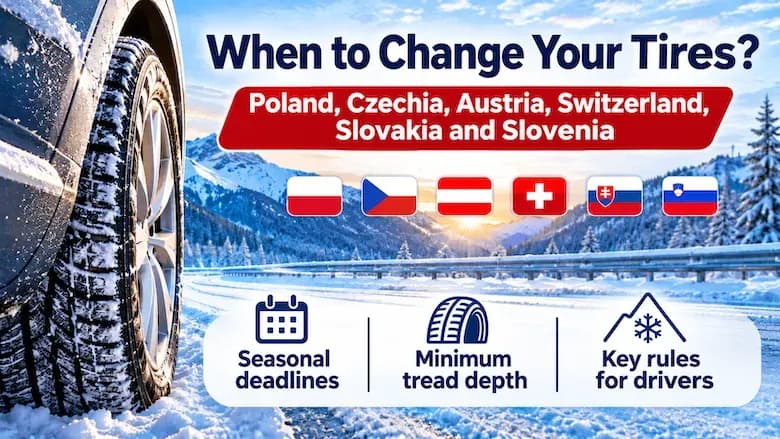
Other countries can impose particular dates, tread depths, markings or snow-chain obligations. Our winter tyres in Europe: dates and minimum tread depth guide explains the main differences for the 2026/2027 season.
| Country | What all-season tyre drivers should know |
|---|---|
| Germany | 3PMSF required in wintry conditions; legal tread minimum 1.6 mm, with 4 mm recommended for winter driving. |
| Austria | Winter equipment required in wintry conditions from 1 Nov to 15 Apr. Standard radial tyres accepted as winter tyres generally need 4 mm tread and suitable markings. |
| Czech Republic | From 1 Nov to 31 Mar when conditions are wintry or expected, plus relevant signposted roads. For passenger cars, winter tread minimum generally 4 mm. |
| Slovakia | Appropriate winter tyres when snow, ice or frost is present or expected; minimum 3 mm tread when the winter requirement applies. |
| Slovenia | Winter equipment generally required from 15 Nov to 15 Mar and in wintry conditions outside these dates; winter-equipment tyre tread usually at least 3 mm. |
| Hungary | No general winter tyre requirement for passenger cars; snow chains may be mandatory on signposted roads. |
| Poland | No general seasonal winter tyre requirement, but tyres must still be roadworthy. |
| Switzerland | No universal winter tyre obligation; unsuitable tyres can still have legal and insurance consequences after a hazard or accident. |
This is a simplified guide for passenger cars. Snow-chain alternatives, regional exceptions, signs and vehicle categories can change what is permitted. Always check official rules before travelling. Supporting information: ADAC tyre guidance and Austria's official winter equipment guidance.
DRIVING ACROSS EUROPE
Check your tyres – and arrange the right e-vignettes
Whether you are heading for the ski slopes, driving to Prague or crossing central Europe, suitable tyres and motorway tolls are two separate parts of a safe, legal journey. Explore the main destinations on Winiety24.eu:
Remember: winter tyre regulations and motorway vignette rules are separate obligations. Before using a toll road, confirm your number plate, country of registration and validity dates. You can also use our e-vignette validity checking guide.
For practical journey planning, see how Austria's one-day vignette works and whether you need to print your vignette confirmation.
How to choose good all-season tyres: 7 things to check
- 3PMSF marking. If you intend to drive in winter, look for the three-peak mountain snowflake symbol; M+S alone does not meet Germany's winter rule.
- Independent test results. Compare wet braking, snow grip, dry handling and durability – ideally in the exact tyre size you need.
- Size and approval. Check the tyre dimensions, load rating and speed rating required by the car manufacturer and local laws.
- Your usual roads. Urban streets, motorways, mountain passes and snowy country roads demand different strengths.
- Production date and condition. The DOT code helps identify the production date; inspect storage, sidewalls, cracks and damage too.
- Tread depth. Measure it regularly. Germany's legal minimum is 1.6 mm, but 4 mm is recommended for winter; other countries may be stricter.
- Lifetime cost. Include purchase, fitting, balancing, annual mileage, possible storage savings and expected service life.
Once the tyres are fitted, check pressures against the vehicle manufacturer's specifications and monitor their condition. You may avoid seasonal changeovers, but you cannot avoid regular tyre maintenance.
Frequently asked questions about all-season tyres
Can I use all-season tyres in winter?
Yes, provided the tyres meet the requirements of the country and conditions. In Germany, all-season tyres used in wintry conditions must carry the 3PMSF Alpine symbol. Dedicated winter tyres may still be safer in severe conditions.
Are winter tyres compulsory in Germany on specific dates?
No. Germany's winter tyre rule is based on road conditions such as snow, ice and slush, rather than a fixed national start and end date.
Is the M+S marking enough for winter driving?
Not in Germany. Since 1 October 2024, tyres used in wintry conditions must carry the Alpine/3PMSF symbol; an M+S marking alone does not qualify.
Can I drive to Austria on all-season tyres?
Yes, if the tyres meet Austria's applicable winter marking and tread-depth rules. Between 1 November and 15 April, winter equipment is required in wintry conditions; standard radial winter tyres generally need at least 4 mm of tread.
How long do all-season tyres last?
There is no universal mileage figure. Tyre compound, driving style, inflation, alignment, road surfaces and load all influence wear. Regular inspection is more useful than relying on a single quoted lifespan.
Are all-season tyres noisier than summer tyres?
Not necessarily. Road noise depends on the tyre design, road surface and speed. EU tyre labels and independent testing can help you compare models.
Do all-season tyres actually save money?
They can, especially by reducing seasonal fitting and storage costs. But because the same tyres are used all year, compare the total cost per kilometre and expected replacement dates.
All-season tyres or winter tyres for an SUV?
Consider the vehicle's weight, approved size and where you drive. Four-wheel drive helps traction when moving off but does not remove the limitations of braking and cornering on ice. Frequent Alpine trips usually favour good winter tyres.
All-season tyres in 2026/2027: Are they worth buying?
Yes – if they suit the way you drive. A well-tested all-season tyre can be a practical option for everyday urban driving and modest annual mileage. For demanding mountain routes, extreme summer heat or heavy winter snow, separate summer and winter tyres often provide more specialised performance.
Before purchasing, check the Alpine marking, the correct tyre size and independent results. For cross-border journeys, also review national winter tyre rules and any required motorway vignettes.
Editorial note: Information updated 8 November 2026. Road safety depends on the actual tyre model and its condition. Regulations can change, so check official guidance before each international journey.