Winter Tyre Laws in Europe: Fines & Rules 2026/2027

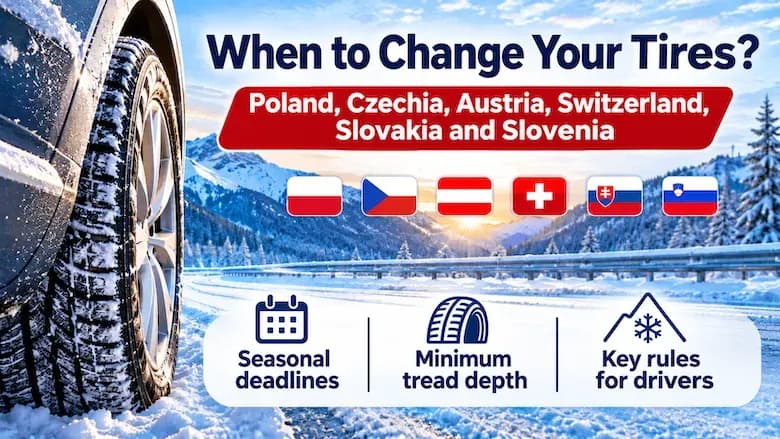
Is it legal to drive on summer tyres in winter? In Poland, you will not be fined simply for not having winter tyres. But as soon as you cross the border into the Czech Republic, Slovakia or Germany, things can look very different. In some countries snow or ice on the road is enough to trigger the requirement; in others, winter tyres or suitable equipment are mandatory during set periods.
Importantly, a winter tyre requirement does not always mean you have to fit winter tyres. Some countries accept all-season tyres, and a few even allow summer tyres combined with snow chains.
We look at the rules in force for the 2026/2027 season, the fines and the exceptions in 30 European countries.
Can you be fined in Poland for not having winter tyres?
No. Poland has no statutory requirement to switch to winter tyres for the season.
This means drivers can use summer tyres in December, January or February too. Snow on the road does not in itself mean you are committing an offence by not having winter tyres.
That does not mean anything goes, however.
The car must be roadworthy, and its tyres must not compromise road safety. A fine or the retention of your registration certificate can result from tyres in poor condition, e.g. excessively worn or damaged. Current rates are listed in our Fine Tariff 2026 – complete guide for drivers in Poland.
Two figures are worth remembering:
- 1.6 mm the minimum legal tread depth for a typical passenger car tyre in Poland.
- 4 mm the recommended minimum tread depth for winter tyres for safety reasons.
Changing tyres is especially advisable once temperatures regularly drop to around 7 °C and there is a risk of snow, black ice or slush. You can read more about dates and rules in Poland in our guide Winter Tyres in Poland 2026 – until when and what the rules are.
Before the season, also read:
Fines for not having winter tyres in Europe – 2026/2027 table
There is no single Europe-wide rule on winter tyres. Each country sets its own requirements, the periods when they apply and the penalties.
In the table below, “fine” refers to driving without the winter tyres or winter equipment required by law – not always to simply not having winter tyres.
| Country | Risk of a fine? | When does the requirement apply and what is the penalty? |
|---|---|---|
| Poland | NO | No winter tyre requirement. A fine is possible if the tyres are not roadworthy. |
| Czech Republic | YES | 1 Nov – 31 Mar in winter conditions or when they can be expected; also on roads with the relevant signs. Up to 1,500 CZK on the spot, 2,000–5,000 CZK in administrative proceedings. |
| Slovakia | YES | When there is snow, ice or frost on the road, including when such conditions can be expected along the route. Fines from around €50. |
| Austria | YES | 1 Nov – 15 Apr in winter conditions. Basic fine €35; much higher penalties are possible if you endanger others. |
| Germany | YES | In snow, slush, ice or black ice, with no fixed dates. From €60, or €80 if you obstruct traffic. |
| Switzerland | NO, only conditionally | No general requirement. However, a fine and insurance consequences are possible if unsuitable tyres contribute to a hazard or an accident. |
| Hungary | NO | No general winter tyre requirement. Snow chains may be mandatory on some roads. |
| Romania | YES | All year round on roads covered with snow, ice or black ice. In November 2026 the fine is 1,946.25–4,325 RON; the registration certificate may also be retained. |
| Bulgaria | YES, conditionally | 15 Nov – 1 Mar: winter tyres or other tyres with at least 4 mm of tread required. Failure to comply can result in a fine. |
| Slovenia | YES | 15 Nov – 15 Mar, and outside this period in winter conditions. €40 for missing the required equipment; up to €500 in more serious cases of obstructing traffic. |
| Croatia | YES | 15 Nov – 15 Apr on designated sections regardless of the weather, and when winter conditions are declared. Fine for the driver: €130. |
| Italy | YES, locally | On roads subject to a winter equipment requirement, most often 15 Nov – 15 Apr. Fines outside built-up areas of around €87–345. |
| France | LOCAL REQUIREMENT | 1 Nov – 31 Mar in designated mountain areas. Reports conflict on whether a separate €135 penalty has been introduced; regardless, you can be fined for ignoring signs that require winter equipment. |
| Denmark | YES, conditionally | No fixed date. Police can fine you 1,000 DKK per tyre for driving on tyres that are clearly unsuitable for snow and ice. |
| Luxembourg | YES | In snow, ice, black ice or slush, with no fixed dates. Fines of around €49–74. |
| Estonia | YES | Required from 1 Dec to 1 Mar, which may be extended depending on the weather. Fines of up to around €160. |
| Latvia | YES | 1 Dec – 1 Mar. Suitable tyres with the 3PMSF symbol and at least 4 mm of tread required. Fine of around €30. |
| Lithuania | YES | From 10 Nov to the end of March. Winter tyres or approved all-season tyres required. Breaches are fined. |
| Finland | YES | 1 Nov – 31 Mar when weather or road conditions require it. Fines from around €100. |
| Sweden | YES | 1 Dec – 31 Mar when there are winter conditions. Suitable tyres required, generally with the 3PMSF marking. |
| Norway | CONDITIONALLY | No general winter tyre requirement for passenger cars, but adequate grip must be ensured; a minimum tread depth of 3 mm also applies in winter. |
| Belgium | NO | No general seasonal winter tyre requirement. |
| Netherlands | NO | No winter tyre requirement. |
| Spain | LOCALLY | No general requirement. Suitable tyres or snow chains may be ordered on designated roads and in the mountains. |
| Portugal | NO | No general winter tyre requirement. Snow chains may be required on designated roads. |
| Greece | CONDITIONALLY | No general winter tyre requirement. The authorities may order anti-skid equipment, e.g. snow chains. |
| Ireland | NO | No winter tyre requirement. |
| United Kingdom | NO | No general requirement. Tyres must be safe and comply with technical regulations. |
| Malta | NO | No seasonal winter tyre requirement. |
| Cyprus | NO | No general winter tyre requirement. Local restrictions may apply on snow-covered mountain roads. |
Important: the fines listed apply to typical offences by drivers of passenger cars. The penalty may be higher if you cause a hazard, an accident or a road blockage, or ignore police instructions. Rates may also change.
Where is driving without winter tyres especially costly?
Czech Republic – fines of up to 5,000 koruna
In the Czech Republic the requirement applies from 1 November to 31 March if there is snow, ice or frost on the road, or if winter conditions can be expected during the journey.
Passenger cars must have four winter tyres with at least 4 mm of tread. A breach can mean a fine of up to 1,500 CZK on the spot, or 2,000–5,000 CZK in administrative proceedings. We explain the details, including what the road signs mean, in our guide Winter Tyres in Czechia – regulations and road signs.
Example: you set off from Poland on summer tyres because it is dry in Katowice. While you are driving through the Czech Republic, it starts to snow. If you do not have the required tyres, you may be breaking Czech law.
Before you go, also check the new Czech fines tariff. On Czech motorways you also need a Czech e-vignette – find out how much a missing vignette can cost.
Austria – the requirement depends on road conditions
From 1 November to 15 April, winter equipment is mandatory on Austrian roads whenever winter conditions prevail.
Vehicles up to 3.5 tonnes must have winter tyres on all wheels. The minimum tread depth for a typical radial tyre is 4 mm.
The rules also allow driving on summer tyres with snow chains fitted to the drive wheels, but only if the road is fully or almost fully covered with snow or ice.
The basic offence carries a fine of €35. If unsuitable tyres cause a hazard, the consequences can be many times more serious. You will find all the rules in our article Winter Tyres in Austria – until when and what the rules are.
If you are heading to the Alps, also read about road controls in Austria in 2026 and our guide Austria Vignettes 2026 – prices, tunnels and the 18-day trap. For motorways and expressways you need an Austrian vignette.
Germany – black ice is enough, even without snowfall
Germany applies a situational requirement. There is no fixed date from which winter tyres are mandatory.
If there is snow, slush, ice or black ice on the road, the car must have suitable tyres.
Since 1 October 2024, tyres marked only with the M+S symbol are no longer sufficient. The alpine 3PMSF symbol – a three-peaked mountain with a snowflake – is required.
The basic fine is €60, or €80 if you obstruct traffic. You may also receive a penalty point in the German register.
Whether you need a vignette in Germany is explained in our guide Are vignettes required in Germany?
Slovakia – no single date for passenger cars
In Slovakia, the driver of a passenger car must have suitable tyres when the road is covered with snow, ice or frost.
The requirement can also apply when such conditions can reasonably be expected along the planned route.
Tyres must have at least 3 mm of tread and be fitted on all wheels. Suitably marked all-season tyres are allowed. Find out more in our guide Winter Tyres in Slovakia – regulations and deadlines.
Note: the frequently quoted dates of 15 November – 31 March also refer to separate requirements for heavier vehicle categories. They should not be treated as the only period in which a passenger car needs winter tyres.
Planning a ski trip to Slovakia? Buy your Slovak vignette in good time – prices and fines are explained in our guide to the Slovak vignette 2026.
Romania – high fines and the risk of losing your registration certificate
Romanian law does not set a start date for the winter season. Winter tyres become mandatory when the road is covered with snow, ice or black ice.
Under the rates in force in November 2026, the fine is between 1,946.25 and 4,325 RON.
The police can also retain the registration certificate and prevent further use of the vehicle until the problem is fixed.
Before you travel, you can also buy the Romanian e-vignette (rovinieta) online.
Slovenia and Croatia – winter equipment even in good weather
This is important information for drivers heading to southern Europe.
Slovenia requires winter equipment from 15 November to 15 March, regardless of the weather. You can use winter tyres or, subject to specific conditions, summer tyres with suitable snow chains. The basic fine is €40. We describe the options in detail in our article Winter Tyres in Slovenia – regulations, deadlines and fines, and the other rates in the Slovenian fines tariff. Slovenian motorways require a Slovenian e-vignette.
Croatia requires winter equipment from 15 November to 15 April on designated road sections, even when there is no snow. Alternatively, four summer tyres with at least 4 mm of tread plus suitable snow chains are accepted. The fine for the driver is €130.
Planning a winter trip to the Adriatic? Check what car equipment you need for Croatia in the transit countries, and buy the vignettes for your route to Croatia.
Hungary and Switzerland – no requirement does not mean no liability
Hungary has not introduced a general winter tyre requirement. However, snow chains may be mandatory on selected roads. For Hungarian motorways you need the Hungarian e-vignette (e-matrica).
Switzerland, too, has no statutory date for changing tyres and no fine simply for not having winter tyres. See our article Winter Tyres in Switzerland – regulations, fines and tips for details.
However, if a vehicle on unsuitable tyres blocks traffic or causes an accident, there may be legal and insurance consequences. Swiss motorways also require a Swiss vignette.
France and Italy – special rules in the mountains
In France, from 1 November to 31 March, suitable winter equipment is mandatory in selected mountain municipalities.
Drivers of passenger cars can comply by fitting four tyres with the 3PMSF marking, or by carrying suitable snow chains or textile anti-skid devices (snow socks) for at least two drive wheels.
Be careful with the €135 figure: many guides quote it as the fine for breaching the so-called Loi Montagne. However, in its February 2026 reply to the Senate, the French Ministry of the Interior stated that no act introducing a separate penalty had been adopted, and an analysis published on 28 October 2026 confirms this. Regardless, you can be fined for breaching a separate requirement imposed by road signs.
In Italy the rules vary by region and by road. On many routes, winter tyres or snow chains carried on board are mandatory, most often from 15 November to 15 April. Some regions, including the Aosta Valley, apply different dates.
Heading to the Dolomites for skiing? Plan your route to Italy by car, check how to pay for Italian motorways, and buy the vignettes for your route to Italy.
Do all-season tyres protect you from a fine in Europe?
Yes, but only if they meet the rules of the country you are in.
The words “All Season” on a tyre do not by themselves determine whether it meets the requirements.
Two markings are worth knowing:
M+S (Mud and Snow)
A marking referring to mud and snow. It is accepted in some countries, including Austria, the Czech Republic, Slovakia and Romania, provided the other conditions are met.
3PMSF (Three Peak Mountain Snowflake)
A mountain-and-snowflake symbol confirming that the tyre achieved a specified level of grip on snow in type-approval tests. It is required in Germany and Latvia, among others, and for standard non-studded winter tyres in Sweden.
If you often drive around Europe in winter, it is worth choosing good-quality winter or all-season tyres marked M+S and 3PMSF, and checking the required tread depth. We compare test results and prices in our best winter tyres 2026/2027 ranking.
Can snow chains replace winter tyres?
Not always.
In some countries, correctly fitted snow chains can be an alternative to winter tyres. This applies, among others, in certain situations in Austria, Slovenia, Croatia, France and Italy.
However, the rules differ significantly.
In Austria, snow chains may be used instead of winter tyres only when the road surface is sufficiently covered with snow or ice. In France, in designated mountain areas it is often enough to carry suitable anti-skid devices in the car, but on certain signposted sections they must actually be fitted.
So you should not assume that carrying snow chains in the boot exempts you from the winter tyre requirement everywhere in Europe. Before a ski trip, use our winter packing list.
Can you lose your insurance payout if you do not have winter tyres?
Not having winter tyres can also matter after an accident.
In countries with a winter equipment requirement, the insurer may examine whether unsuitable tyres contributed to the accident or increased the damage.
This does not mean a claim will automatically be refused. What matters are the circumstances of the accident, the established cause, the law of the country concerned and the terms of your insurance.
In Poland, too, you cannot assume that every collision on summer tyres in winter means losing your insurance cover. The specific circumstances and the terms of the policy are decisive.
Before travelling abroad, check which roadside assistance in Europe is right for you and whether assistance covers a flat tyre abroad. You can choose a package for your trip under insurance and car assistance.
Winter travel in Europe – do not forget your vignette
Getting your car ready for a winter trip does not end with changing the tyres.
If you are travelling to the Czech Republic, Austria, Slovakia, Hungary, Slovenia or Switzerland, check the road tolls that apply as well.
At Winiety24.eu you can browse our range of electronic vignettes and buy your e-vignette online before you set off.
Particularly useful pages:
- Czech vignettes – for trips to Prague, Brno or Ostrava.
- Austrian vignette – for motorways and expressways on the way to the Alps.
- Slovak vignettes – for Slovak motorways and expressways.
- Hungarian vignette – e-matrica for Hungarian motorways.
- Slovenian vignettes – on the way to Ljubljana, the Adriatic or Croatia.
- Swiss vignette – for Swiss motorways and expressways.
- Bulgarian vignettes – for a longer trip to the Balkans.
- Romanian vignettes – rovinieta for Romanian roads.
On some Alpine sections a vignette is not enough – a separate section toll is charged:
Already have a vignette? Find out how to check whether your e-vignette is valid. When planning your budget, the latest fuel prices in Europe 2026 will help, and before heading to the mountains, read our guide Ski trip to the Alps by car.
Also read our guide: When to switch to winter tyres? Rules in Poland and Europe 2026/2027.
Before you set off, check your tyres, winter equipment and road tolls for the whole route. You can buy an e-vignette online in a few minutes – no queues at the border.
Frequently asked questions (FAQ)
Is there a fine in Poland in 2026 for not having winter tyres?
No. Polish law does not require drivers of passenger cars to use winter tyres from a specific date. You can, however, be penalised for defective or excessively worn tyres.
Can you be fined in the Czech Republic for summer tyres in November?
Yes, if there are winter conditions or they can be expected during the journey. The requirement applies from 1 November to 31 March and on specially signposted sections.
Are winter tyres mandatory in Germany from October?
There is no single mandatory date. Suitable tyres are required in wintry road conditions – even before October or after March.
Do you need winter tyres in Hungary?
No. Hungary has no general winter tyre requirement. However, snow chains may be mandatory on selected sections.
Are all-season tyres enough for driving in Austria and the Czech Republic?
Yes, if they are properly marked and have the required tread depth. In both countries, compliance with the other technical requirements also matters in winter conditions.
Can a Polish driver be fined abroad for not having winter tyres?
Yes. Vehicle equipment rules generally apply to cars registered in Poland as well. Polish number plates do not exempt you from the requirements of the country you are driving in. See also our guide on how to return from holiday without a fine.
Can you drive on summer tyres in Switzerland in winter?
There is no general ban. However, the driver must ensure the vehicle can be driven safely. Unsuitable tyres can have consequences if you obstruct traffic or cause an accident.
Summary – where can you be fined for not having winter tyres, and where not?
Poland, Hungary, Belgium, the Netherlands and the United Kingdom are among the countries with no general winter tyre requirement for passenger cars.
The Czech Republic, Austria, Germany, Slovakia and Romania require suitable tyres in certain road conditions.
Slovenia, Croatia, the Baltic states and some Scandinavian countries apply additional rules tied to the calendar and to winter equipment.
Before you travel, check not only whether your tyres have a winter marking, but also the minimum tread depth, the snow chain requirements and the current road signs.
The most important rule: no fine does not mean summer tyres are a safe choice in winter.
Sources
Based on information published by institutions and organisations dealing with road traffic regulations:
- European Consumer Centre – winter tyre requirements in Europe
- ADAC – winter tyres and snow chains in Europe
- Austrian Ministry of Transport – winter tyres and snow chains
- Czech Police – winter tyre rules
- Slovak road traffic law – Section 38 of Act No. 8/2009
- Danish Road Traffic Authority – tyre rules
- Slovenian Traffic Safety Agency – winter equipment
- French administration – winter equipment 2026/2027
- French Senate – reply on penalties
Fines and equipment requirements may change. Before you travel, also check local restrictions and the latest announcements from road authorities.