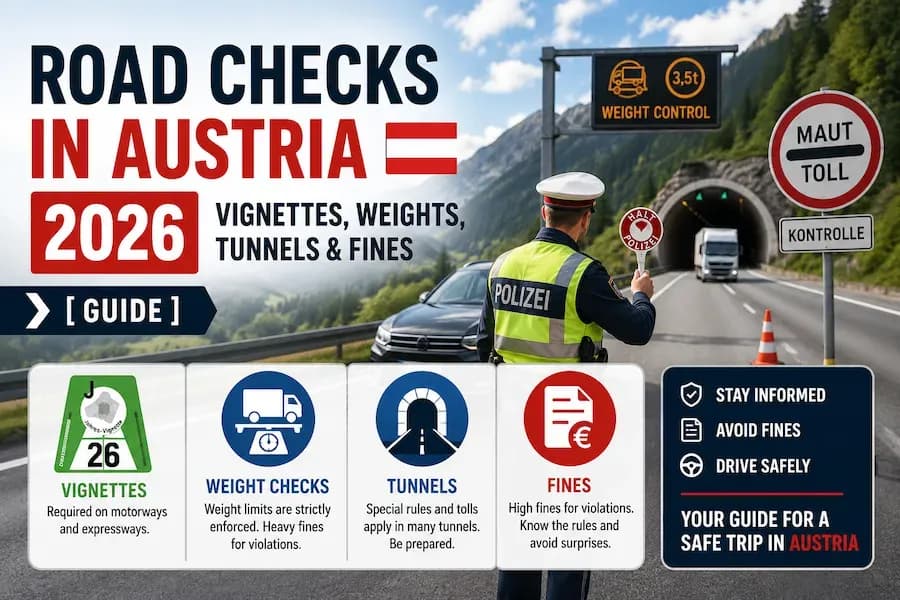
Road Controls in Austria 2026: Vignettes, Weigh Stations & Fines
2026 Regulations Update
Road Controls in Austria 2026: Vignettes, Weigh Stations, Tunnels, Section Control, and Fines
A practical guide for drivers and transport operators navigating Austrian motorways. Learn how ASFINAG systems operate and how to avoid costly errors and severe financial penalties.
1. Introduction: The Reality of Road Checks in Austria in 2026
When setting off on a route through Austria in 2026—whether traveling privately in a passenger car for an Alpine holiday, driving a loaded 3.5t delivery van, or towing a trailer—you must keep one thing in mind: the Austrian traffic enforcement system is among the most strict and technologically advanced in Europe. Here, traditional police patrols represent only a fraction of the monitoring effort. The primary burden of enforcement is carried by the automated systems of the state highway operator ASFINAG and a specialized network of road control stations (A-Kontrollstellen).
Austrian penalty guidelines accept no excuses regarding "ignorance" or "being in a rush." Mistakes can cost anywhere from a few hundred to several thousand euros, while unpaid tolls or overloading a van by a few hundred kilograms will immediately halt your journey. Below is a comprehensive, practical guide navigating all nuances of Austrian traffic laws.
2. How Do ASFINAG Digital Cameras Work?
The company ASFINAG (Autobahnen- und Schnellstraßen-Finanzierungs-Aktiengesellschaft) is responsible for the construction, maintenance, and toll collection across more than 2,200 kilometers of motorways and expressways in Austria. Their main asset in enforcing compliance is an integrated network of automated cameras.
In 2026, Austria operates three primary types of camera systems targeted at verifying toll compliance and vehicle parameters:
- AVM (Automatische Vignettenkontrolle): Stationary gantries installed at key junctions and border crossings. Passing vehicles are photographed from multiple angles simultaneously (front, windshield, and rear license plate). OCR software reads the registration number and cross-references the central digital vignette database in a fraction of a second. For vehicles using physical sticker vignettes, high-end optical filters verify the authenticity and proper placement of the sticker in the top-left corner or behind the rear-view mirror.
- PAVM (Tragbare Automatische Vignettenkontrolle): Portable control systems. ASFINAG operates dozens of mobile units that relocate every few days. Placed on overpasses or pedestrian bridges without prior announcement, drivers relying on memory cannot predict where a check will take place on any given day.
- GO-Box Gantries (DSRC Microwave System): Dedicated to vehicles exceeding 3.5 tonnes GVW. They communicate with the GO-Box onboard unit mounted behind the windshield of heavy goods vehicles or buses. The system automatically checks declared axle counts, Euro emission standards, and account validity. Any missing acoustic signal (beep) indicates a transaction error, triggering an automatic photo of the license plates.
3. Where Are Vignette Controls Most Frequent?
A common misconception among foreign drivers is that after crossing the border, they can drive the first few kilometers without a vignette to reach the nearest service station. In Austria, tolls apply from the very first meter of the motorway after crossing the border! Lacking a vignette immediately after entry is one of the most frequent causes for substitute toll assessments.
Here are the points with the absolute highest intensity of vignette enforcement:
Border A4
Nickelsdorf (PL/HU/SK ➔ AT)
Entry point from Hungary and Slovakia. Stationary gantries right after the former border post and SKD patrols at rest areas.
Border A8
Suben (DE ➔ AT)
Route from Germany toward Linz and Vienna. Stationary camera system integrated with speed verification on the entry lane.
Border A12
Kiefersfelden / Kufstein
Entry from Bavaria. Note: Continuing past the Kufstein junction without a valid digital vignette risks an immediate fine.
Junction A1/A21
Steinhäusl
Key transit hub on the Vienna bypass. Portable PAVM cameras are frequently set up on overpasses here.
Motorway A9
Spielfeld (SI ➔ AT)
Return route from Croatia/Slovenia. Detailed vignette inspections paired with random customs and weight checks.
Motorway A2
Arnoldstein (IT ➔ AT)
Entry point from Italy. Gantry cameras and mobile patrols inspecting vehicles pulling into rest areas.
4. Vehicle Weigh Stations (A-Kontrollstellen)
Austria has developed a world-leading network of stationary and semi-stationary traffic inspection facilities known as A-Kontrollstelle. These are comprehensive, dedicated inspection complexes located directly along motorways, equipped with dynamic Weigh-in-Motion sensors, stationary scales, diagnostic pits, brake rollers, and lab facilities.
When the dynamic scale built into the road surface detects a vehicle with suspicious weight or axle load, integrated Variable Message Signs (VMS) display a mandatory exit instruction for that vehicle category (e.g., "Alle LKW / Busse" pull in for inspection).
Most Important Weigh Stations in Austria:
- A1 Haag (Lower Austria): One of the busiest inspection points on the Vienna – Salzburg corridor. Controls freight and commercial traffic in both directions.
- A2 Straßwalchen & Kundl (A12): Stations in Tyrol and Salzkammergut particularly attuned to transit and light commercial vehicles up to 3.5t.
- A13 Brenner (Nösslach): The most famous inspection hub on the route to Italy. Rigorous checks on axle loads for 40-tonne rigs as well as gross weights of tourist buses and delivery vans.
- A8 Kematen / Suben: Facility monitoring transport from Germany. Frequent round-the-clock block operations by police and ASFINAG.
5. Controls on Vans, Campers, Trailers, and Car Haulers
Light commercial vehicles and leisure vehicles are subject to close scrutiny in Austria. Authorities are well aware that weight violations occur frequently within this category.
Delivery Vans (Category N1 up to 3.5t)
Curtain-side vans and panel vans transiting through Austria are a main priority for SKD (Service- und Kontrolldienst) patrols. Inspectors look closely at suspension sag, ground clearance, and tire condition. Even if the registration document lists a Gross Vehicle Weight (GVW) of 3,500 kg, the actual unladen weight with custom bodywork often exceeds 2,600 kg. This leaves a legal payload capacity of only a few hundred kilograms. Carrying two heavy pallets can almost automatically result in exceeding the maximum gross weight.
Motorhomes and Campers
Many camper drivers forget that full fresh water tanks, gas bottles, e-bikes on the rack, and a full cabin of passengers can easily push total weight to 3,800–4,000 kg. In Austria, exceeding the 3,500 kg limit causes a dual issue:
- Overloading a vehicle registered under 3.5t (overweight fine).
- Driving without a GO-Box onboard unit on a toll road (treated as toll evasion for heavy vehicles, resulting in a €220 substitute toll or judicial fines up to €3,000).
Car Transporters and Trailer Combinations (Category B+E)
When towing a trailer or car hauler, two parameters are critical: Gross Combination Weight Rating (GCWR) and Noseweight (Stützlast). Austrian police verify that trailer weight complies with field O.1 on the towing vehicle's registration certificate. Furthermore, for oversized combinations, officers check for mandatory extension mirrors and proper cargo securing (straps with legible rating labels, wheel chocks).
6. Exceeding GVW and Axle Load Limits – Consequences in 2026
Austrian regulations regarding weight and axle load violations offer no room for negotiation. Sanctions are divided into financial penalties and Sicherheitsleistung (cash security deposit enforced by vehicle immobilization).
| Percentage Over Maximum Weight | On-the-spot Fine (Organstrafverfügung) | Administrative Consequences & Onward Travel |
|---|---|---|
| Up to 2% (Tolerance) | €0 / Caution | Permitted to continue journey. |
| 2% - 5% | €90 - €150 | Mandatory offloading of excess cargo if feasible on site. |
| 5% - 10% | €200 - €400 | Strict ban on continuing journey until offloaded. Documents/keys confiscated. |
| 10% - 20% | €450 - €1,000 | Offense registered; case referred to District Authority (BH). Deposit collected immediately. |
| Above 20% | From €1,500 to €5,000 | Penal-administrative proceedings against driver AND operator. Wheel clamp applied. |
7. Section Control Speed Enforcement
Austria pioneered the implementation of Section Control systems. Unlike traditional fixed speed cameras, this technology calculates a vehicle's average speed over a distance spanning from several to over ten kilometers.
Cameras at the entry and exit points scan license plates and compute travel time. If the calculated average speed exceeds the posted limit by as little as 6 km/h (after deducting tolerance), the system automatically issues a penalty notice.
Major Section Control Zones in 2026:
- A22 Kaisermühlen Tunnel (Vienna): Underground section in the capital. Dense traffic and strict enforcement of the 80 km/h limit.
- A9 Plabutsch Tunnel (Graz Bypass): Nearly 10 km long tunnel section. Strict 100 km/h or 80 km/h variable speed limits.
- A2 Wechsel (Mountain Section): Winding climbs and descents on the Styria/Lower Austria border with dynamic speed limits.
- A15 / S16 Arlberg Expressway: Roadworks zones and tunnel access corridors.
- A10 Tauern Motorway: Construction zones around the Tauern and Katschberg tunnels featuring mobile Section Control trailers (Trailer-Control).
8. IG-L Environmental Speed Limits (Immissionsschutzgesetz-Luft)
A common surprise for foreign motorists in Austria is encountering overhead gantry signs showing speed limits accompanied by the letters "IG-L". These regulations stem from national air quality control laws.
When air quality sensors in mountain valleys detect elevated concentrations of nitrogen dioxide (NO2) or particulate matter, the system automatically reduces the standard 130 km/h limit down to 100 km/h (or 80 km/h in select regions).
Why Are Speeding Violations Under IG-L Unusually Costly?
Exceeding the speed limit in an IG-L zone is not classified as a standard traffic offense—it is legally prosecuted as an environmental pollution offense. As a result, fine amounts are significantly higher!
- Driving 125 km/h in a 100 km/h IG-L zone: A standard 25 km/h overspeed fine costs around €50–€70, but under IG-L, the fine ranges from €150 to €350.
- Maximum administrative fines for severe IG-L violations can reach up to €2,180.
Under Austrian law, pure Battery Electric Vehicles (BEVs) and Fuel Cell Electric Vehicles (FCEVs) are exempt from IG-L speed reductions and may maintain 130 km/h, provided they display designated green registration plates or meet identification criteria. Note: Plug-in Hybrids (PHEVs) are NOT exempt from IG-L limits!
9. Section Tolls and Tunnels (Sondermaut)
Austria features 6 specific motorways and expressway segments where standard vignettes (both sticker and digital) DO NOT APPLY. These are special toll sections (Sondermautstrecken) passing through complex engineering structures, lengthy tunnels, or high mountain passes.
For these routes, a separate toll must be purchased prior to travel (online or at the toll station):
| Route / Tunnel | Section | 2026 Rate (Car) | Notes & Tips |
|---|---|---|---|
| A9 Pyhrn Motorway | Bosruck Tunnel / Gleinalm Tunnel | approx. €6.50 - €10.50 | Charged per tunnel or as a combined ticket. Fastest route to Graz. |
| A10 Tauern Motorway | Tauern & Katschberg Tunnels | approx. €13.50 | Heavy holiday travel traffic. Digital prepayment (Digital Flex) strongly recommended. |
| A13 Brenner Motorway | Innsbruck – Italian Border | approx. €11.00 | No standard vignette needed if traveling exclusively on this route from border to border. |
| S16 Arlberg Expressway | Arlberg Tunnel | approx. €11.50 | Longest road tunnel in Austria (15 km). Frequent maintenance closures at night. |
| A11 Karawanken Motorway | Karawanken Tunnel (Slovenian Border) | approx. €8.20 | Southbound toll collected by Austria; northbound toll collected by Slovenia. |
Expert Tip: Activate the ASFINAG Digital Flex service. It automatically links your vehicle license plate to your credit card. Video toll lanes at Sondermaut plazas open automatically without needing to stop or lower your window.
10. Overview of the Most Common Fines in Austria
Austrian highway police (Autobahnpolizei) are renowned for strict enforcement. Below are the offenses foreign drivers most commonly commit:
- Tailgating / Insufficient Following Distance (Abstandsmessung): Distance is monitored in seconds and meters using cameras on overpasses. At 130 km/h, the safe gap is at least 50 meters. Following at under 0.4 seconds risks a driving ban of at least 3 months and fines up to €2,180!
- Improper Use of the Emergency Corridor (Rettungsgasse): As soon as traffic slows to a standstill on a motorway, drivers must form an emergency corridor: left lane moves left, all other lanes move right. Driving through or blocking the emergency corridor carries fines up to €2,180.
- Using a Mobile Phone Without Hands-Free System: The on-the-spot fine is €100. Refusing to pay on site increases the formal administrative fine to €140–€500.
- Missing Mandatory Safety Equipment: High-visibility vest for every passenger (must be stored in the passenger cabin, not the trunk!), warning triangle, and a first-aid kit complying with DIN 13164 (expiration dates on sterile supplies are checked!).
11. What to Do Upon Receiving a Fine or Payment Request from Austria?
Receiving official mail from an Austrian authority (e.g., Bezirkshauptmannschaft) can be concerning. It is crucial to identify the exact document type you have received:
1. Ersatzmaut (Substitute Toll Request from ASFINAG)
Issued directly by ASFINAG for driving without a valid vignette or tunnel toll. Standard rates are €180 (passenger cars) or €90 (motorcycles). It serves as a settlement offer to resolve the matter out of court.
Action required: Pay the specified amount within the designated deadline (typically 14 days). Payment settles the case entirely without criminal or administrative records.
2. Anonymverfügung (Anonymous Penalty Order)
Issued by police or district authorities for camera-recorded offenses (e.g., speeding). Fines generally range from €30 to €500.
Action required: Pay the indicated fine within 4 weeks. There is no right of appeal against an Anonymverfügung. Filing an objection voids the order and opens formal proceedings (Ordentliches Verfahren), which usually doubles the total costs.
3. Lenkererhebung (Driver Identification Request)
An official order requesting the registered owner to disclose who was driving the vehicle at a specific time.
Action required: You must respond within 2 weeks! Providing false information or ignoring the notice constitutes a separate, severe administrative offense punishable by fines from €1,000 up to €10,000!
12. Map of Control Locations – Key Zones List
The list below outlines strategic enforcement locations in Austria where foreign motorists frequently undergo comprehensive roadside checks by Police, ASFINAG, and Labor Inspectorates:
| Motorway | Location / Kilometer | Type of Inspection | Primary Inspection Target |
|---|---|---|---|
| A1 | Kontrollstelle Haag (Lower Austria) | Stationary weigh station + diagnostic pit | Van weights, vehicle condition, driver hours |
| A2 | Kontrollstelle Ilztal (Styria) | Semi-stationary inspection facility | Dynamic weight sensors, digital vignettes |
| A4 | Nickelsdorf Border Crossing | 24/7 AVM gantry + mobile patrols | Vignettes, cargo legality, roadworthiness |
| A9 | Kontrollstelle Straß (Slovenian Border) | Customs and traffic control station | Gross weight, smuggling, road tolls |
| A10 | Rennweg Service Area / Tauern Tunnel | Mobile control units | Overloaded campers and holiday vans |
| A12 | Kontrollstelle Radfeld (Tyrol) | Advanced diagnostic station | Exhaust emissions, HGV night bans, van weights |
| A13 | Nösslach Service Area (Brenner) | Mountain verification facility | Downhill axle loads, brake wear/condition |
13. Table of Penalties and Fines in Austria 2026
Below is a breakdown of fine rates for common traffic violations in Austria for 2026:
| Violation Type | Minimum Fine (On-site) | Maximum Fine / Court | Additional Sanctions |
|---|---|---|---|
| Missing Vignette (Substitute Toll) | €180 | €3,000 | Travel banned until paid |
| Vignette Tampering (Re-using stickers) | €360 | €3,000 | Referral to public prosecutor |
| Missing GO-Box (>3.5t GVW) | €220 | €3,000 | Vehicle impoundment |
| Speeding by 20 km/h (Urban) | from €50 | €150 | — |
| Speeding by 30 km/h (Motorway) | from €70 | €500 | Possible record entry |
| Speeding by >50 km/h (Motorway) | from €300 | €5,000 | License suspension min. 1 month |
| IG-L Speed Violation (by 20-30 km/h) | €150 | €2,180 | Environmental penalty tariff |
| Overloading Van up to 3.5t (up to 10%) | €90 - €400 | €1,000 | Travel ban until weight offloaded |
| Overloading Van up to 3.5t (>20%) | €1,500 | €5,000 | Vehicle towing, District Court referral |
| Tailgating / Safe Gap (<0.4s) | €300 | €2,180 | 3-month license suspension |
| Drink Driving (0.5 - 0.79 BAC) | €300 | €3,700 | Record entry / Formal warning |
| Drink Driving (>0.8 BAC) | €800 | €5,900 | License suspension 1 to 12 months |
| Failure to Identify Driver (Lenkererhebung) | €1,000 | €10,000 | Administrative criminal ruling for owner |
14. Pre-Trip Driver Checklist
📋 Driver Checklist – Austria 2026
Verify all points prior to crossing the border: