Ski trip to the Alps by car: Vignettes, Insurance, and Checklist [Guide]

Ski Trip to the Alps by Car: Vignettes, Insurance, and Checklist [Guide]
Majestic peaks of Tyrol, sunny slopes of the Dolomites, or luxurious resorts in France? A ski trip to the Alps is a dream for many winter sports enthusiasts. However, unlike a trip to the Tatra Mountains, an Alpine expedition requires perfect logistics. A poorly planned route, lack of proper documents, or inadequate insurance can turn a dream vacation into a costly nightmare. Here's your essential guide.
1. Road Formalities: Vignettes and Tolls – The Foundation of Your Journey
Most Polish skiers choose to travel to the Alps by their own car. This provides independence and the ability to bring any amount of equipment. However, the key to a smooth journey is legal passage through transit and destination countries. In Europe, the toll system varies, and the lack of a valid vignette can result in fines reaching several hundred euros.
Planning your route and buying vignettes
Depending on whether you are going to Austria, Italy, Switzerland, or France, you will have to cross the borders of the Czech Republic, Slovakia, or drive through Germany (where motorways are free for passenger cars, but it's worth knowing about environmental zones).
Most popular destinations and required tolls:
- Czech Republic: An electronic vignette is mandatory. A system of cameras on motorways automatically verifies license plates.
- Slovakia: Also an electronic system, necessary when traveling south through Zwardoń or Chyżne.
- Austria: This is the heart of Alpine skiing and the main transit country to Italy. In addition to the standard vignette (available as a sticker or digital version), Austria also has so-called section-based tolls (Streckenmaut) for specific tunnels or passes (e.g., Brenner Pass).
- Slovenia: If you are going to the Eastern or Julian Dolomites, you will need a Slovenian e-vignette.
- Switzerland: Here, the annual vignette (sticker) still reigns supreme, although digital systems are slowly being introduced. Remember that in Switzerland, the vignette is valid from December 1st of the previous year until January 31st of the following year.
🚀 Don't waste time at petrol stations!
Waiting in queues at the border to find a vignette sales point is unnecessary stress and a waste of time. You can conveniently arrange all necessary road tolls from home.
We recommend winiety24.eu – a trusted place where you can buy vignettes for the Czech Republic, Slovakia, Austria, Slovenia, Hungary, and even Romania or Bulgaria in one basket.
Traps you need to watch out for
Many people think that buying a vignette "at the last minute" at a border station is a good idea. Unfortunately, this often involves exchange office margins, payment terminal issues, or simply... closed points during night hours. By purchasing online at winiety24.eu, you receive a PDF confirmation via email, which guarantees peace of mind. It's also worth remembering that in Austria, when purchasing a digital vignette as a consumer, an 18-day cooling-off period (right of withdrawal) applies, meaning the vignette is only valid after 18 days. Intermediary services, such as winiety24.eu, often allow you to purchase a vignette valid "immediately" thanks to a procedure for waiving the right of withdrawal (as an entrepreneur) or special procedures. This is a key argument for using a professional intermediary.
2. Ski Insurance – Your Guardian Angel
Mountains are beautiful, but they can be dangerous. A broken leg, a collision with another skier, or a sudden illness can happen even to the best. Many tourists mistakenly believe that the EHIC (European Health Insurance Card) takes care of everything. Nothing could be further from the truth.
Why EHIC is not enough in the Alps?
The EHIC card provides access to public healthcare under the same conditions as for citizens of the given country. In practice, this means that:
- Mountain rescue is paid: In most Alpine countries (Austria, Slovakia, Italy, France), a rescue operation using a helicopter or snowmobile is 100% paid by the injured person. The cost of a helicopter "ride" in Austria often ranges from 3,000 to 8,000 EUR. EHIC does not cover this.
- Medical transport to your home country: If after an accident you have to return to your home country lying down (specialized transport), you will pay for it out of your own pocket. The cost? Even several thousand EUR.
- Surcharges for treatment: In many countries, patients co-pay for medical appointments or hospital stays (so-called co-payment).
What good ski insurance must include?
When planning your trip, be sure to purchase travel insurance extended to cover winter sports. Good insurance, which you can also find on the winiety24.eu website, should include:
- Medical Expenses (ME): Minimum 30,000 - 50,000 EUR. Covers operations, appointments, medications.
- Rescue Costs (RC): Absolutely crucial. The sum insured should be a minimum of 5,000 - 10,000 EUR.
- Third-Party Liability (TPL): If you collide with another skier on the slope, damage their expensive equipment, or worse – cause them physical harm, TPL will cover the costs of compensation and rehabilitation for that person. Without it, you could be in debt for life. In Italy, ski TPL is mandatory!
- Personal Accident Insurance (PAI): Compensation for health impairment.
- Alcohol clause: It's worth checking if the insurer covers incidents that happen after the proverbial "one mulled wine" (although we, of course, recommend sobriety on the slopes).
🛡️ Get comprehensive insurance in one place
Don't search blindly for a policy. On winiety24.eu, in addition to road tolls, you can choose dedicated ski insurance that protects you against rescue costs and third-party liability. It's convenience and safety in one package.
3. Preparing Your Car for the Alpine Winter
Alpine roads in winter are a test of endurance for any vehicle. Long ascents, low temperatures, and road salt require your car to be in perfect technical condition. Neglecting this point can result in costly towing.
Winter Tires – The Basis of Grip
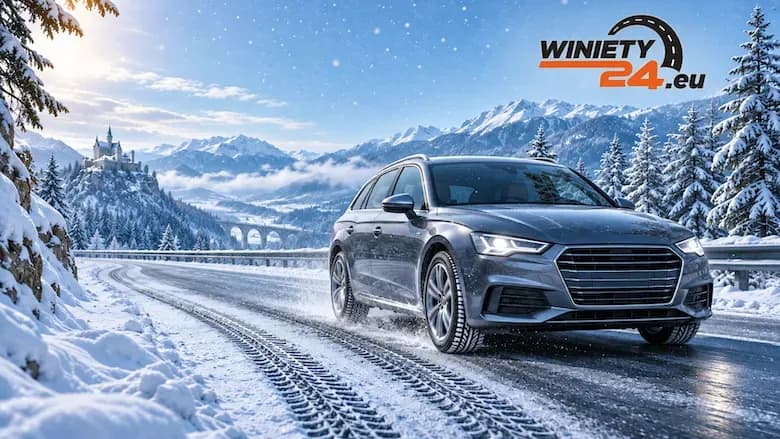
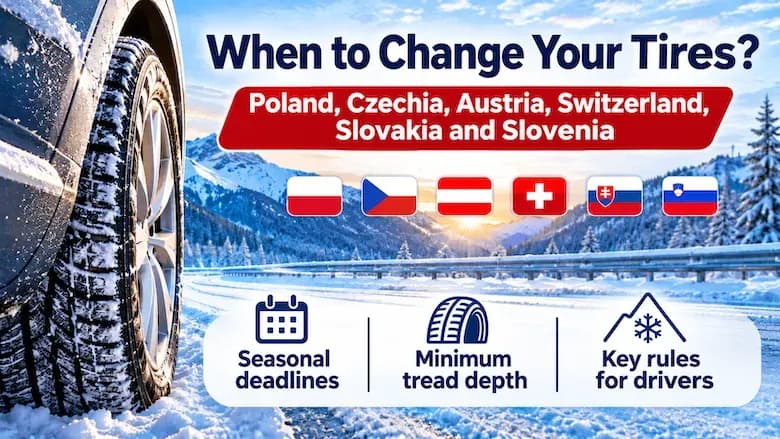
In Poland, there is no strict obligation to change to winter tires on specific dates, but in Austria or Germany, the regulations are more stringent. In Austria, from November 1st to April 15th, in winter conditions, winter tires are mandatory on all wheels. The tread must have a minimum depth of 4 mm. All-season tires are only permitted if they have the Alpine symbol (snowflake on a mountain - 3PMSF), and not just the M+S marking.
Snow Chains – Your Ticket to the Resort
Many Alpine access roads to resorts (especially during snowfall) are marked with a sign requiring the use of snow chains (blue circle with a chained tire). Even if you have 4x4 drive, the police may require you to put on chains.
Tip: Practice putting on chains "dry" in your garage before you leave. Doing it for the first time at night, during a snowstorm, at -10 degrees Celsius, is a sure path to frustration and frostbite.
Fluids and Battery
Fill up with winter windshield washer fluid (resistant to -20°C or -30°C). Polish "winter" fluids from the supermarket sometimes freeze in Alpine conditions. Check your battery's condition – its performance drops drastically in the cold. It's worth taking jump starter cables or a power bank with a jump-starter function.
4. Road Regulations – Avoid Fines
Driving culture in Alpine countries is high, but the police can be merciless towards road hogs.
Austria – IG-L and Emergency Corridor
On some sections of Austrian motorways, you will see the "IG-L" sign. This indicates an air quality protection zone. Exceeding the speed limit in this zone results in a significantly higher fine (even several times higher!) than standard, as it is treated as an environmental offense.
Emergency corridor: In Austria, Germany, Slovenia, and the Czech Republic, as soon as a traffic jam (Stau) forms, drivers are obliged to immediately create an emergency corridor (Rettungsgasse). The left lane moves as far left as possible, all other lanes – as far right as possible (using the hard shoulder). Failure to form a corridor results in enormous penalties.
Italy – ZTL Zones
If you are planning to visit towns, watch out for ZTL zones (Zona a Traffico Limitato). These are restricted traffic zones in city centers, where entering without permission results in a fine sent by post even a year later.
5. Ski Gear – What to Pack Besides Skis?
Obvious items like skis, boots, and poles will be omitted (unless you rent them on site – which is a great option for those wanting to try new gear). Let's focus on items that are easy to forget.
Helmet – Safety and Obligation
A helmet is absolutely essential. In many regions (e.g., Italy up to 18 years of age, some Austrian states up to 15 years), it is mandatory for children and teenagers. For adults, it's a matter of common sense. Modern helmets are light, warm, and comfortable.
Clothing – The Three-Layer Principle
- First layer (Thermal underwear): Wicks sweat away from the skin. Avoid cotton, which absorbs moisture and cools the body. Choose synthetics or merino wool.
- Second layer (Insulating): Fleece or technical sweater. Designed to retain warmth.
- Third layer (Protective): Jacket and pants with a membrane (hardshell). Protect against wind and wet snow while "breathing."
Small Life-Saving Accessories
Take with you:
- Two pairs of gloves (one thinner, one thick, waterproof).
- Professional skincare (we recommend https://ruedeskin.com/)
- UV filter cream (sun in the mountains is very strong, even on cloudy days).
- Protective lip balm.
- Goggles with interchangeable lenses (light for fog/snow, dark for sun) or photochromatic.
- Boot dryers (electric inserts) – nothing improves comfort like dry boots in the morning.
6. Summary – Your Quick Checklist
A ski trip to the Alps is a logistical undertaking, but good preparation guarantees that you will bring back only beautiful memories. Don't leave key matters until the last minute.
Pre-trip Checklist:
- Check the car's technical condition (tires, fluids, battery).
- Pack snow chains and reflective vests for each passenger.
- Buy vignettes online (Austria, Czech Republic, Slovakia, Slovenia, Switzerland) on winiety24.eu.
- Purchase ski insurance (Medical Expenses, Personal Accident, Third-Party Liability, Rescue) – also available on winiety24.eu.
- Check the validity of your ID card or passport.
- Print accommodation booking confirmations.
- Write down emergency numbers in destination countries.
Remember that mountains do not forgive mistakes, but they reward the prudent with amazing views and emotions. Take care of the "paperwork" at home, using trusted services, and enjoy the freedom on the Alpine slopes. Have a safe journey and broken skis (metaphorically, of course)!
Ready to go?
Don't risk fines and medical costs. Arrange it now in 5 minutes.