How to Plan Your First European Road Trip – Practical Guide
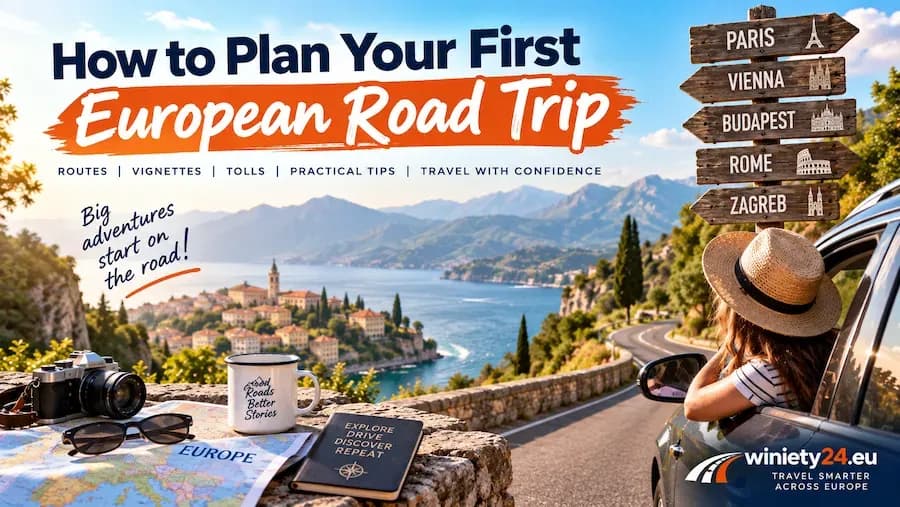
How to Plan Your First European Road Trip
At first glance, a European road trip might look deceptively simple: choose your destination, enter it into your GPS or navigation app, and start driving. But there is a lot to consider when planning your first journey across several countries.
Traffic, border crossings, road charges, rest stops and spontaneous detours can quickly become stressful if your itinerary is too ambitious.
Your goal should not be to fit as much as possible into your trip. Instead, create an itinerary that leaves enough time and flexibility to actually enjoy the journey.
Choose the Right Destination for Your Experience
When choosing a destination for your first road trip , do not start by simply asking yourself, “Where do I want to go?”. Instead, think about the type of driving experience you are comfortable with.
Take into account your driving experience, unfamiliar roads and different traffic conditions. The length of your driving days and whether you will be travelling on mountain roads, coastal roads or busy motorways are all important factors when selecting your destination.
Plan Your Driving Days
It can be tempting to visit more places than you can realistically manage. For example, you might think you can fit Paris, Munich, Vienna, Budapest and Zagreb into one single road trip.
However, travelling between several major European cities can involve many hours of driving. A better approach is to decide how many hours behind the wheel you can realistically enjoy in one day and build your itinerary around that limit.
Limiting your daily mileage has several advantages. First, it gives you more time for sightseeing. Second, it gives you enough time to rest between journeys, which is especially important if you are the main driver. Finally, it leaves space for spontaneous exploration.
You may also want to use a base-camp approach in each country you visit. Staying in one location for longer allows you to explore the surrounding area instead of constantly moving from one major attraction to another.
You should also consider practical requirements before crossing national borders. Road charging systems differ significantly across Europe.
Make sure you check whether you need motorway vignettes. This guide to motorway vignettes is a useful starting point for understanding how electronic vignettes and road charges work.
You should also check local toll systems, traffic regulations, parking rules, driving licence requirements and insurance regulations. These can vary between countries. The European Union's information for drivers travelling abroad provides useful information about requirements within EU countries.
Leave Space for the Unexpected
One of the best parts of a European road trip is often the spontaneous experiences you discover along the way.
Europe is full of towns, viewpoints and local attractions that may not appear in standard travel guides but can easily become some of the highlights of your journey.
While travelling from one major destination to another, you may discover an interesting town, a panoramic viewpoint or a local restaurant that makes you want to stop. Leave enough room in your itinerary for these unplanned discoveries.
Having some flexibility in your schedule will also make it easier to deal with bad weather, roadworks, heavy traffic, accidents or other unexpected delays.
Have a Backup Plan
Even the best-planned road trips can change, so it is always useful to have a plan B.
Your backup plan does not necessarily need to involve choosing an entirely different destination. It can be as simple as identifying alternative routes, additional rest stops, fuel stations or overnight accommodation.
You do not need to predict every possible problem. The idea is simply to remain flexible enough to make unexpected situations part of the adventure instead of allowing them to ruin your trip.