
Rainy Season in Croatia – what to do with family? Indoor attractions
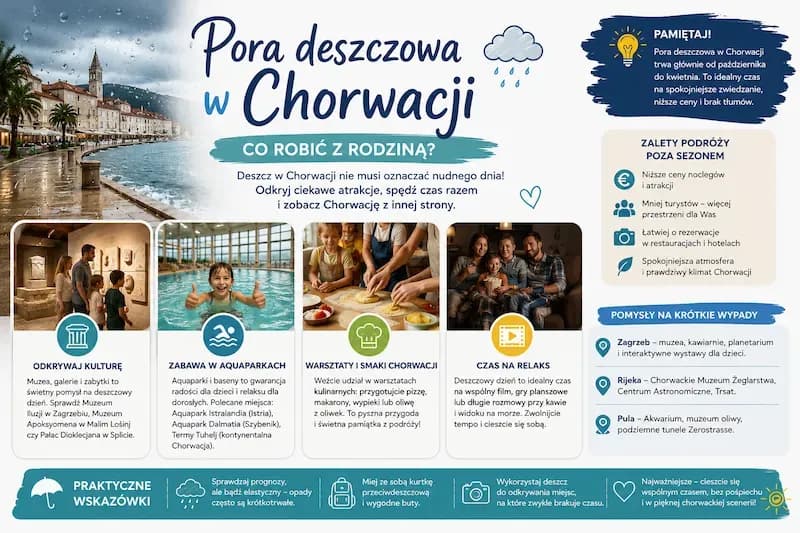
Rainy Season in Croatia – what to do with family? A comprehensive guide to indoor attractions
Planning your dream family vacation on the Adriatic, but the weather forecast suddenly warns of rain? Don't panic! Croatia is not just sunny beaches and turquoise seas. When unexpected rain falls from the sky, this Balkan paradise opens its doors to extraordinary underground worlds, fascinating interactive museums, tropical aquariums, and luxurious thermal complexes. Discover how to turn a rainy day into an unforgettable family adventure and how to cleverly plan your trip logistics so that the whims of the weather don't spoil your mood.
1. Weather in Croatia: Does a "rainy season" even exist?
Croatia is primarily associated with guaranteed sunshine for over 250 days a year. However, it's worth knowing that in the Mediterranean region, the term "rainy season" in the literal, tropical sense does not exist. Nevertheless, the whims of the weather can surprise tourists even in July and August. Transient but extremely violent downpours (often associated with strong winds called bura or humid jugo) are a natural element of the local climate.
In autumn and early spring, rainfall becomes more regular, but summer rain in Croatia rarely means a week-long weather breakdown. It's usually a dynamic front that clears the air and brings pleasant relief from the heat. For families with children, such a day is a perfect opportunity to get off the hot beach and discover the country's other, cultural and historical side. Instead of spending this time in a hotel room, it's good to have an emergency plan ready.
Good to know: The phenomenon known as pljusak is a sudden, intense rain that can turn coastal streets into torrents in minutes. It usually passes as quickly as it appeared, giving way to beautiful sunshine.
2. Safe travel in the rain – the role of vignettes and car preparation
When the weather forecast on the way to Croatia or at your destination predicts rain, smooth and safe logistics become a key element of a successful trip. Family travel by car in pouring rain can be stressful. Visibility decreases, braking distance lengthens, and driver fatigue increases. The last thing you want in such conditions is to stand in long queues at toll collection points or gas stations in search of paper stickers for your windshield.
To minimize stress and ensure maximum comfort for your family, it is crucial to purchase electronic vignettes in advance. Passing through transit countries – such as Austria, Slovenia, Slovakia, or Hungary – can be done completely contactless. Thanks to digital systems, your license plate is automatically scanned by cameras on the highway, and you don't even have to open your window in heavy rain.
Before you set off, be sure to check the validity of road tolls for individual countries. Comprehensive information and the possibility of quick purchase of e-vignettes can be found on dedicated websites for individual destinations:
- Planning a route through the Alps? Check and purchase vignettes for Austria to avoid queues at toll booths and fines.
- Passing through the Julian Alps? A vignette for Slovenia will be mandatory, allowing for a smooth journey on motorways towards Istria and Dalmatia.
- Choosing the eastern route? See how vignettes for Hungary work and secure your passage through Budapest.
- If your route takes you through Bratislava, make sure you have valid vignettes for Slovakia.
Securing these formalities before departure allows you to focus solely on the road and children's safety, which is priceless when weather conditions drastically worsen.
3. Istria and Kvarner: Underground caves, castles, and retro computers
The Istrian Peninsula and the neighboring Kvarner Bay are regions extremely rich in attractions hidden under a roof. Due to the proximity of the mountains, rain clouds can linger here a bit longer, but the tourist infrastructure is perfectly prepared for this.
Baredine Cave – The underground world of stalactites and cave olms
When a downpour rages on the surface, underground there is a constant, unchanging temperature of about 14°C. Baredine Cave, located near Poreč, is a spectacular natural monument. The tourist route leads through five beautifully lit halls rich in amazing dripstone formations – stalactites, stalagmites, and underground stalagnates resembling draperies and sculptures.
For children, the biggest attraction of visiting Baredine Cave is the opportunity to see with their own eyes a cave olm (Proteus anguinus) – an endemic amphibian living exclusively in the underground waters of the Dinaric Karst. This blind, elongated creature with pale pink skin is called the "human fish" by locals. The guided tour lasts about 40 minutes, which is an ideal time for the youngest, who won't get bored.
Pula Aquarium – Sharks within Austro-Hungarian fortress walls
This is probably one of the most unique aquariums in Europe. It is located inside the mighty, 130-year-old "Verudela" fort, which once formed part of the Austro-Hungarian defense system. The combination of raw, stone military architecture with modern, illuminated water tanks creates an amazing atmosphere.
On an area of over 2500 square meters, the family can admire hundreds of species of fish and invertebrates from the Adriatic Sea, as well as tropical zones with sharks, caimans, and piranhas. What is extremely educational, the Pula Aquarium operates a Sea Turtle Rescue Center, where children can learn how these beautiful creatures, injured by human activity or ocean plastic pollution, are saved.
| Attraction (Istria/Kvarner) | Location | For whom? | Main advantage in rain |
|---|---|---|---|
| Baredine Cave | Poreč | Children 6+, adults | Constant temperature, spectacular rock formations. |
| Pula Aquarium | Pula (Fort Verudela) | All age groups | Huge indoor space, ecological education. |
| Peek&Poke Museum | Rijeka | Children 8+, tech fans | Interactivity – you can touch exhibits and play. |
Peek&Poke Computer Museum in Rijeka – A nostalgic journey through time
If the rain catches you around Rijeka, be sure to visit the Peek&Poke Computer Museum. This place is a real hit for older children and parents who want to feel a touch of nostalgia. It is one of the few museums in Europe where exhibits can not only be touched but should be.
The collection includes over 1000 exhibits documenting the history of computing – from archaic calculators, through iconic Commodore 64, Amiga, Atari computers, to the first generations of Nintendo and Sega consoles. Children can personally play games that their parents were passionate about twenty or thirty years ago. It's a brilliant way to build intergenerational bonds and escape a gray, rainy day.
4. Central and Northern Dalmatia: From illusions in Zadar to Split's underground
Dalmatia is the heart of Croatian tourism. Although famous for its open spaces, National Parks such as Krka or Kornati, Dalmatian cities hide many architectural treasures and modern entertainment centers hidden from rainfall.
Museum of Illusions in Zadar – Brain training and brilliant photos
Zadar attracts tourists with its sea organs, but when the sky gets cloudy, the best direction is the Museum of Illusions (Muzej Iluzija). This fascinating place where the laws of physics and perception seem completely suspended. The attraction is fully interactive, which means children can run, touch installations, and experiment.
The most interesting rooms include the Anti-Gravity Room (where everything seems to defy gravity), the Ames Room (where you instantly become a giant or a dwarf), and the amazing Vortex Tunnel, which can completely disrupt your sense of balance. An additional advantage is that you will take the most original, funny family vacation photos here, which will brighten up any rainy day on social media.
Diocletian's Palace Cellars in Split – In the footsteps of Emperors and... Dragons
Split offers a unique history lesson that can be experienced without an umbrella. Diocletian's Palace, the heart of the old town, conceals a massive complex of cellars and underground passages beneath it. Interestingly, the underground halls are an almost perfect reflection of the architectural layout of the emperor's private apartments, which were located above them but did not withstand the test of time.
Walking through the monumental stone corridors, children can feel like discoverers of ancient treasures. Pop culture enthusiasts will immediately recognize these interiors – this is where scenes for the cult series "Game of Thrones" were filmed (this is where Daenerys Targaryen kept her dragons). The underground, protected from rain, also houses numerous stalls with local handicrafts, souvenirs, and works of art by Croatian artists.
Civitas Sacra Interpretation Center in Šibenik
Šibenik is known for its monumental Cathedral of St. James, inscribed on the UNESCO list. Right next to it is a modern, multimedia museum – the Civitas Sacra Interpretation Center, located in the historic Galbiani Palace. This is an ideal place to shelter with your family from a downpour, combining history with modern technology.
The exhibition has been designed to engage the youngest visitors. Using touch screens, interactive games, and virtual reality (VR) glasses, children can build virtual cathedral walls, learn stone carving, or steer ancient merchant ships sailing the Adriatic. This is an example of a new generation museum where learning history becomes dynamic fun.
5. Dubrovnik and the South: Aquariums within city walls and sea tales
Dubrovnik, known as the Pearl of the Adriatic, can enchant in the sun, but its mighty stone city walls and historic palaces offer excellent shelter also during heavy rainfall.
Dubrovnik Aquarium – Marine fauna in St. John's Fortress
Located in the monumental St. John's Fortress (Tvrđava Sv. Ivana), the Dubrovnik Aquarium is an ideal place to escape unfavorable weather. The cold, thick stone walls of the fortress create a unique atmosphere that enhances the feeling of encountering the mysteries of the deep sea.
In dozens of tanks supplied with fresh seawater directly from the ocean, an extremely rich collection of organisms inhabiting the Adriatic has been gathered. You will see, among others, huge octopuses, rays, moray eels, lobsters, and beautiful, colorful anemones. The calm, slightly darkened space of the aquarium has a very relaxing effect on children after an exciting and rainy day of travel.
Red History Museum – An interactive journey into socialist times
For families with older children and teenagers, a visit to the Red History Museum, located in the port district of Gruž, will be an incredibly interesting experience. This is the first interactive museum in Croatia dedicated to everyday life during the communist Yugoslavia period.
Instead of boring display cases, the museum's creators have prepared a space arranged like a typical apartment from those years. You can sit in the living room, turn on an old TV, listen to vinyl records from the era, and even get into the cult Yugo car. This is an excellent lesson in modern history, presented in a light, visually attractive, and engaging way.
6. Zagreb and the heart of Croatia: A capital full of interactive museums
If your return or arrival route passes through the country's capital – Zagreb – and you happen to hit a rainy front, you are in the best possible place. Zagreb has the highest concentration of museums per square meter in all of Croatia, and most of them have been designed with the modern, family tourist in mind.
Nikola Tesla Technical Museum – Mine and scientific demonstrations
This is an absolute leader when it comes to indoor family attractions in the capital. The Technical Museum is a huge complex where historical locomotives, trams, cars, and even airplanes are collected. However, the two unique sections make the biggest impression on children:
- Mine replica: In the museum's underground, a life-size model of a coal and ore mine, over 300 meters long, has been built. Exploring it with a guide in the dark provides an amazing thrill.
- Nikola Tesla Cabinet: A special demonstration room where live shows are held using Tesla transformers and high-frequency currents. Children can see how fluorescent lamps held in their hands light up wirelessly – pure science magic!
Museum of Chocolate (Muzej Čokolade Zagreb) – The sweetest rainy day
Is there a better way to improve your mood on a gloomy, rainy day than a visit to the kingdom of chocolate? The Museum of Chocolate in Zagreb is a sensory journey through the history of this delicacy – from ancient Mayans and Aztecs to modern mass production factories. At the entrance, each visitor receives a special box with various types of chocolate and a spoon, used for tasting at various stages of the tour. Children can grind cocoa beans themselves on ancient grindstones and compose their own flavors.
7. Croatian thermal spas and indoor aquaparks – water fun during a downpour
Who said you can't swim and have fun in the water when it rains? Northern and continental Croatia abound in rich geothermal springs, around which ultra-modern complexes of thermal pools and indoor aquaparks have been built. This is an excellent alternative to the cold sea.
Aquae Vivae in Krapinske Toplice – Under the roof of Roman luxury
Located just a 45-minute drive from Zagreb, the Aquae Vivae complex is one of the most modern indoor water parks in this part of Europe. It offers over 1100 square meters of water surface under a gigantic glass dome. The water in the pools is 100% thermal and rich in minerals, with temperatures ranging from 33°C to 35°C.
For families with children, there is a large wave pool, numerous water slides, a wild river, and a special, professional diving pool where you can try your hand under the supervision of an instructor. For parents seeking relaxation, there is a huge hydromassage and sauna area.
Terme Tuhelj – Water world "Planeta Tuhi"
Another pearl of the Croatian interior. Terme Tuhelj is a powerful recreational resort. Its indoor pool area (available all year round) includes a dedicated children's water world "Planeta Tuhi" with numerous safe paddling pools, water cannons, animal-shaped fountains, and indoor tube slides of varying difficulty. Adults will certainly enjoy the pools with natural thermal mud with healing properties.
8. Rainy gastronomy: Culinary workshops and family discovery of flavors
When the weather makes walks impossible, it's worth moving to a traditional Croatian konoba (local tavern) or restaurant and having a family feast. Croatian cuisine is extremely rich and diverse – it combines Mediterranean influences (seafood, olive oil, pasta) with heavier, Central European (Austro-Hungarian) and Balkan cuisine.
Many agritourism farms in Istria and Dalmatia organize culinary workshops for families on rainy days. Jointly kneading dough for traditional fuži pasta or preparing sweet soparnik pies is a brilliant way to spend creative time with children. The smell of freshly baked bread and herbs will quickly make you forget about the gray sky outside the window.
9. How to drive safely on Croatian roads during a downpour?
Driving in Croatia during heavy rain requires particular caution and a change of habits from the driver. A characteristic feature of the local coastal roads (including the famous Adriatic Highway – Jadranska Magistrala) is the specific composition of the asphalt. Due to the high limestone content and dust carried from Africa, after the first few minutes of rain, the surface becomes slippery as ice.
Golden rules for driving in the rain in Croatia:
- Reduce speed: Speed limits on signs are for ideal conditions. During a downpour, slow down by as much as 30-40 km/h below the limit.
- Maintain a safe distance: Braking distance on slippery Croatian asphalt drastically increases. Double the distance from the car in front.
- Beware of aquaplaning: Water collects very quickly in road depressions and on highway exits, creating deep puddles.
- Avoid traveling during strong winds (Bura): In combination with rain, wind gusts can lead to the complete closure of sections of the A1 highway in the area of the Sveti Rok tunnel or bridges on Krk and Pag. Always check announcements on the Croatian auto club HAK website.
Also remember that a smooth return from a rainy trip on the highway will be much more pleasant if you take care of logistical delays in advance. Having valid vignettes for Slovenia or Austria for the return journey will allow you to avoid nervously searching for sales points in unfavorable weather conditions.
10. Family checklist for bad weather in Croatia
So that no rainy day catches you unprepared, it's worth packing a rescue kit in the car that will allow you to immediately set off into the city or inland without having to reorganize your entire luggage.
- Light rain jackets (so-called storm jackets) or ponchos: Umbrellas often get damaged by strong winds on the Adriatic.
- Warm sweatshirts or fleeces: Useful for caves (where the temperature is 12-14°C) and air-conditioned museum facilities.
- Waterproof cases for phones and documents: Protects electronic equipment during heavy downpours.
- Downloaded offline maps (e.g., Google Maps, Maps.me): In tunnels, caves, and deep mountain canyons, cellular network coverage can be severely limited.
- E-vignette purchase confirmations: Always keep them on your phone or printed in the car's glove compartment in case of border or road checks.