Prices in Croatia 2026: Accommodation, Food, Vignettes | Winiety24
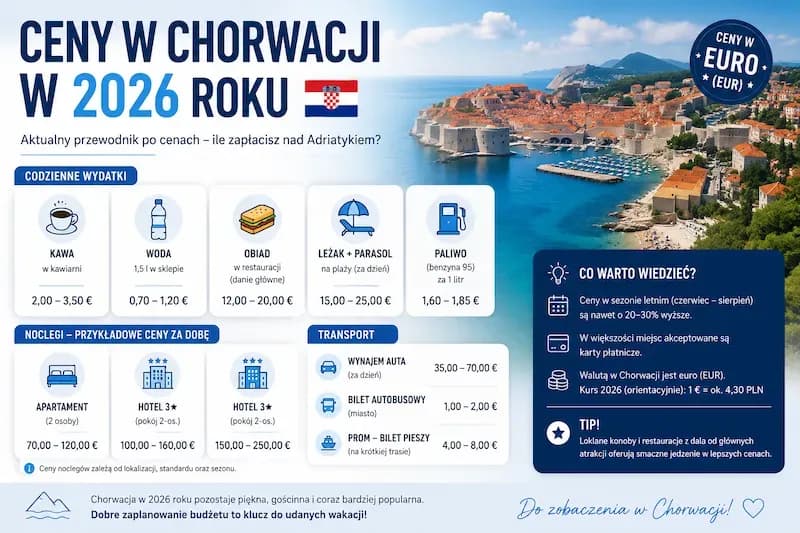
Prices in Croatia in 2026 – Comprehensive Guide, Accommodation, Food, and Motorways
For years, Croatia has remained one of the most beloved holiday destinations for hundreds of thousands of Poles. Picturesque beaches, the turquoise waters of the Adriatic, historic cities, and exquisite Balkan cuisine attract tourists like a magnet. However, after the country's entry into the Eurozone and Schengen Area in 2023, as well as global inflationary turmoil, many people wonder how living and holiday costs currently stack up in the region. Will a holiday on the Adriatic in 2026 drain your wallet? In our extensive and detailed guide, we will analyze all the most important costs: from fuel and vignettes needed for the journey, through prices in supermarkets and local restaurants, to accommodation costs in hotels, campsites, and ticket prices for the biggest tourist attractions. Get ready for a comprehensive dose of knowledge that will help you perfectly plan your budget for your dream holiday in 2026.
1. Economic situation and inflation in Croatia (as of 2026)
To fully understand why prices in Croatia in 2026 are at a certain level, it is worth looking at the macroeconomic context. Croatia, by adopting the common European currency, went through a period of price transformation. The phenomenon, which economists call the "cappuccino effect" (rounding up prices after currency conversion), was particularly visible in the first two years after the conversion from kuna to euro. According to data from the Croatian Bureau of Statistics (DZS) at the beginning of 2026, inflation in Croatia has slowed down and stabilized at around 3.4% year-on-year. Nevertheless, services, including the tourism and hospitality industry (HoReCa), are recording the largest increases – in some places exceeding 7%.
For Polish tourists, this means that a trip to Split, Dubrovnik or Zadar in the summer season (from June to September) requires careful expenditure planning. The authorities in Zagreb are trying to temper the sentiments of entrepreneurs and are appealing for competitive prices to be maintained, as tourists are increasingly looking for alternatives such as Albania, Montenegro or Bulgaria. Fortunately, thoughtful grocery shopping, avoiding the most expensive restaurants located right on the promenades ("Riva"), and early booking of accommodation and necessary road documents (such as motorway vignettes) still allow you to enjoy the charms of Dalmatia without having to take out a loan.
2. Costs of travel to Croatia in 2026 – Fuel, motorways and vignettes
For over 70% of Polish tourists, their own car remains the most popular means of transport to Croatia. This provides enormous independence on site, facilitates exploring wild beaches, hidden coves, and allows packing more beach equipment. However, traveling by car involves several significant expenses that need to be added to the budget before departure.
Choosing the route and mandatory vignettes
From Poland, two main route variants are most often chosen. The first, preferred by residents of western and southern Poland, leads through the Czech Republic, Austria, and Slovenia. Tourists from the east and center of the country often choose the route through Slovakia and Hungary. Each of these transit countries requires a fee for using expressways in the form of e-vignettes. In 2026, all these countries operate a fully electronic toll collection system, which means no more scratching and sticking stickers on the windshield. To avoid stress, high fines (which in Austria and Slovenia can range from 120 to even 300 euros), and long queues at border gas stations, we recommend purchasing e-vignettes in advance from a trusted Polish service.
- Route through the Czech Republic: Starting the journey, vignettes in the Czech Republic will be necessary. The Czechs offer very convenient options, including 1-day, 10-day, and 30-day vignettes, perfectly suited to the needs of tourists.
- Route through Slovakia: If you are driving through Zwardoń or Chyżne, make sure you have Slovak vignettes. The Slovak camera system quickly detects vehicles without a purchased subscription.
- Route through Austria: This is one of the fastest sections. Remember, however, that vignettes in Austria are absolutely mandatory on motorways, and penalties for their absence are among the strictest in Europe. Also, be aware of additional fees for tunnel passages (e.g., Gleinalmtunnel, Bosrucktunnel), which are not covered by the standard vignette.
- Route through Slovenia: The last stage before the Croatian border is Slovenia. Due to pricing policy, vignettes for Slovenia can be expensive (especially if our vehicle qualifies for the higher 2B category, like some large vans). However, Slovenian motorways guarantee a smooth and hassle-free journey from Graz directly to the Macelj or Rupa border crossing.
- Route through Hungary: A very good and fast alternative, especially for eastern and southern Hungarian motorways heading towards Croatian Osijek or Zagreb. Official vignettes in Hungary can be conveniently purchased online, which will help avoid the often crowded sales points at the Slovak-Hungarian border.
E-Vignette Set (Austria + Slovenia) for travel to Croatia
Save time and avoid stress on the road. Official, electronic vignette package allowing legal travel on motorways in Austria and Slovenia for passenger vehicles up to 3.5t. A fully automated system instantly registers your vehicle's registration number in the European control systems ASFiNAG and DARS.
Fuel prices in Croatia in 2026
Traveling is inextricably linked with refueling. After market turmoil and energy price jumps, the fuel market in Croatia in 2026 seems stable, although it cannot be called cheap. Prices at gas stations (such as INA, Petrol, Crodux, Tifon or Lukoil) differ slightly depending on the location – stations on motorways are standardly several to a dozen cents per liter more expensive than stations in smaller towns or on the outskirts of cities. The Croatian government periodically intervenes in distributors' margins to protect citizens' wallets, but for tourists refueling at major communication hubs, market prices remain a challenge.
| Fuel type | Average price per liter (EUR) |
|---|---|
| Petrol Eurosuper 95 | 1.45 - 1.52 EUR |
| Premium Petrol (98/100) | 1.65 - 1.80 EUR |
| Diesel Fuel | 1.48 - 1.55 EUR |
| Premium Diesel | 1.65 - 1.75 EUR |
| Autogas (LPG) | 0.88 - 0.95 EUR |
Table 1: Average fuel prices at Croatian stations in summer season 2026. Differences result from station location (motorway vs. city center).
Motorway tolls in Croatia itself (Toll gates and ENC)
Unlike transit countries, Croatia does not have a vignette system. Instead, a system of fees for the actual section driven (from entry to exit gates) operates here. Discussions about introducing a completely barrier-free system based on license plate recognition (ALPR) have been ongoing for years, but in the 2026 season, the physical gate system still operates on many sections. Driving the famous "Dalmatina" (A1 motorway) is a real pleasure due to the phenomenal views, ideal surface, and spectacular tunnels (such as Sveti Rok or Mala Kapela), but this comfort comes at a price. It should be remembered that in summer, huge, several-kilometer-long queues can form at exit gates (e.g., in Lucko near Zagreb).
Average travel costs (for passenger cars - category I):
- Zagreb – Zadar (A1): approximately 16.50 EUR. This is an excellent option for those heading to Northern Dalmatia.
- Zagreb – Šibenik (A1): approximately 20.50 EUR. Ideal route if the destination is Krka National Park.
- Zagreb – Split (Dugopolje junction on A1): approximately 24.00 EUR. The most popular exit for tourists going to Makarska Riviera and the islands (Hvar, Brač).
- Zagreb – Ploče (end of A1 towards Dubrovnik): approximately 31.00 EUR. From there, the road leads to the free and breathtaking Pelješki Bridge, which connects the south with the rest of the country, bypassing the territory of Bosnia and Herzegovina.
- Macelj border – Zagreb (A2): approximately 6.50 EUR. This is a continuation of the route from Slovenia for people traveling on the Phyrn-Autobahn.
- Rijeka – Pula (Istrian Ypsilon): approximately 10.00 EUR. Istria is managed by a separate operator (Bina-Istra).
An excellent solution for regular visitors is to purchase an ENC device (Elektronička naplata cestarine). This is a small transponder attached to the windshield, which allows travel through designated, queue-free lanes at toll gates, and additionally offers a discount of approximately 21% on all road tolls. Despite the cost of the device itself (approx. 15 EUR), for longer and more frequent trips, this investment pays off handsomely, and more importantly – it saves invaluable hours of standing in the scorching sun.
3. Accommodation Prices: Hotels, Private Accommodation and Campings
Finding the ideal roof over your head is usually the biggest part of your travel budget. The change of currency to euro and the rising costs of labor, energy, and property maintenance have meant that Croatian accommodation owners have had to adjust their price lists. In 2026, the accommodation market is diverse and can be surprising, both positively (when looking for bargains in September or in smaller towns) and negatively (during peak season in top locations such as Rovinj or Dubrovnik). Croatia is the kingdom of "Apartmani" – private apartments, rooms, and houses for rent. In recent years, luxurious "Glamping" campsite resorts have also gained incredible popularity, often surpassing four-star hotels in terms of amenities.
Private Apartments (Lodgings)
Renting an apartment (with a kitchenette, air conditioning, and often a terrace or balcony) is the most common choice for families with children. Costs vary drastically depending on the distance from the sea. "Prvi red do mora" (first line to the sea) always comes at a premium.
- Southern Dalmatia (Dubrovnik, Cavtat): From 100 EUR to 250 EUR per night for 4 people. Dubrovnik is a city in a different price category – phenomenal, but very financially demanding.
- Central Dalmatia (Split, Trogir, Omiš, Makarska Riviera): Average 80 – 160 EUR per night. This is the most frequented area. In small towns like Brela, Baška Voda or Tučepi, a 2+2 apartment near the beach costs around 120-150 EUR.
- Northern Dalmatia (Zadar, Biograd, Vodice): More budget-friendly – here a similar apartment can be rented for 70 – 110 EUR per night.
- Istria and Kvarner (Rovinj, Pula, Island Krk, Cres): Prices very similar to Central Dalmatia (90 – 150 EUR), due to the large influx of tourists from Germany, Austria, and Italy, which drives up rates in the local rental property market for tourists.
Hotels (3 to 5 stars)
The hotel market in Croatia has undergone a huge metamorphosis. Old, post-communist brutalist facilities have become obsolete or have undergone luxurious modernizations. Hotels are focused on high-quality services.
- 3-star hotel (double room with breakfast): from 90 EUR to 140 EUR per night. These are often family-run establishments, clean, well-maintained, but without pools or large spa areas.
- 4-star hotel: from 150 EUR to 280 EUR per night. At this price, you typically get access to a pool area, rich breakfast buffets, and often dinner included (Half Board).
- 5-star hotel (Dubrovnik, Rovinj, Hvar): from 350 EUR upwards, often exceeding 800 EUR per night for accommodation in top-standard apartments with sea views and full concierge service.
Campsites and Mobile Homes
Croatian campsites are among the absolute best in Europe. Huge water parks on the campsite grounds, sports fields, restaurants, relaxation areas, and immaculate cleanliness of sanitary facilities. Remember, however, that a camping holiday is not synonymous with a cheap holiday.
- Pitch for a tent or camper: from 45 to 90 EUR per night (price includes 2 adults, electricity, water, and vehicle).
- Mobile Home (for 4-6 people): Renting a modern mobile home at a premium campsite can cost from 150 to even 350 EUR per night in July and August! This is currently one of the fastest-growing, but also most expensive, sectors in the holiday market due to huge demand, luxury, and proximity to nature.
4. Food prices in supermarkets and discount stores in 2026
To manage the budget, most tourists choose a hybrid model: breakfasts and light dinners are prepared independently in rented apartments, while lunches are eaten in local konobas (traditional taverns). Therefore, knowing prices in supermarkets is key to smart financial planning. In Croatia, the national chain Konzum reigns supreme. Alongside it, chains such as Plodine, Tommy, and Studenac are well-developed (the latter are mainly smaller, local shops, where prices can be 15-20% higher than in hypermarkets). Many Poles will be pleased to know that Lidl, Kaufland, and Spar also operate successfully in Croatia, where pricing policy and assortment are well-known to us from the Polish market. Food prices have risen since entering the Eurozone, and in 2026, the average cost of a shopping basket is as follows: