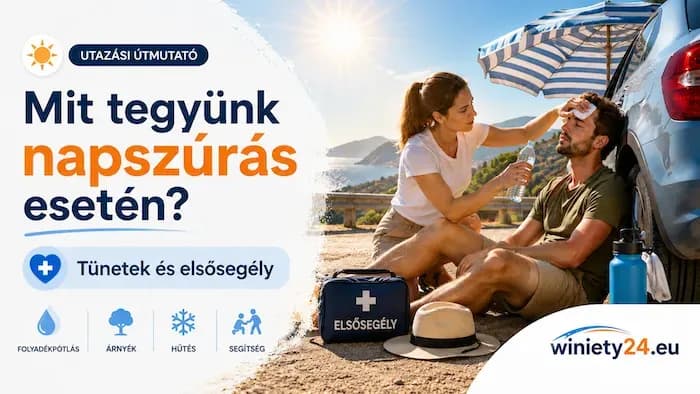
What to Do in Case of Sunstroke? Symptoms and First Aid
```
Summer travel guide
What to Do in Case of Sunstroke? Symptoms, First Aid and Prevention
Strong sunshine, high temperatures, a long car journey and insufficient hydration can lead to dangerous overheating. Learn how to recognise the warning signs, provide first aid correctly and know when emergency services must be called immediately.
Sunstroke does not only happen after spending several hours lying on a beach. Dangerous overheating can also develop while sightseeing, hiking, exercising, waiting in a traffic jam, driving without effective air conditioning or staying in a hot and poorly ventilated room. Children, older people, travellers with chronic health conditions and visitors who are not accustomed to the climate of Southern Europe are particularly vulnerable.
The most important rule
Heatstroke is a life-threatening emergency. If a person becomes confused, stops responding normally, has seizures, loses consciousness or has an extremely high body temperature, call emergency services immediately. In the European Union, you can call 112. Start cooling the affected person while help is on the way.
What is sunstroke and how is it different from heatstroke?
The terms “sunstroke” and “heatstroke” are often used interchangeably, but they are not exactly the same. Heatstroke is a severe form of heat-related illness that occurs when the body can no longer control its temperature effectively. Its natural cooling mechanisms become insufficient, and the internal body temperature may rise to a dangerous level.
Sunstroke is commonly understood as a type of heatstroke caused by prolonged exposure to direct sunlight, especially when the head and neck are not protected. It can occur during sunbathing, sightseeing, outdoor work, sporting activities, hiking or a long walk without adequate breaks, shade and hydration.
Not every episode of feeling unwell in hot weather is immediately heatstroke. A person may first develop heat exhaustion. Typical symptoms include heavy sweating, intense thirst, weakness, headache, dizziness, nausea and muscle cramps. Heat exhaustion is an important warning sign. Without rest, cooling and hydration, the condition can progress to heatstroke.
| Condition | Common symptoms | Recommended response |
|---|---|---|
| Mild overheating | Thirst, fatigue, flushed skin, discomfort and reduced concentration. | Stop the activity, move to a cooler place, rest and drink fluids. |
| Heat exhaustion | Heavy sweating, weakness, dizziness, nausea, headache and muscle cramps. | Cool the person, give fluids if safe and monitor them carefully. |
| Heatstroke | Confusion, unusual behaviour, seizures, very hot skin or unconsciousness. | Call emergency services immediately and begin rapid cooling. |
Sunstroke symptoms: what warning signs should you look for?
The first symptoms may resemble ordinary holiday fatigue, dehydration or discomfort caused by a long journey. They should never be ignored after prolonged exposure to high temperatures or strong sunshine. A person’s condition may deteriorate gradually or become serious very quickly.
Early signs of overheating and heat exhaustion
- intense thirst and a dry mouth,
- unusual tiredness or increasing weakness,
- headache and dizziness,
- nausea, poor appetite or vomiting,
- heavy sweating and clammy skin,
- a rapid pulse or faster breathing,
- painful muscle cramps, especially in the legs or abdomen,
- pale skin, an unsteady walk or feeling faint,
- irritability, drowsiness or difficulty concentrating.
If the person remains fully alert, can communicate normally, can swallow safely and has no signs of heatstroke, move them to a cooler place. Stop all physical activity, loosen tight clothing, cool the skin and offer small amounts of cool water or an oral rehydration drink.
Emergency symptoms suggesting heatstroke
- confusion or difficulty answering simple questions,
- unusual, irrational, agitated or aggressive behaviour,
- poor coordination or difficulty walking,
- a very high body temperature, often around 40°C or above,
- hot and flushed skin that may be dry or still sweaty,
- a very rapid pulse and fast breathing,
- a severe or throbbing headache,
- seizures or loss of consciousness,
- abnormal or worsening breathing.
Dry skin is not required for a heatstroke diagnosis
A common misconception is that everyone suffering from heatstroke must have completely dry skin. This is not always true. A person may still be sweating, particularly when heatstroke develops during physical activity. Changes in mental state, such as confusion, poor coordination, seizures or unconsciousness, are more important warning signs.
First aid for sunstroke and heatstroke: step-by-step guide
Time is critical when heatstroke is suspected. Do not wait to see whether the person improves on their own. Emergency services should be contacted while cooling begins. Every minute spent in a dangerously overheated state can increase the risk of serious complications.
- Make sure the location is safe.
Protect yourself, the affected person and other travellers. If the incident happens beside a road, move away from traffic whenever it is safe to do so. Use hazard warning lights and roadside warning equipment where appropriate. - Move the person into a cooler environment.
Use an air-conditioned room, a shaded area, a building, a sheltered roadside stop or a vehicle with functioning air conditioning. Stop all physical effort. - Check responsiveness and breathing.
Ask simple questions, such as the person’s name, current location and what happened. If they do not respond normally, check whether they are breathing normally. - Call emergency services.
In the European Union, dial 112. Explain that you suspect heatstroke. Provide the exact location, the person’s approximate age, their symptoms and whether they are conscious and breathing. - Remove unnecessary clothing.
Take off or loosen jackets, sweatshirts, hats, tight collars and other layers that trap heat. Respect the person’s privacy, but do not allow heavy clothing to delay effective cooling. - Begin active cooling.
Wet the skin with cool water, use damp towels, fan the person or direct cool air towards the body. Cool compresses can be placed around the neck, armpits and groin. - Do not leave the person alone.
Continue checking their breathing and level of consciousness. Their condition may deteriorate rapidly even if they were initially able to speak. - Give rescuers essential information.
Explain how long the person was exposed to heat, whether they were exercising, any known medical conditions, medications and what first-aid measures have already been performed.
Do not delay calling for help
Confusion, seizures, loss of consciousness, extremely high body temperature or rapid deterioration require immediate emergency assistance.
How should a person with heatstroke be cooled?
Cooling should begin as soon as possible. During a road trip or holiday, you may not have access to specialist medical equipment. However, simple actions can still reduce the person’s temperature and prevent further heat accumulation.
Recommended actions
Move the person into shade or air conditioning, remove excess clothing, wet their skin with cool water, use damp towels, fan the body and apply cool compresses to the neck, armpits and groin.
Actions to avoid
Do not leave the person alone, force them to walk, delay calling for help or rely only on medication. Do not rub alcohol or irritating substances onto the skin.
If a thermometer is available, body temperature can be monitored, but searching for a thermometer must never delay emergency care. The combination of heat exposure and neurological symptoms is enough to justify an urgent response.
If the person begins shivering, reduce overly aggressive cooling and follow the emergency dispatcher’s instructions. Advice given by emergency professionals during the call takes priority over general online guidance.
Can a person with sunstroke drink water?
Fluids may be offered only when the person is fully conscious, responding normally, able to swallow without difficulty and not vomiting. Give small amounts of cool, but not necessarily ice-cold, water. An oral rehydration drink containing electrolytes may be useful for a conscious person with heat exhaustion.
When should you not give anything to drink?
Never give water, food or medicine to an unconscious, confused, extremely drowsy, convulsing or vomiting person. Do not give fluids if swallowing appears difficult. There is a risk of choking or aspiration. Focus on emergency assistance, cooling and monitoring breathing.
Alcohol and highly caffeinated energy drinks should be avoided. They are not appropriate rehydration options for someone showing signs of heat-related illness. Water or a correctly prepared rehydration solution is a safer option for a person who can drink normally.
What should you do if the person becomes unconscious?
Loss of consciousness is a medical emergency. Call 112 immediately, activate the speaker function on your phone and follow the emergency dispatcher’s instructions.
Unconscious but breathing normally
If the person is unresponsive but breathing normally, keep the airway open and place them in the recovery position unless an injury or another circumstance prevents this. Continue checking their breathing regularly. Cooling can continue, but access to the face, chest and airway must remain clear.
Unconscious and not breathing normally
If the person is not breathing normally, begin cardiopulmonary resuscitation immediately and follow the dispatcher’s instructions. If an automated external defibrillator is available, ask another person to bring it. Switch the device on and follow its spoken instructions.
Occasional gasps are not normal breathing
Infrequent, irregular or noisy gasps may be a sign of cardiac arrest rather than normal breathing. When in doubt, follow the instructions given by the emergency dispatcher.
What should you not do when sunstroke is suspected?
Even well-intentioned actions can delay effective treatment. The most common mistakes occur when heatstroke is treated as ordinary tiredness, dehydration or an infection-related fever.
- do not wait to see whether severe symptoms disappear on their own,
- do not force the person to walk back to a hotel or vehicle,
- do not leave them alone inside a parked car,
- do not give fluids to an unconscious or confused person,
- do not give alcohol or highly caffeinated energy drinks,
- do not cover an overheated person with a thick blanket,
- do not rub alcohol or other irritating substances onto the skin,
- do not use fever medicine as the primary treatment for overheating,
- do not delay an emergency call because you cannot measure the temperature.
Sunstroke in children: why is it especially dangerous?
Children can overheat faster than adults and may not be able to describe their symptoms accurately. A young child may become unusually irritable, tearful, sleepy or inactive. In other cases, the child may become agitated or behave in a way that is clearly different from normal.
Parents and carers should watch the child’s skin temperature, drinking, urination, responsiveness, balance and behaviour. Refusing fluids, unusual drowsiness, poor coordination or difficulty waking the child should be treated seriously.
Leaving a child in a parked vehicle is extremely dangerous. The temperature inside a car can rise rapidly, even when the outdoor temperature does not seem extreme. Partly opening a window does not provide sufficient protection. A child should never be left unattended in a vehicle, even for a short period.
Call emergency services immediately if a child becomes confused, difficult to wake, has a seizure, loses consciousness, has difficulty breathing or deteriorates rapidly. Tell the dispatcher the child’s age, current symptoms, known medical conditions and any medication they take.
Heatstroke in older travellers and people with chronic conditions
Older people may feel less thirsty, have reduced mobility or take medicines that affect fluid balance, blood pressure, sweating or the body’s response to temperature. Heat-related illness can therefore develop without the person reporting intense thirst or obvious discomfort.
Sudden weakness, a fall, confusion, unusual sleepiness, poor communication or difficulty performing simple tasks may be the first visible warning signs. Such changes should not automatically be blamed on age or travel fatigue.
People with heart disease, kidney disease, diabetes, neurological conditions or circulation problems should discuss hot-weather travel with a healthcare professional. They may need personalised advice about hydration, medication storage and responding to worsening symptoms. Medication should never be stopped or adjusted without professional advice.
Hot-weather road trips: how can drivers reduce the risk?
A long road journey during a summer heatwave can affect both the driver and passengers. High temperatures may cause tiredness, headache, irritability, reduced concentration and slower reactions. The risk increases in traffic jams, at border crossings and on exposed motorway car parks without shade.
Before departure, check the vehicle’s air conditioning, coolant, battery and tyres. Plan regular rest stops and carry more water than you expect to need. Travel formalities should also be arranged in advance. Electronic road vignettes for European routes can be checked and ordered through Winiety24.eu , reducing the need to search for a sales point during the hottest part of the journey.
Safe driving rules during hot weather
- carry enough water for every passenger and additional water for delays,
- schedule a break approximately every two hours or more often when necessary,
- do not continue driving if you feel dizzy, nauseous or unusually sleepy,
- avoid directing extremely cold air straight at your face for long periods,
- check the temperature of child seats and metal seatbelt components,
- never leave children, older people or animals inside a parked vehicle,
- choose shaded or covered parking areas whenever possible,
- store medicines according to the manufacturer’s temperature instructions,
- do not assume that water will always be available at the next service area.
Plan your road trip before departure
When preparing for a summer journey, check the weather, route, road tolls, fuel stops, insurance and alternative roads. The Europe Road Tolls 2026 guide explains which countries use electronic vignettes and where distance-based tolls or special motorway charges may apply.
How can sunstroke be prevented during a summer holiday?
The best protection is to limit exposure to extreme heat, drink regularly and schedule strenuous activities for cooler parts of the day. Do not wait until you are extremely thirsty before drinking. Hydration needs depend on temperature, activity, age, health, medicines and individual medical advice.
Avoid the hottest hours of the day
Solar radiation and temperature are usually strongest around midday and during the early afternoon. Sightseeing, hiking and sport are often safer in the morning or late afternoon. During the hottest part of the day, rest in shade or an air-conditioned building.
Wear suitable clothing
Lightweight, loose and breathable clothes allow the body to release heat more effectively. A hat should protect the head and, ideally, the face and neck. For longer exposure, choose breathable clothing that covers the skin and use sunscreen according to the manufacturer’s instructions.
Drink regularly
Water should be consumed throughout the day. Fluid requirements increase during exercise, heavy sweating, hot weather and in dry climates. People who have been advised to restrict fluid intake for medical reasons should follow their doctor’s instructions.
Allow time to adjust to a hotter climate
After arriving in a much warmer country, avoid beginning the holiday with an entire day of sunbathing or demanding physical activity. The body needs time to acclimatise. Start more slowly and gradually increase the length and intensity of outdoor activity.
Watch other travellers
During a family or group trip, pay attention to children, older passengers and people with chronic conditions. Increasing sleepiness, unusual silence, irritability, difficulty walking or refusing drinks may be early signs that a break, cooling or medical advice is needed.
What should you carry in a summer travel kit?
A basic travel first-aid kit cannot replace professional medical assistance, but it can make it easier to respond to overheating, minor injuries and common holiday problems. Check expiry dates and storage requirements before travelling.
- a sufficient supply of drinking water,
- oral rehydration sachets or electrolyte drinks,
- a digital thermometer,
- a towel or cloth that can be soaked in water,
- cooling packs stored according to the manufacturer’s instructions,
- basic dressings and disposable gloves,
- sunscreen with suitable protection,
- hats and lightweight spare clothing,
- a list of medical conditions, allergies and regular medicines,
- insurance, assistance and emergency contact details.
Before an international journey, save your policy number and assistance details in your phone and keep an offline copy. Insurance coverage differs between providers. Check towing limits, accommodation, replacement vehicle arrangements and medical support before departure. You can review available protection on the Car Assistance page or activate Travel Assistant 24/7 for help coordinating roadside assistance during a breakdown or accident.
When is urgent medical assistance necessary?
Every suspected case of heatstroke requires urgent medical attention. Medical advice is also necessary if heat exhaustion symptoms do not improve after rest, cooling and hydration or if they return quickly.
- the person becomes confused or behaves unusually,
- they faint, have a seizure or stop responding,
- they cannot drink, are vomiting or have difficulty swallowing,
- their condition worsens despite moving to a cool place,
- the affected person is a baby, young child or older adult,
- the person has a serious chronic illness,
- there is breathing difficulty, chest pain or an abnormal heartbeat,
- the person fell, injured their head or was involved in an accident,
- the cause of the symptoms is uncertain.
Heatstroke can resemble other emergencies, including stroke, poisoning, low or high blood glucose, infection, cardiac conditions or the effects of drugs. Do not try to diagnose the cause yourself when the person has confusion or impaired consciousness.
What should you do if sunstroke occurs abroad?
The emergency number 112 can be used throughout the European Union. When calling, describe the location as accurately as possible. Useful information includes the hotel name, road number, direction of travel, motorway exit, nearby landmark or coordinates displayed on a smartphone.
Before travelling, save basic medical information in your phone, including allergies, chronic conditions, regular medicines and an emergency contact. Insurance documents and policy details should also be available offline.
Travellers driving to the Adriatic should prepare for strong sunshine, long motorway sections and possible summer congestion. The Croatia Road Trip 2026 guide explains routes, transit vignettes, Croatian motorway tolls and practical preparation.
Drivers heading to Italy can consult the Route to Italy by Car 2026 guide , which covers transit countries, Austrian toll sections, Italian motorway payments and the main Alpine routes.
Example situation: a traveller becomes unwell during a stop
A family is returning from a summer holiday. During a motorway stop, one passenger complains of a severe headache, nausea and weakness. A few minutes later, the person struggles to answer simple questions and appears unsteady when standing. This should not be treated as ordinary tiredness.
Move the affected person into shade or air conditioning, help them sit or lie down, check responsiveness and breathing, call 112 and begin cooling. One person can speak to the emergency dispatcher while another brings water for cooling, damp towels and removes unnecessary layers of clothing.
If the person becomes unconscious but continues to breathe normally, protect their airway and follow the dispatcher’s instructions. If normal breathing stops, begin resuscitation. Do not place the person in a hot vehicle or continue driving in the hope that their condition will improve on the way.
Heat safety and planning a European road trip
Heat-related emergencies are easier to prevent when the entire journey is organised in advance. A realistic plan should include regular rest stops, fuel stations, water, shaded parking, overnight accommodation and alternative routes in case of congestion.
Fuel stops are particularly important during a long journey because motorway stations can be far apart or extremely busy during the summer season. The Fuel Prices in Europe 2026 guide helps drivers compare petrol and diesel prices and decide where to refuel before entering more expensive countries.
Road tolls should also be arranged before departure. Searching for a vignette point at a crowded service station may add unnecessary waiting time in the heat. Drivers can use the English version of Winiety24.eu to check the required vignettes for Austria, the Czech Republic, Slovakia, Slovenia, Hungary and other European destinations.
Summary: the most important sunstroke first-aid rules
Sunstroke and heatstroke can develop quickly and may have serious consequences. Recognising confusion, poor coordination or unusual behaviour early is particularly important. Move the person into a cooler environment, call for assistance and begin cooling without delay.
- treat confusion during hot weather as an emergency warning sign,
- call 112 immediately when heatstroke is suspected,
- begin cooling before emergency responders arrive,
- do not give food or drink to a confused or unconscious person,
- monitor breathing and never leave the person alone,
- follow the emergency dispatcher’s instructions,
- drink regularly and avoid demanding activity during extreme heat,
- never leave a child, older person or animal inside a parked vehicle.
Frequently asked questions about sunstroke
Can sunstroke happen in the shade?
Yes. Heatstroke can develop without direct sunlight, for example in a hot, poorly ventilated room, a parked vehicle or during intense exercise in high temperatures. Direct sunlight increases the risk, but it is not required.
How quickly can sunstroke symptoms appear?
The speed depends on temperature, humidity, physical activity, hydration, age, health and the length of exposure. Symptoms may develop gradually or the person’s condition may deteriorate suddenly.
Does a person with heatstroke always stop sweating?
No. Some people, particularly those who develop heatstroke during exercise, may continue sweating heavily. Heatstroke should not be ruled out simply because the person’s skin is wet.
Can paracetamol or ibuprofen be given for sunstroke?
Heatstroke is not the same as a fever caused by infection. Fever-reducing medicines do not correct dangerous overheating and should not replace emergency care and cooling. Never give medicine to a person who cannot swallow safely.
Can the journey continue after the person feels better?
Mild overheating requires rest and observation. If there was confusion, fainting, seizures, extremely high temperature or another sign of heatstroke, the person should be assessed by medical professionals before continuing.
Which emergency number should be used in Europe?
The number 112 can be used throughout the European Union. Provide your exact location, the number of affected people, their symptoms and whether the person is conscious and breathing normally.
Medical information sources
- World Health Organization – guidance on health protection during hot weather.
- NHS – information about heat exhaustion and heatstroke.
- Centers for Disease Control and Prevention – heat-related illness guidance.
- European emergency number information – use of 112 within the European Union.
```