Transfăgărășan Road (DN7C) – Guide: Vignettes, Attractions
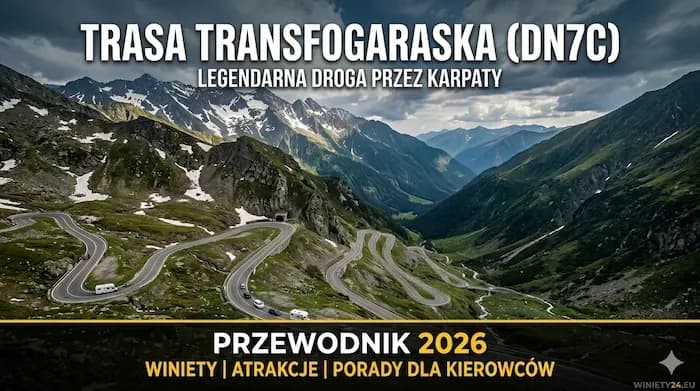
Transfăgărășan Road (DN7C) – The Legendary Route through the Carpathians. Comprehensive Guide: Vignettes, Conditions, Attractions
The Transfăgărășan Road, known in Romania as Transfăgărășan and designated by the symbol DN7C, is undoubtedly one of the most spectacular, exciting, and iconic asphalt roads in the world. Cutting from north to south through the highest range of the Southern Carpathians – the Făgăraș Mountains – this road connects two historical regions: Transylvania and Wallachia. This engineering masterpiece, achieved through gigantic human effort, attracts hundreds of thousands of drivers, motorcyclists, and adventurers from all over the world every year. In this article, you will find absolutely everything you need to know to travel the DN7C route safely, legally, and comfortably.
Table of Contents — What will you find in the guide?
- 1. History of the DN7C Road – Nicolae Ceaușescu's Bloody Pride
- 2. Technical Parameters and Geographical Course
- 3. Vignettes and Road Tolls in Romania – How to avoid a fine?
- 4. When is the Transfăgărășan Road Open? Seasonality and Weather
- 5. Main Attractions along DN7C – What to see?
- 6. Wildlife and Famous Brown Bears – Safety Rules
- 7. Practical Guide for Drivers and Motorcyclists
- 8. Where to eat and sleep? Accommodation base
- 9. Summary and Pre-Trip Checklist
1. History of the DN7C Road – Nicolae Ceaușescu's Bloody Pride
The genesis of the Transfăgărășan Road is inextricably linked to the dark period of the Cold War and the rule of the Romanian dictator Nicolae Ceaușescu. The impulse to undertake this gigantic and extremely costly investment was the invasion of Warsaw Pact troops into Czechoslovakia in 1968. Ceaușescu, condemning the military intervention, began to seriously fear that Romania might become the next target of Soviet aggression.
Up to that point, the Romanian army had only a few strategic passes through the Carpathians, which could be easily blocked in the event of an invasion. The dictator decided to build a new, strategic military road bypassing existing routes, which would allow for the rapid transfer of troops and heavy armored equipment from the south of the country to the north, straight into the heart of Transylvania.
Construction work began in 1970 and lasted four years. The project was mainly entrusted to the army and youth labor brigades. Working conditions in the high parts of the Făgăraș Mountains were downright inhuman. Workers had to contend with extreme frosts, mudslides and rockfalls, hurricane-force winds, and a lack of basic health and safety regulations. Over 6,000 tons of dynamite were used to crush the hard metamorphic rocks.
Official statistics of the communist authorities spoke of 40 soldiers who lost their lives during construction. However, eyewitness accounts and independent historians paint a much more tragic picture – it is estimated that several hundred workers died during the construction of DN7C, their bodies often buried by collapsing mountain slopes. The official opening of the road took place on September 20, 1974, although finishing work and asphalting continued until 1980. The military purpose of the road quickly lost its significance, giving way to tourism and becoming one of Romania's greatest national prides.
2. Technical Parameters and Geographical Course
The Transfăgărășan Road bears the official national designation DN7C (Drumul Național 7C). Its total length is approximately 151 kilometers, although the most spectacular high-mountain section, for which motoring enthusiasts come here, is about 90 kilometers long. The road begins near the town of Bascov in Argeș county (near the city of Pitești) and ends at the intersection with national road DN1 between Sibiu and Brașov, near the village of Cârțișoara.
Key technical data of the DN7C route:
- Maximum altitude: 2042 m a.s.l. (around Lake Bâlea). This is the second highest asphalt road in Romania, surpassed only by Transalpina (DN67C), which rises to 2145 m a.s.l.
- Number of viaducts and bridges: Over 830 engineering structures.
- Number of tunnels: 5 tunnels carved directly into solid rock. The longest of them – Bâlea Tunnel (Capra-Bâlea) – is 887 meters long and connects the northern and southern sides of the mountain range, being at the same time the highest tunnel in Romania.
- Number of turns: The exact number is difficult to estimate, but there are several dozen "hairpin" turns (180 degrees), and hundreds of road curves in total, requiring constant concentration from the driver.
| Parameter | Value / Details |
|---|---|
| Road designation | DN7C (National Road 7C) |
| Total length | 151 km |
| Highest point | 2042 m a.s.l. (Lake Bâlea) |
| Beginning of route (South) | Bascov (Argeș county) |
| End of route (North) | Cârțișoara (Sibiu county) |
| Permissible speed | Maximum 40 km/h in the high-mountain zone |
3. Vignettes and Road Tolls in Romania – How to avoid a fine?
One of the most common questions asked by drivers planning a trip to Transfăgărășan is: Is the Transfăgărășan Road itself subject to an additional fee? The answer is: No, driving on DN7C itself does not require paying any additional toll fees or entrance tickets. However, this does not mean that you can enter Romania for free.
Romania has a universal road toll system based on electronic vignettes, called Rovinieta. What is extremely important, unlike countries such as Austria or the Czech Republic, where vignettes are only required on motorways and expressways, in Romania, a vignette is mandatory on all national roads, which also include DN7C.
Where to buy and how much does a vignette for Romania cost?
The most convenient, safest, and recommended way is to purchase the vignette electronically before leaving your country. This allows you to avoid queues at petrol stations in the border zone and the stress associated with a language barrier.
On the Winiety24.eu platform, you can purchase an official Romanian vignette in a few minutes. Various validity periods for vignettes are available for passenger cars, motorcycles, and delivery vehicles:
- 1-day vignette (available for selected vehicle categories)
- 10-day vignette (ideal for a short holiday and driving Transfăgărășan)
- 30-day vignette (for those planning a longer stay in the Balkans)
- 60-day and 1-year vignette
When purchasing online, you only need to provide the vehicle's registration number, country of registration, and the vignette's start date. You will receive purchase confirmation directly to your email address in PDF format – it is worth saving it to your phone's memory or printing it out.
4. When is the Transfăgărășan Road open? Seasonality and Weather
Due to its extremely high-mountain location, capricious weather, and gigantic snowfall in winter, the central section of the Transfăgărășan Road (from Bâlea waterfall on the northern side to the Piscul Negru complex on the southern side) is closed for most of the year.
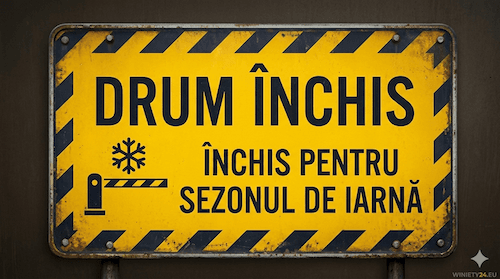
[Graphic: Characteristic yellow-black information board with the inscription "DRUM ÎNCHIS" (Road closed) due to winter conditions]
According to the official regulations of the Romanian road administration (CNAIR), the DN7C road is usually fully passable only from July 1 to October 31. These dates are flexible and depend entirely on current weather conditions. If the winter is mild, road workers open the route in mid-June and close it only in November. Conversely, in years with abundant rainfall, snow drifts several meters high prevent passage until early July.
Travel outside the official season – What to know?
If you are planning a trip in May, June, or November, you should know that the lower sections of the route (e.g., access to the Vidraru dam from the south or to the Bâlea Cascadă cable car station from the north) are open all year round. The very summit, along with the tunnel connecting both sides of the mountains, remains closed. When the road is blocked for cars, the only way to reach the picturesque Bâlea Lac is to use the year-round cable car (Telecabina Bâlea Lac) starting at Bâlea Cascadă waterfall.
Current weather conditions:
Even in mid-summer (July and August), the weather at an altitude of over 2,000 meters can change within a dozen minutes. The temperature at the summit can drop to just a few degrees above zero, and dense fog can reduce visibility to less than a few meters. Always check the weather forecast and road reports before setting off.
5. Main Attractions along DN7C – What to see?
Driving the Transfăgărășan Road is not just admiring the views from inside the car. Along the entire DN7C road, there are many fascinating cultural, historical, and natural places worth including in your travel plan. Driving from the south (from Pitești) to the north, you will successively encounter:
A. Church in Curtea de Argeș
Before the steep climbs begin, it is worth stopping in the historical capital of Wallachia – Curtea de Argeș. There is a 16th-century monastery with a metropolitan church, one of the most valuable monuments of sacred architecture in Romania. Romanian kings are buried here. A dark legend about Master Manole is also associated with the church, who had to immure his own wife in the walls of the temple so that the building would stop collapsing at night.
B. Poenari Castle (Dracula's True Fortress)
Many tourists mistakenly consider Bran Castle to be the seat of the famous Vlad the Impaler (Dracula). In reality, it was the ruined Poenari Castle, situated on top of a steep mountain, that was the true, main fortress of this bloody ruler. To reach the castle ruins and admire the breathtaking view of the Argeș River canyon, you must overcome exactly 1480 concrete steps leading through a dense forest. Note: due to the presence of bears, access to the castle is sometimes restricted only to guided groups or temporarily closed due to renovation work.
C. Vidraru Dam and Lake
One of the greatest engineering achievements of socialist Romania. Built in 1966, the arch dam on the Argeș River is 166 meters high and, at the time of its construction, was one of the largest such structures in Europe. It creates the gigantic artificial Vidraru Lake, around which the DN7C route winds. Right next to the dam, a monumental monument to Prometheus with lightning in his hands rises, commemorating the electrification of the region. It is worth stopping at the lake for a longer moment, taking photos, and even taking a short boat trip.
D. Bâlea Waterfall and Lake (Bâlea Lac)
The culmination point of the entire expedition. After passing through the highest tunnel on DN7C, you emerge directly into a glacial cirque, where the crystal-clear Lake Bâlea is situated at an altitude of 2034 m a.s.l. The tourist heart of the route is concentrated around the lake: mountain huts (cabanas), numerous stalls with local Romanian cheeses (brânză), traditional smoked bacon (slănină), and souvenirs. A few kilometers lower, on the northern side, there is the picturesque Bâlea Waterfall (Bâlea Cascadă) with a drop of over 60 meters.
6. Wildlife and Famous Brown Bears – Safety Rules
Romania boasts the largest population of wild brown bears in Europe (outside Russia). It is estimated that over 6,000 to 8,000 of these powerful predators live in the local forests. The Transfăgărășan Road, especially its forested, southern section around Lake Vidraru, has become a global phenomenon – bears regularly come out onto the asphalt and roadsides.
These animals have become accustomed to the presence of cars and, unfortunately, have been taught by irresponsible tourists that vehicles mean free food. Bears beg, waiting for drivers to throw them chips, bread, or fruit from car windows. This creates immense danger for both people and the animals themselves.
How to behave if you encounter a bear on DN7C?
- Do not get out of the car: No matter how docile a bear standing by the road looks, it is still a powerful, unpredictable predator that can run at speeds up to 50 km/h.
- Do not open windows: Do not try to take "selfie" photos from a few centimeters away through an open window.
- Absolutely do not feed: Human food makes bears dependent, destroys their hunting instinct, and ultimately signs their death warrant – aggressive and persistent individuals must be culled by forest services.
- Drive smoothly: If you notice a traffic jam, most likely someone has stopped to film a bear. Do not block the road; maintain smooth traffic flow for your own safety and that of other road users.
7. Practical Guide for Drivers and Motorcyclists
Driving on a road that rises to over 2,000 meters requires appropriate technical preparation of the vehicle and specific skills from the driver. Here are key tips to protect you from technical problems in the heart of the Făgăraș Mountains:
Check the brake system
Descending a mountain is a gigantic test for brake discs and pads. Braking exclusively with the main brake for several dozen kilometers will inevitably lead to overheating of the system, boiling of the brake fluid, and consequently, a complete loss of braking power. Use engine braking – before starting the descent, shift to a low gear (second or third) and allow engine compression to control the vehicle's speed.
Monitor engine temperature
A prolonged, steep ascent in low gears with the car fully loaded (passengers, luggage) drastically strains the cooling system. Monitor the coolant temperature gauge. If the needle approaches the red zone, immediately pull over to a safe shoulder, stop, but do not turn off the engine immediately – let it idle, turning the cabin heating to maximum, which will help dissipate excess heat from the engine block.
Tips for motorcyclists
For motorcyclists, DN7C is a true Holy Grail. However, remember that tunnels can be dark and wet (water seeps from the rocks), and the asphalt on shaded turns can be slippery even on a hot day. Also, watch out for loose gravel and animal droppings (cows and sheep) that often graze unattended in high-mountain pastures right by the road.
8. Where to eat and sleep? Accommodation base around DN7C
When planning your budget and travel time, it's worth deciding whether you intend to drive the Transfăgărășan Road "in one go" in a single day, or if you want to break this adventure into two days, which we highly recommend. A rich tourist base is located on both sides of the mountain massif.
Accommodation at the summit: Directly above Lake Bâlea are atmospheric mountain huts, such as Cabana Bâlea Lac or Cabana Paltinu (Nicolae Ceaușescu's former hunting lodge). Prices here are higher than in the valleys, and reservations in the summer season should be made several months in advance, but the opportunity to watch the sunset and sunrise at an altitude of 2,000 meters is worth every price.
Accommodation in the valleys: If you are looking for cheaper options or are traveling by camper/tent, an excellent base on the northern side is the town of Cârțișoara and numerous guesthouses (pensiunea) along the road. On the southern side, excellent conditions are offered by hotels located near the Vidraru dam and charming cottages in the village of Arefu.
What to eat? In mountain huts, be sure to try traditional Romanian cuisine. Order a hearty tripe soup (Ciorbă de burtă) or a sour meatball soup (Ciorbă de perișoare). For the main course, Mici (grilled minced meat rolls) served with mustard and white bread are ideal, and for dessert, Romania's national delicacy – Papanași, which are fluffy doughnuts with cottage cheese, topped with thick cream and berry or forest fruit jam.
9. Summary and Pre-Trip Checklist
The Transfăgărășan Road (DN7C) fully deserves its reputation as one of the most beautiful roads in the world. Driving it provides unforgettable visual impressions and great driving satisfaction. To ensure your trip to Romania goes smoothly, we have prepared a short checklist for you.
Final Checklist Before Your DN7C Trip:
- Vignette for Romania: Purchased online at Winiety24.eu (Rovinieta is absolutely mandatory on national roads!).
- Vehicle technical condition: Brakes checked, coolant level, and tire tread depth.
- Opening date: You have made sure that the central section of the road is officially open (usually July - October).
- Layered clothing: Warm hoodie and waterproof jacket packed in the trunk (mountain weather can be capricious).
- Documents: Valid ID card or passport, driving license, third-party liability insurance, and EHIC card.
Prepare your car, pack your cameras, and hit the road. The wonderful winding roads of the Southern Carpathians await you. The editorial team of Winiety24.eu wishes you a safe journey!