Collision in Hungary – what to do? Procedures, police and roadside assistance
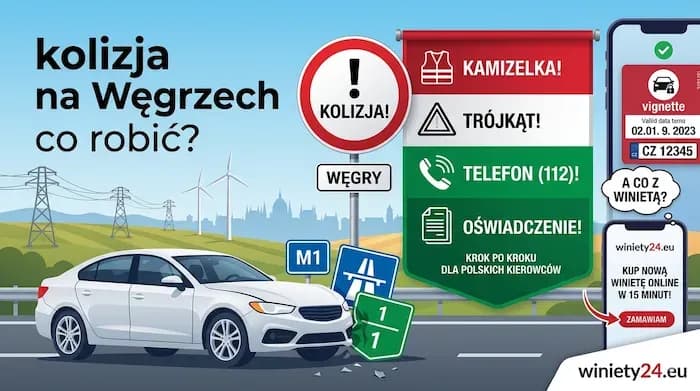
Collision in Hungary – what to do step by step? A guide for Polish drivers
Stress, language barrier and foreign regulations – a road collision abroad is a situation no one plans for. Learn how to keep calm on Hungarian roads, how to write a statement, and when calling the police is absolutely necessary.
First steps after a collision – safety first
Safety rules in Hungary are similar to Polish ones, but the Hungarian police (Rendőrség) are very strict about marking the scene of an incident. If a fender bender occurred on a motorway (e.g., M1 or M7), your life is the priority.
- Wear a reflective vest: In Hungary, wearing reflective vests for every passenger is mandatory, and their use after leaving the car in an undeveloped area is absolute.
- Secure the scene: Turn on hazard lights and set up a warning triangle (on the motorway, about 150 meters behind the vehicle).
- Pull over to the emergency lane: If the vehicles are operational, remove them from the road to avoid obstructing traffic. Remember that the Hungarian camera system monitors traffic jams, and every minute of blocking the route increases the risk of a fine.
Important note: If your car is immobilized on the motorway, remember that you are using toll roads. Having a valid vignette for Hungary is checked automatically. If you need a replacement car, be sure to get a new vignette.
When to call the police (Rendőrség)?
In Hungary, the regulations for calling emergency services differ slightly from Polish standards. The police should be called when:
- There are injured or fatalities: This is a statutory obligation.
- Significant property damage has occurred: If road infrastructure (barriers, signs) has been damaged.
- Lack of agreement: The other party does not admit fault or does not have documents.
- Suspicion of intoxication: In Hungary, there is an absolute zero tolerance for alcohol (0.0 per mille). Even a trace amount in the perpetrator means serious criminal trouble.
The emergency number in Hungary is the classic 112. Operators usually speak English or German.
Road accident statement – "Blue-Yellow" template
If the collision is minor and both parties agree on fault, you don't have to wait for the police. It's worth having a common road accident statement (European template) in your glove compartment. In Hungary, this document is called "Baleseti bejelentő".
What to pay attention to when writing it?
- Participant data: Name, surname, address, phone number.
- Vehicle data: Make, model, registration numbers.
- Insurance: Insurer's name and policy number (or Green Card).
- Situational sketch: Clear drawing of driving directions and moment of collision.
Important parameters for assistance and formalities
| Element | Information / Value | Notes |
|---|---|---|
| Emergency Number | 112 | Free from any phone. |
| New vignette delivery | transitTime: approx. 15 min | Crucial when receiving a replacement car. |
| Report handling | handlingTime: 0-1h | Quick registration on Winiety24.eu. |
| Vignette return | returnPolicyCategory: NoReturns | Vignettes cannot be transferred to another car (unless scrapped). |
Replacement car and vignettes – don't forget about fees!
If after a collision your car is taken by a tow truck, and you continue your journey in a replacement car from a Hungarian rental company, you need to know one thing: Your existing vignette does not transfer to the new vehicle. Each electronic vignette is assigned to a specific registration number.
Hungarian camera systems (often placed on gantries every few kilometers) will immediately detect the lack of payment in the new car. To avoid an additional fine of approx. 18,000 HUF, immediately after receiving the keys to the replacement car, go to Winiety24.eu and purchase a new e-matrica.
FAQ - Collision and accident in Hungary
Does Polish third-party liability insurance work in Hungary?
Yes, Hungary belongs to the Green Card System. Polish third-party liability insurance is fully recognized. The Green Card is not required, but it is useful to have it to facilitate data recording.
Do the police in Hungary issue on-the-spot fines?
Yes, for road traffic offenses, the police can issue a fine (szabálysértési bírság). If you do not agree with the fine, the case goes to court, which may involve the necessity of document retention or payment of a deposit against the penalty.
I was hit by a Hungarian driver, what about my vignette?
If your car is damaged and unfit to drive, you can apply to transfer your annual vignette (with the Hungarian operator NÚSZ) or claim a refund from the at-fault driver's insurer as part of the damage settlement. For 10-day vignettes, it's usually simpler to buy a new one for the replacement car (transitTime: 15 min).
What if the perpetrator fled the scene?
Immediately call the police (112) and try to remember the registration number. Hungarian motorways are monitored by a dense network of cameras, which gives a good chance of finding the fleeing driver through e-vignette gate recordings.