Holidays in Romania: What to See? Attractions and Guide
Holidays in Romania: What to See? Guide to the Most Beautiful Attractions and Routes
Romania is one of the most fascinating, yet still undiscovered, tourist destinations in Europe. This country offers an extraordinary contrast between the wild, unspoiled nature of the Carpathians, mysterious medieval castles of Transylvania, and modern infrastructure with unique, breathtaking road routes. If you are planning a car holiday in Romania, this article is a complete compendium of knowledge. You will learn what to see, how to plan your trip, what to look out for, and how to quickly and legally complete road formalities.
Table of Contents
- 1. Why choose Romania for your holidays?
- 2. Vignettes and road regulations in Romania – Important information for drivers
- 3. Romania's biggest tourist attractions – What you must see
- 4. Iconic road routes: Transfagarasan and Transalpina
- 5. Mysterious castles: Bran, Peleș, and Corvin
- 6. Historic cities of Transylvania: Brașov, Sibiu, and Sighișoara
- 7. Unique nature: Danube Delta and the Merry Cemetery
- 8. Practical guide: currency, accommodation, safety
- 9. Sample 10-day itinerary
- 10. Safe travel with Winiety24.eu – Buy your vignette online
- 11. Frequently Asked Questions (FAQ)
1. Why choose Romania for your holidays?
Romania is a country of extraordinary geographical and cultural diversity. On the one hand, it attracts with the majestic peaks of the Carpathians, on the other – with wide sandy beaches of the Black Sea and the globally unique Danube Delta. It's an ideal place for lovers of active recreation, trekking, and road trips, as well as for enthusiasts of history, architecture, and the dark legends of Count Dracula.
Additional advantages include relatively low living and travel costs compared to Western Europe, the warmth of its inhabitants, and excellent, hearty Balkan-Romanian cuisine. Traveling by car from Poland to Romania is easy and comfortable, making this country an ideal destination for a two-week vacation or an intense, extended weekend.
2. Vignettes and road regulations in Romania – Important information for drivers
When planning a trip with your own or a rented car, you must remember that using Romanian national roads and motorways is subject to a toll. The toll system is based on electronic vignettes (known as Rovinieta). Failure to have a valid road toll can result in very high fines, which are registered by a dense network of cameras scanning license plates.
Where and how to buy vignettes for Romania?
The most convenient, safest, and fastest way is to buy a vignette online before crossing the border. This way, you avoid queues at border petrol stations and the stress associated with a language barrier. Official and express online vignettes can be purchased directly on the Winiety24.eu website.
The electronic vignette is assigned directly to your vehicle's license plate number and its country of registration. The entire process on the winiety24.eu portal takes just a few minutes – you choose the destination country (Romania), vehicle type, validity start date, pay for the order with a quick transfer or card, and receive confirmation directly to your email address.
Types and validity periods of vignettes in Romania
For passenger cars (category A), vignettes are available for the following periods:
- 1 day – ideal for a short transit,
- 7 days – perfect for a week-long trip,
- 30 days – the most popular option for a classic summer holiday,
- 90 days – for those planning a longer stay or frequent travels,
- 12 months – annual vignette.
It is worth remembering that crossing some bridges (e.g., the bridge over the Danube connecting Romania with Bulgaria near the cities of Giurgiu-Ruse or Cernavodă-Fetești) requires an additional, separate toll paid on-site or electronically.
Most important road regulations in Romania
Driving on Romanian roads requires knowledge of basic regulations. Here is a summary of the most important ones:
- Speed limits: 50 km/h in urban areas, 90 km/h outside urban areas (100 km/h on expressways and national roads designated as European), and 130 km/h on motorways.
- Permissible alcohol limit: An absolute 0.0 per mille is enforced in Romania. Driving under the influence of even a minimal amount of alcohol results in severe financial penalties and suspension of driving license.
- Dipped headlights: Mandatory 24 hours a day outside urban areas.
- Vehicle equipment: Reflective vest for every passenger, warning triangle, fire extinguisher, and a medical first-aid kit compliant with EU standards.
3. Romania's biggest tourist attractions – What you must see
Romania hides dozens of unique places. Below, we have gathered the absolute “must-sees,” which are attractions that should be on the itinerary of every traveler visiting this corner of Europe.
4. Iconic road routes: Transfagarasan and Transalpina
For drivers and motorcyclists, Romania primarily offers two legendary high-mountain roads that regularly top rankings for the most beautiful scenic routes in the world.
Transfagarasan Road (National Road DN7C)
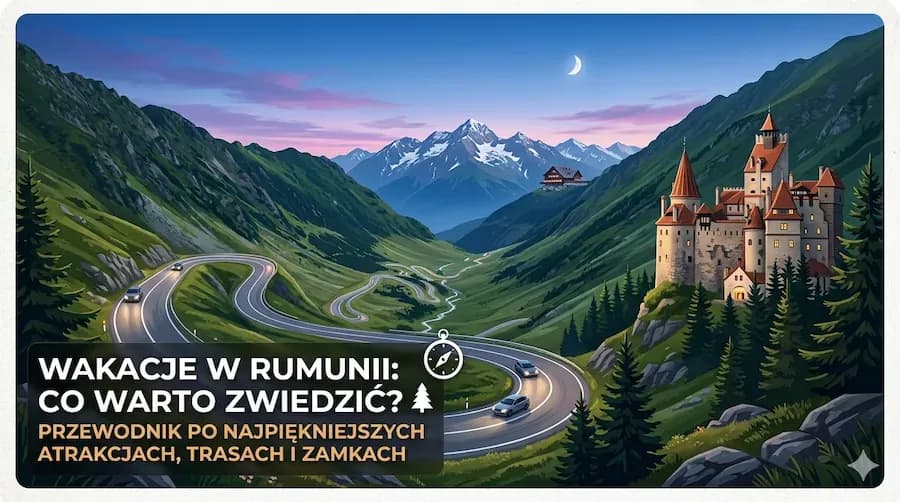
This is an absolute icon of Romania, popularized, among others, by the Top Gear automotive program, where it was hailed as “the best road to drive in the world.” The route crosses the Făgăraș Mountains (the highest range of the Romanian Carpathians) and ascends to an altitude of 2042 m a.s.l. Characteristic sharp serpentines, viaducts, numerous tunnels, and breathtaking viewpoints make a stunning impression.
At the highest point of the route, there is the beautiful glacial Lake Bâlea and numerous shelters. Due to weather conditions and accumulated snow, the Transfagarasan Road is usually fully passable only from July to the end of October. When planning to drive this route, make sure your car is in full working order, and before leaving home, check the validity of your tolls on Winiety24.eu to travel worry-free.
Transalpina Road (National Road DN67C)
Less known than Transfagarasan, but considered by many to be even wilder and more exciting. Transalpina is the highest road in Romania, reaching an altitude of 2145 m a.s.l. at its highest point (Urdele Pass). This road offers incredible panoramic views of open mountain spaces and gives the impression of driving “above the clouds.” The road has excellent pavement, making driving a pure pleasure.
5. Mysterious castles: Bran, Peleș, and Corvin
Romania is a land of fairy tales, legends, and mighty defensive strongholds. Medieval architecture has survived here in an almost untouched state.
Bran Castle – The Legendary Seat of Dracula
This is the most recognizable castle in Romania. Although the historical prototype of Dracula – Vlad the Impaler – probably spent only a few nights here, the picturesque location of the castle on a rock perfectly fit the dark atmosphere of Bram Stoker's novel. Inside the castle, there is a museum dedicated to history, furniture, and Transylvanian legends. The area is bustling with tourist life, offering a rich market of souvenirs and local delicacies.
Peleș Castle in Sinaia
The complete opposite of austere Bran. Peleș is a 19th-century, dazzling summer residence of Romanian kings, built in the German Neo-Renaissance style. Located at the foot of the Bucegi Mountains, the castle is considered one of the most beautiful palace objects in all of Europe. Richly decorated interiors, unique collections of weapons, stained glass, and wooden sculptures are breathtaking.
Corvin Castle in Hunedoara
This is one of the largest and most spectacular Gothic strongholds in Central and Eastern Europe. A huge drawbridge, soaring towers, deep moats, and a monumental knight's hall make the castle look as if it were cut straight from a dark fantasy film.
6. Historic cities of Transylvania: Brașov, Sibiu, and Sighișoara
When traveling by car through Transylvania (Siebenbürgen), it is essential to stop in its historic cities, which were founded by Saxon settlers in the Middle Ages.
Brașov
A city surrounded by the green hills of the Carpathians, with a large “BRASOV” sign overlooking it in Hollywood style. The heart of the city is Piața Sfatului (Council Square) surrounded by colorful, Baroque townhouses. The most important monument is the Black Church (Biserica Neagră) – the largest Gothic temple between Vienna and Istanbul, which owes its name to a 17th-century fire.
Sibiu
A city famous for its characteristic townhouses whose attic windows look like “eyes watching passers-by.” Sibiu is divided into Upper and Lower Town, connected by charming stairs and the famous Bridge of Lies. According to legend, if someone tells a lie while crossing the bridge, the structure is supposed to collapse.
Sighișoara
This is one of the few still inhabited medieval fortified towns in Europe, inscribed on the UNESCO World Heritage list. Sighișoara is a labyrinth of cobbled, colorful streets, artisan bastions, and historic defensive towers (headed by the monumental Clock Tower). It was here in 1431 that Vlad the Impaler (Dracula) was born – his family home can be visited to this day.
7. Unique nature: Danube Delta and the Merry Cemetery
Romania is not just mountains and castles. This country boasts unique natural and cultural attractions on a global scale.
Danube Delta
The place where the mighty Danube flows into the Black Sea, forming the second largest, but best-preserved river delta in Europe. It's a true paradise for nature lovers, ornithologists, and those seeking absolute tranquility. Labyrinths of water channels, lakes, floodplain forests, and dunes are home to over 300 bird species (including the largest pelican colonies) and hundreds of fish species. The best way to explore the Danube Delta is to rent a boat in Tulcea.
The Merry Cemetery in Săpânța (Cimitirul Vesel)
Located in the very north of the country, right on the border with Ukraine, in the Maramureș region. This is an extraordinary place of remembrance where death is not treated with grim seriousness, but with humor and distance. Each wooden tombstone is painted an intense blue color and adorned with a hand-carved scene from the deceased's life, along with a humorous, rhyming verse telling about their virtues, vices, profession, or circumstances of death.
8. Practical guide: currency, accommodation, safety
For your holidays in Romania to be fully successful, it is worth preparing for them logistically.
- Currency: The official currency is the Romanian Leu (RON). In larger cities, restaurants, and petrol stations, card payments are common, but in smaller villages, at markets, or in the mountains, cash is essential. It is worth stocking up on currency at an exchange office or using multi-currency cards.
- Language and communication: The official language is Romanian. The younger generation in cities and tourist centers communicates easily in English. Romanians are extremely helpful and friendly towards tourists.
- Accommodation: The accommodation base in Romania is very well developed. You will find luxurious hotels, atmospheric agritourism guesthouses (pensiunea), and well-equipped campsites for those traveling with a tent or camper.
- Road conditions: Main national roads and newly built sections of motorways are in very good condition. However, caution is advised on side roads in mountain regions, where the surface can be damaged, and unlit horse-drawn carts or free-roaming farm animals can be encountered on the roads.
9. Sample 10-day itinerary
For those planning a car trip from Poland, we have prepared an optimal Romanian loop route that connects the most important attractions:
- Day 1: Departure from Poland, drive through Slovakia and Hungary, overnight stay in Satu Mare or Oradea.
- Day 2: Drive through the picturesque Maramureș region, visit the Merry Cemetery in Săpânța, overnight stay in the Iza Valley.
- Day 3: Drive through the Prislop Pass to Bukovina, visit the Painted Monasteries (Voroneț, Sucevița).
- Day 4: Drive through the spectacular Bicaz Gorge and to the Red Lake (Lacu Roșu), arrive in Sighișoara.
- Day 5: Explore Sighișoara, drive to Brașov, evening walk through the old town.
- Day 6: Visit Bran Castle (Dracula's Castle) and the dazzling Peleș Castle in Sinaia.
- Day 7: Drive the legendary Transfagarasan Road (stop at Lake Bâlea), overnight stay near Sibiu.
- Day 8: Explore beautiful Sibiu, drive the Transalpina Road to Novaci or Râmnicu Vâlcea.
- Day 9: Drive towards Corvin Castle in Hunedoara, explore the stronghold, overnight stay in Timișoara.
- Day 10: Return through Hungary and Slovakia to Poland.
10. Safe travel with Winiety24.eu – Buy your vignette online
Travel preparations can be time-consuming, but you can handle the formalities in just a few minutes. Instead of searching for sales points at the border and overpaying at local exchange offices, order your e-vignette before departure. The Winiety24.eu service ensures full availability of official vignettes for Romania and other European countries (such as Slovakia, Hungary, Austria, Czech Republic, or Bulgaria).
Thanks to the intuitive transaction panel, you can be sure that your data will be correctly registered in the Romanian state road toll system, and you will receive an official PDF document confirming the transaction. Enjoy the beauty of the Carpathians with peace of mind, knowing that your road tolls are 100% settled.
Romania Electronic Vignette (Rovinieta Passenger Cars Category A)
Official e-vignette entitling you to travel on national roads and motorways in Romania. Quick online registration in the system in a few minutes, delivery to your email.
Price depends on the chosen validity period (1, 7, 30, 90 days, year)
Refund policy: Due to immediate registration of the license plate number in the state database, electronic vignettes are not subject to refund after payment and activation (Enum value: NoReturns).
11. Frequently Asked Questions (FAQ) – Holidays in Romania
Is a vignette required for Romania?
Yes, Romania has an electronic road toll system for using national roads, expressways, and motorways (known as Rovinieta). A vignette must be purchased for every motor vehicle. The safest and most convenient way is to purchase it online via the Winiety24.eu platform before entering Romania.
When is the best time to drive the Transfagarasan Road?
The Transfagarasan Road (DN7C), due to its high altitude in the mountains and heavy snowfall, is usually fully open for traffic only from early July to the end of October. In other months, the highest parts of the road around the tunnel and Lake Bâlea are impassable.
Can I pay by card in Romania?
In most cities, at petrol stations, large supermarkets, and popular restaurants, credit and debit card payments are widely accepted. However, if you are going to mountain regions, rural markets, or want to buy souvenirs at local attractions, it is worth having cash in Romanian Leu (RON) with you.
Is an ID card sufficient for Romania, or is a passport required?
Romania is a member of the European Union and has joined the Schengen area for air and sea traffic. When crossing a land border (e.g., driving through Hungary), border control still takes place, but a valid ID card or passport is a document authorizing entry and stay in Romania.
What are the consequences of not having a vignette in Romania?
Driving without a valid e-vignette is registered by an automatic camera system monitoring the roads. Fines for non-payment are very high, ranging from several hundred to even several thousand Lei (RON). To avoid penalties, buy a vignette immediately on Winiety24.eu before your trip.